Indiana Social Studies WG.3.1
The Standard
Define Earth’s physical systems: atmosphere, lithosphere, biosphere, and hydrosphere. Categorize the elements of the natural environment as belonging to one of the four systems and explain how systems work together.
2026 Indiana Academic Standards: K-12 Social Studies
Teacher's field guide
What This Standard Means
What Students Need to Do
- Students identify air, rock and soil, water, and living things as parts of four Earth systems. They sort examples into the right system and explain how the systems affect one another.
What Mastery Looks Like
- Given a riverbank scene, a student labels the air, rocks, river, and trees correctly. They explain how river water can wear away rock or supply water to trees.
Common Misconceptions
- Students may put plants in the lithosphere because their roots grow in soil. They may classify rain as air because it falls through the sky, or name the systems without explaining how they interact.
How to Assess It
- Have students draw a stream, rock, tree, and sky. Ask them to label the water, rock, tree, and air by system, then write how the water affects the rock or tree.
Lesson moves
Ways to Teach It
Give pairs picture cards of a fish, pond, boulder, and wind, and have them place each on four labeled paper mats.
Ask, 'What happens to soil and plants when a creek floods?' Have students name the systems in their answers.
Play a four-corner sort: call out 'mushroom,' 'river,' 'granite,' or 'breeze,' and have students move to the matching system sign.
Show a photo of a street tree after rain and have students mark air, wet soil, water, and leaves with four colors.
Free download
Printable WG.3.1 Worksheet
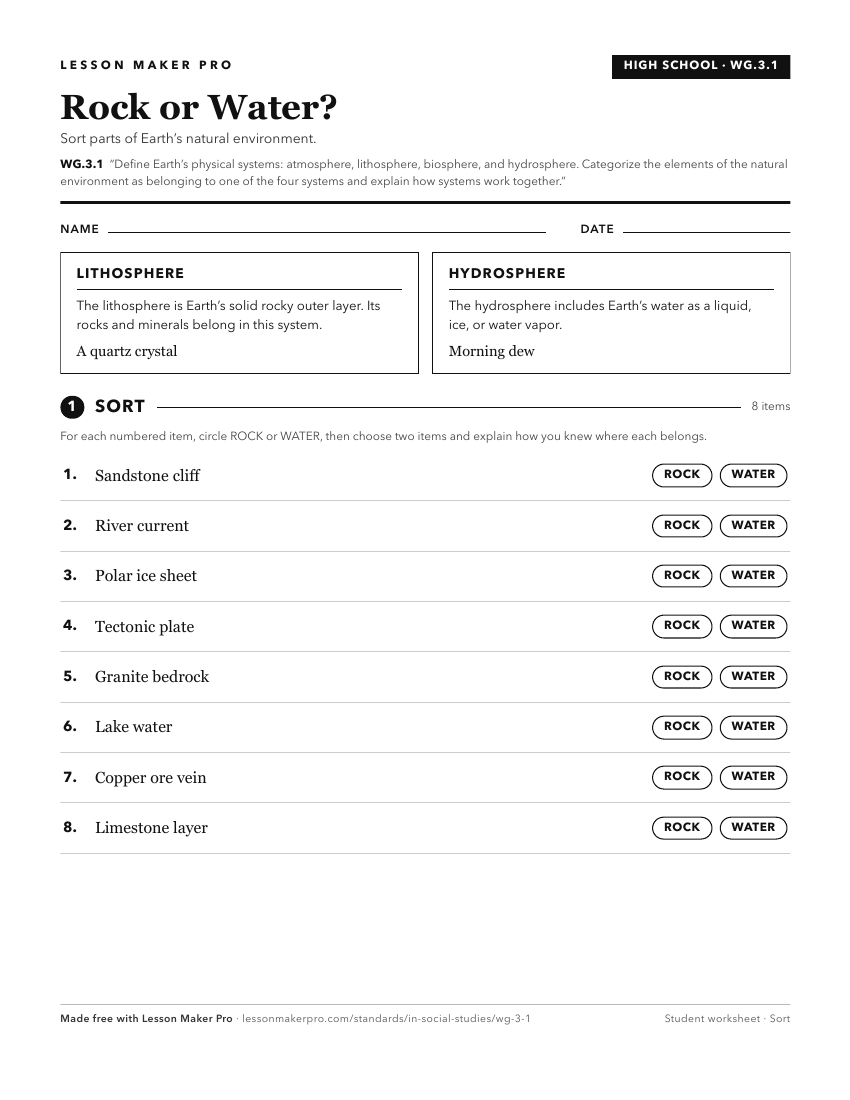
A ready-to-print activity worksheet aligned to WG.3.1, with an answer key for the teacher on its own page. No account needed.
PDF, US Letter, prints cleanly in black and white.
Download the worksheetKeep exploring
Related Standards
- WG.5.6
Create basic policies designed to guide the use and management of Earth’s resources and that reflect multiple points of view.
- 3.G.8
Identify and describe how human activities and natural systems affect the local environment.
- WG.3.4
Explain and give examples of the physical processes that shape Earth’s surface that result in existing landforms and identify specific places where these proces...
- WG.3.2
Identify and account for the distribution pattern of the world’s climates, taking into account the Earth/Sun relationship, ocean currents, prevailing winds, and...
Turn this exact standard into a lesson
Grade, subject, topic, and the complete standard are prefilled. Create one free, no account needed.
Also for this standard:Make a WorksheetMake a QuizMake a Sub Lesson