Indiana Social Studies WG.3.4
The Standard
Explain and give examples of the physical processes that shape Earth’s surface that result in existing landforms and identify specific places where these processes occur.
2026 Indiana Academic Standards: K-12 Social Studies
Teacher's field guide
What This Standard Means
What Students Need to Do
- Students explain how moving plates, lava, water, and ice build or wear down land. They connect each process to a landform and a named place, such as plate collision in the Himalayas or river erosion at the Grand Canyon.
What Mastery Looks Like
- A student can explain that plate collision raised the Himalayas and the Colorado River carved the Grand Canyon over time. They can locate both places on a map and explain the difference between erosion and deposition.
Common Misconceptions
- Students may think every mountain is a volcano or that rivers cut canyons in a single flood. They may confuse erosion, which removes sediment, with deposition, which leaves it behind.
How to Assess It
- On an exit ticket, ask: What formed the Himalayas, and what carved the Grand Canyon? For each place, explain what moved and how the land changed.
Lesson moves
Ways to Teach It
Pour water over a tilted sand tray, then sketch where channels form and where sand collects; label erosion and deposition.
Ask: Why is the Grand Canyon a canyon, not a mountain? Write two sentences about the Colorado River's role.
Give pairs photo cards of the Himalayas, Hawaiian Islands, and Yosemite Valley; match each to plate collision, lava, or glaciers on a map.
Compare before-and-after photos of Hawaii's coast near Kilauea from 2018, then mark land added by lava on a printed map.
Free download
Printable WG.3.4 Worksheet
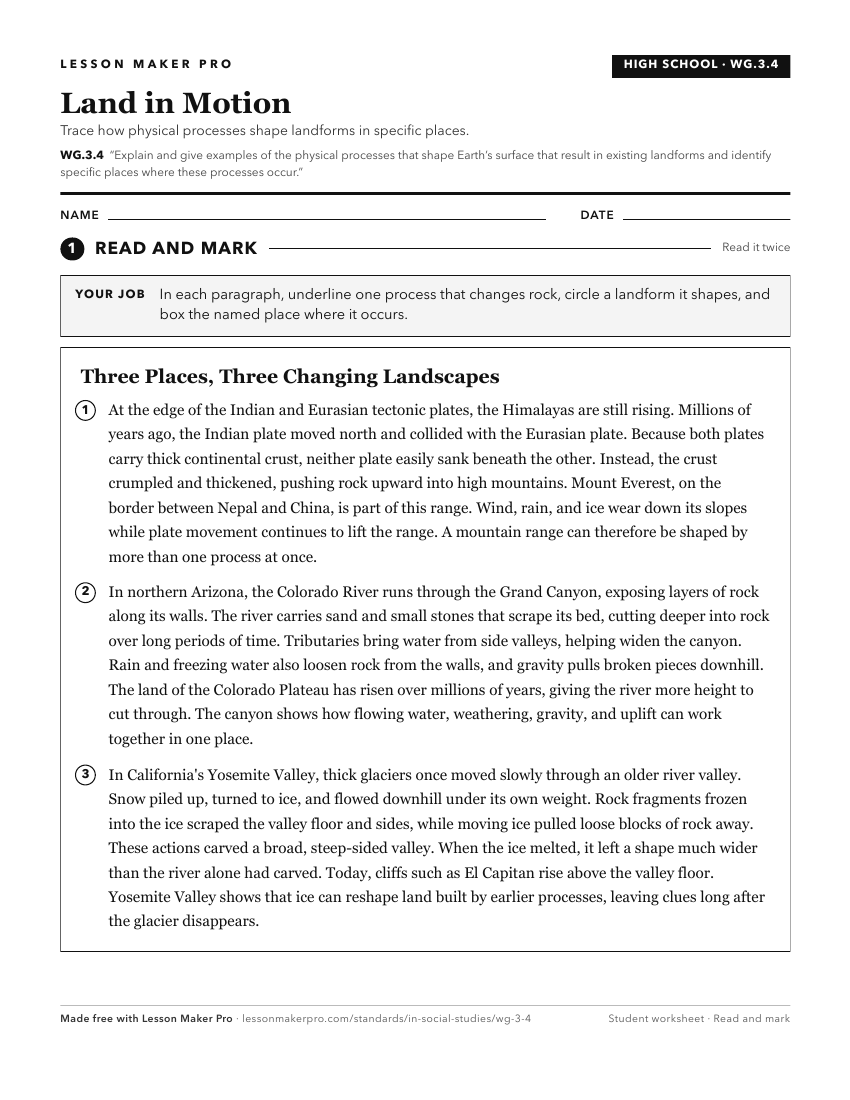
A ready-to-print activity worksheet aligned to WG.3.4, with an answer key for the teacher on its own page. No account needed.
PDF, US Letter, prints cleanly in black and white.
Download the worksheetKeep exploring
Related Standards
- WG.2.1
Give examples of how and why places and regions change or do not change over time.
- 5.G.7
Describe and analyze how specific physical features influenced historical events.
- WG.2.2
Analyze and provide examples of ways in which people's changing views of places and regions reflect cultural changes; explain how people's views of physical fea...
- 7.G.4
Identify major physical characteristics of regions of Africa, Asia, and the Southwest Pacific, such as deserts, basins, plains, mountains, and rivers, and descr...
Turn this exact standard into a lesson
Grade, subject, topic, and the complete standard are prefilled. Create one free, no account needed.
Also for this standard:Make a WorksheetMake a QuizMake a Sub Lesson