Indiana Social Studies WG.1.2
The Standard
Evaluate the source of particular maps to determine possible biases.
2026 Indiana Academic Standards: K-12 Social Studies
Teacher's field guide
What This Standard Means
What Students Need to Do
- Students find out who made a map and who it was made for. They check its labels, symbols, and missing features to see how the source might shape what readers notice.
What Mastery Looks Like
- Given two maps of the same place, students identify each publisher and point to a specific difference. They explain why a publisher might make that choice without treating every omission as dishonest.
Common Misconceptions
- Students may treat a map as a neutral picture of a place. They may assume a government map is free of bias, or that every missing road was left out to mislead readers.
How to Assess It
- Hand out a tourism-office map showing attractions but no bus routes. Ask: Who published it, what does it emphasize, and how might that shape a visitor's view?
Lesson moves
Ways to Teach It
Print a tourism-office map and a transit-agency map of the same city; students circle the source and highlight features each map leaves out.
Ask students to write: How would a tourism map change if bus riders were its audience? Use two details from the map.
Cover the source lines on three maps; pairs match each map to its publisher, then uncover the lines and check their reasons.
Compare a home listing map with a local flood-risk map; students identify the publishers and note what a buyer might miss using only one.
Free download
Printable WG.1.2 Worksheet
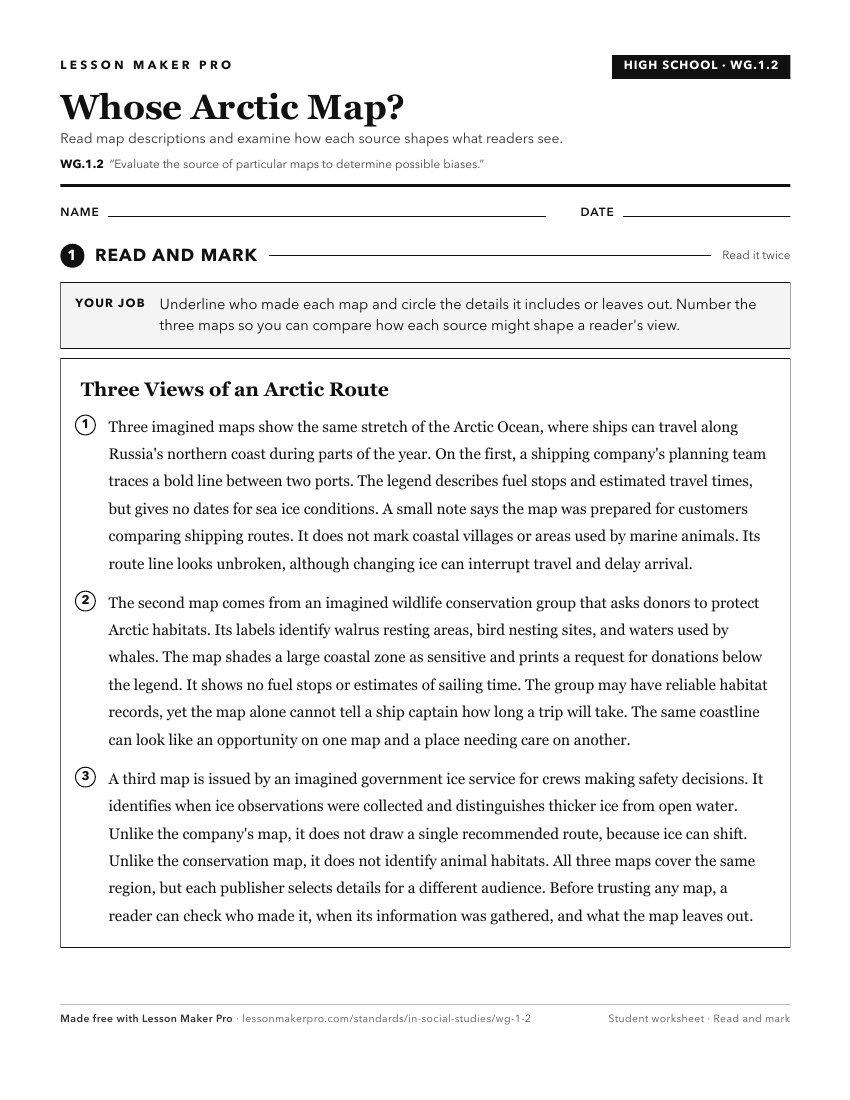
A ready-to-print activity worksheet aligned to WG.1.2, with an answer key for the teacher on its own page. No account needed.
PDF, US Letter, prints cleanly in black and white.
Download the worksheetKeep exploring
Related Standards
- WG.4.2
Develop maps of human migration and settlement patterns at different times in history and compare them to the present.
- S.1.6
Distinguish fact from opinion in data source analysis.
- GHW.4.1
Analyze maps and assess ways that colonialism and imperialism have persisted and continue to evolve in the contemporary world.
- WG.1.3
Create and compare mental maps or personal perceptions of places. Explain how experiences and culture influence these perceptions and identify ways in which men...
Turn this exact standard into a lesson
Grade, subject, topic, and the complete standard are prefilled. Create one free, no account needed.
Also for this standard:Make a WorksheetMake a QuizMake a Sub Lesson