Indiana Social Studies USH.6.4
The Standard
Explain and analyze U.S. foreign policies and conflicts during the Cold War, including relations between the United States and the Soviet Union.
2026 Indiana Academic Standards: K-12 Social Studies
Teacher's field guide
What This Standard Means
What Students Need to Do
- Students explain why the United States used military aid, alliances, force, and arms talks during the Cold War. They connect those choices to Soviet actions and the risk of nuclear war.
What Mastery Looks Like
- Given a Cold War crisis, a student can name the U.S. goal, describe the Soviet response, and explain the outcome. They use a specific event or source as evidence and tell direct confrontation apart from wars fought through allies.
Common Misconceptions
- Students may think the United States and Soviet Union fought each other directly in Korea or Vietnam. They may assume containment always meant sending troops, rather than also using aid and alliances. Some think the Cuban missile crisis ended with only Soviet concessions.
How to Assess It
- Give students a map of missile sites in 1962 and a short excerpt from Kennedy’s televised address. Ask: Why did Kennedy choose a naval quarantine of Cuba, and what risk did it create?
Lesson moves
Ways to Teach It
Place paper markers for Soviet missiles in Cuba and U.S. missiles in Turkey on a map, then list each side’s security concerns.
Read excerpts from Truman’s 1947 speech and the 1972 SALT I agreement, then write how each addresses Soviet power.
Sort Berlin blockade, Korean War, Cuban missile crisis, and SALT I cards into confrontation, proxy war, or negotiation, then defend each choice.
Compare NATO membership maps from 1949 and today, then write one question about how Cold War alliances still shape Europe.
Free download
Printable USH.6.4 Worksheet
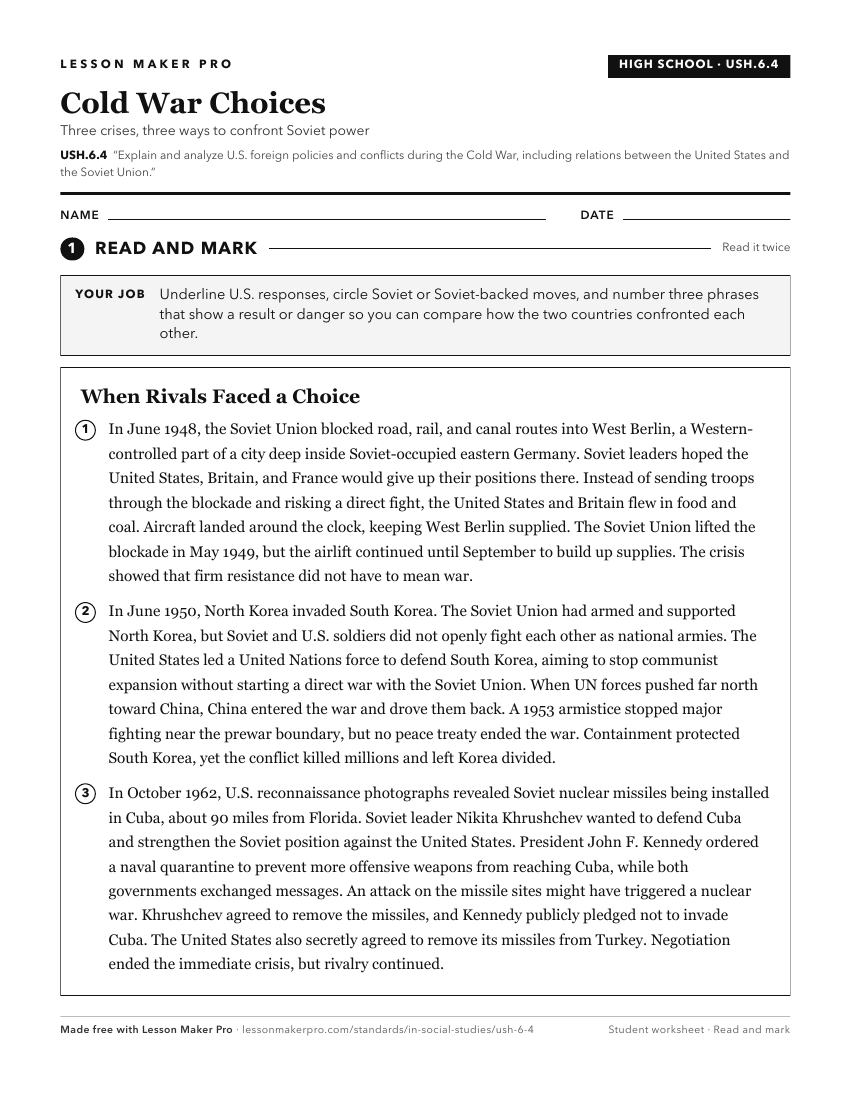
A ready-to-print activity worksheet aligned to USH.6.4, with an answer key for the teacher on its own page. No account needed.
PDF, US Letter, prints cleanly in black and white.
Download the worksheetKeep exploring
Related Standards
- IS.1.24
Analyze the responses in Indiana resulting from Cold War tensions.
- USG.4.2
Identify and explain world issues, including political, cultural, demographic, economic, and environmental challenges that affect the United States foreign poli...
- WH.6.6
Explain the causes and consequences of the Cold War, and describe the role it played in ethnic or nationalistic conflicts in various parts of the world.
- USH.6.3
Explain the origins and cultural, economic, and political implications of the Cold War.
Turn this exact standard into a lesson
Grade, subject, topic, and the complete standard are prefilled. Create one free, no account needed.
Also for this standard:Make a WorksheetMake a QuizMake a Sub Lesson