Indiana Social Studies USH.6.3
The Standard
Explain the origins and cultural, economic, and political implications of the Cold War.
2026 Indiana Academic Standards: K-12 Social Studies
Teacher's field guide
What This Standard Means
What Students Need to Do
- Students trace how the United States and Soviet Union went from wartime allies to rivals. They explain how that rivalry changed daily life, government decisions, and spending.
What Mastery Looks Like
- A student can explain how disagreements over postwar Europe increased distrust. They can connect air-raid drills, defense jobs, and NATO to cultural, economic, and political change.
Common Misconceptions
- Students may think American and Soviet troops fought each other directly, or that one event started the conflict. They may mistake the Marshall Plan for a military alliance.
How to Assess It
- Exit ticket: Name one cause of postwar tension between the United States and Soviet Union. Give one specific cultural, economic, and political effect of that tension.
Lesson moves
Ways to Teach It
Give pairs a map of occupied Germany and a Berlin blockade photo; have them mark Berlin and explain why its location caused tension.
Have students read short excerpts from the Truman Doctrine and Novikov telegram, then write which fear each side expressed.
Run a card sort with air-raid drills, defense contracts, and NATO; students label each effect cultural, economic, or political.
Have students find the nearest interstate on a map and read the name 'Interstate and Defense Highways'; ask why defense appears there.
Free download
Printable USH.6.3 Worksheet
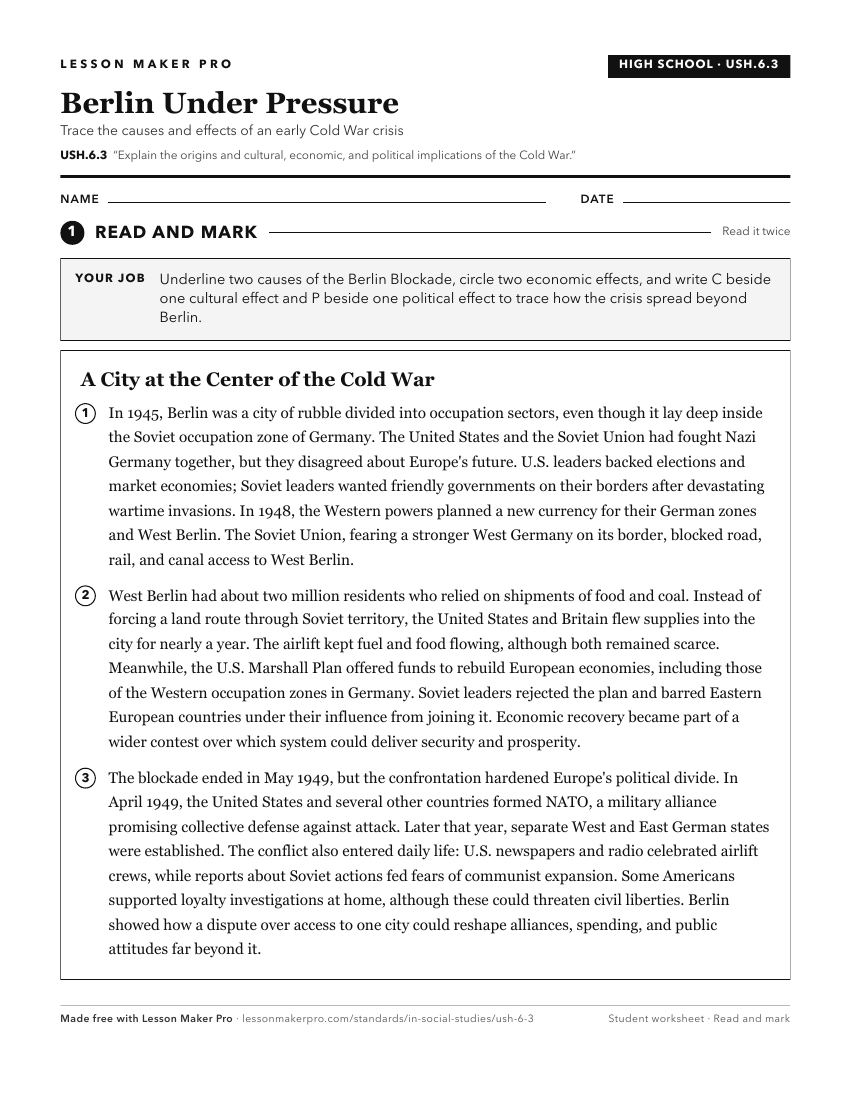
A ready-to-print activity worksheet aligned to USH.6.3, with an answer key for the teacher on its own page. No account needed.
PDF, US Letter, prints cleanly in black and white.
Download the worksheetKeep exploring
Related Standards
- IS.1.24
Analyze the responses in Indiana resulting from Cold War tensions.
- USH.6.2
Analyze key economic, cultural, political, and social changes in post-World War II American life.
- WH.6.6
Explain the causes and consequences of the Cold War, and describe the role it played in ethnic or nationalistic conflicts in various parts of the world.
- USH.6.4
Explain and analyze U.S. foreign policies and conflicts during the Cold War, including relations between the United States and the Soviet Union.
Turn this exact standard into a lesson
Grade, subject, topic, and the complete standard are prefilled. Create one free, no account needed.
Also for this standard:Make a WorksheetMake a QuizMake a Sub Lesson