Indiana Social Studies USH.6.1
The Standard
Describe the challenges involved with the enforcement of desegregation directives in Brown v. Board of Education of Topeka (1954).
2026 Indiana Academic Standards: K-12 Social Studies · Students are expected to trace and analyze chronological periods and examine the significant themes and concepts in U.S. History. Students develop historical thinking and research skills using primary and secondary sources to explore topical issues to understand the cause for changes in the nation over time.
Teacher's field guide
What This Standard Means
What Students Need to Do
- Students explain why a Supreme Court ruling did not immediately change who attended school together. They use examples of local resistance and federal action to show how integration was delayed or enforced.
What Mastery Looks Like
- A student can explain how the 1955 order to proceed with “all deliberate speed” allowed districts to delay. They can describe how Arkansas’s governor used the National Guard to block nine Black students in Little Rock and why Eisenhower sent troops.
Common Misconceptions
- Students may think the 1954 ruling made every school integrate immediately. They may also blame delays only on angry crowds, overlooking resistance from school boards and governors.
How to Assess It
- Exit ticket: In the Little Rock case, name one action that blocked integration and one action that enforced it. Explain why the 1954 ruling alone did not settle the issue.
Lesson moves
Ways to Teach It
Pairs put the 1954 ruling, 1955 follow-up order, Little Rock blockade, and troop deployment on a desk timeline with red delay and blue response stickers.
Read excerpts from the Southern Manifesto and Eisenhower’s 1957 address, then write whose authority each defends and why.
Match obstacle cards, enrollment delays and the Guard blockade, to response cards, NAACP lawsuits and Eisenhower’s troop order, then defend each match.
Open your district’s school assignment page; identify who assigns students, then compare that local role with federal intervention in Little Rock.
Free download
Printable USH.6.1 Worksheet
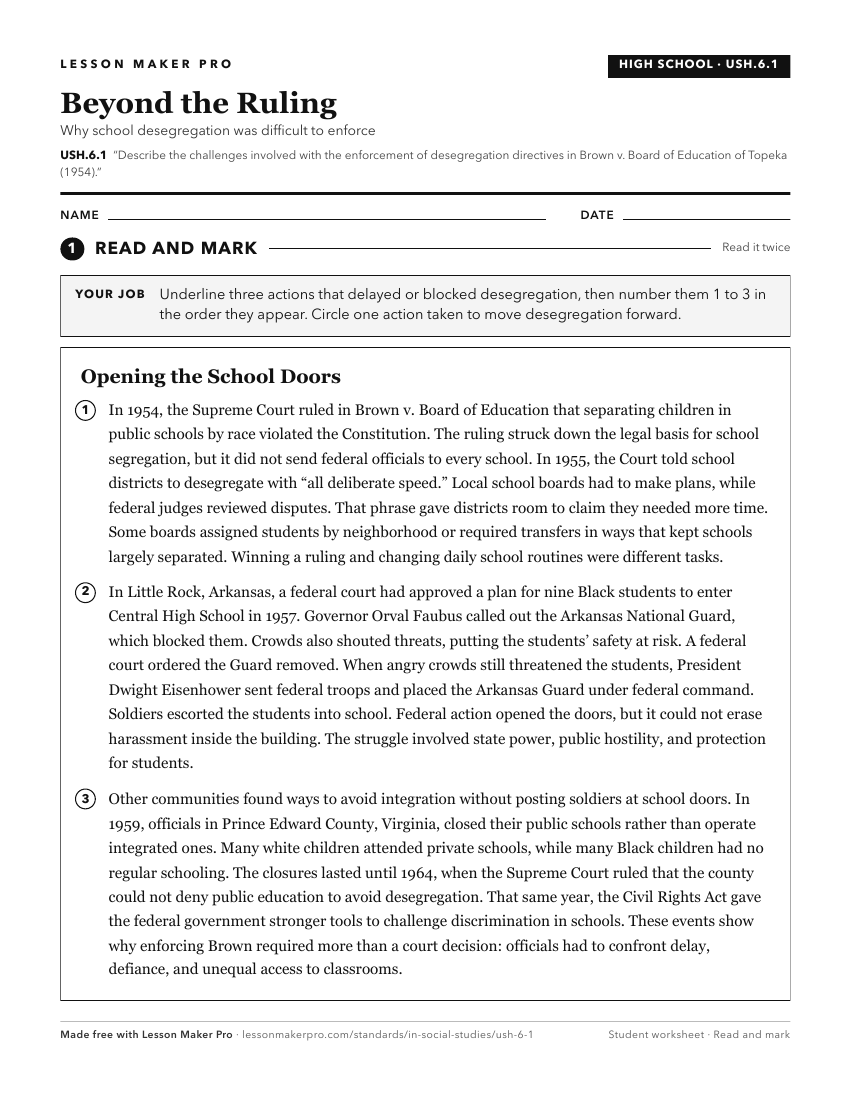
A ready-to-print activity worksheet aligned to USH.6.1, with an answer key for the teacher on its own page. No account needed.
PDF, US Letter, prints cleanly in black and white.
Download the worksheetKeep exploring
Related Standards
- IS.1.26
Summarize and assess the various actions which characterized the early struggle for civil rights and racial equality in Indiana.
- IS.1.27
Examine the impact of the Civil Rights Movement of the 1960s and 1970s in Indiana through the actions of leaders and groups that were active in the movement.
- USH.2.3
Analyze the development of “separate but equal” policies culminating in the Plessy v. Ferguson (1896) case. Explain the historical significance of the denial of...
- IS.1.13
Identify "separate but equal" policies and "Black Codes" in Indiana prior to the Plessy v. Ferguson case (1896). Analyze the impact of these policies on civil r...
Turn this exact standard into a lesson
Grade, subject, topic, and the complete standard are prefilled. Create one free, no account needed.
Also for this standard:Make a WorksheetMake a QuizMake a Sub Lesson