Indiana Social Studies IS.1.26
The Standard
Summarize and assess the various actions which characterized the early struggle for civil rights and racial equality in Indiana.
2026 Indiana Academic Standards: K-12 Social Studies · Post-War Indiana: 1945 to 1960
Teacher's field guide
What This Standard Means
What Students Need to Do
- Students describe how people in Indiana pushed for racial equality from 1945 to 1960. They explain what actions changed, and where discrimination continued.
What Mastery Looks Like
- A student can explain how NAACP organizing and Indiana's 1949 school desegregation law addressed unequal schooling. They can use evidence to judge why a new law did not guarantee equal access right away.
Common Misconceptions
- Students may assume the 1949 law integrated every school immediately. They may also think civil rights struggles happened only in Southern states.
How to Assess It
- Exit ticket: Name two actions taken for racial equality in Indiana between 1945 and 1960. Use one fact from today's source cards to explain a result or limit of one action.
Lesson moves
Ways to Teach It
Give groups cards on NAACP organizing, the 1949 school law, and school district responses; have them arrange the cards and label each action's effect.
Ask students to write: Did passing a school desegregation law mean Indiana students had equal schooling? Support your answer with a source card.
Play claim check: pairs correct cards such as 'The 1949 law integrated every Indiana school immediately' using their source cards.
Compare a local school district's current equal opportunity statement with a summary of the 1949 law; list what each promises and how to check it.
Free download
Printable IS.1.26 Worksheet
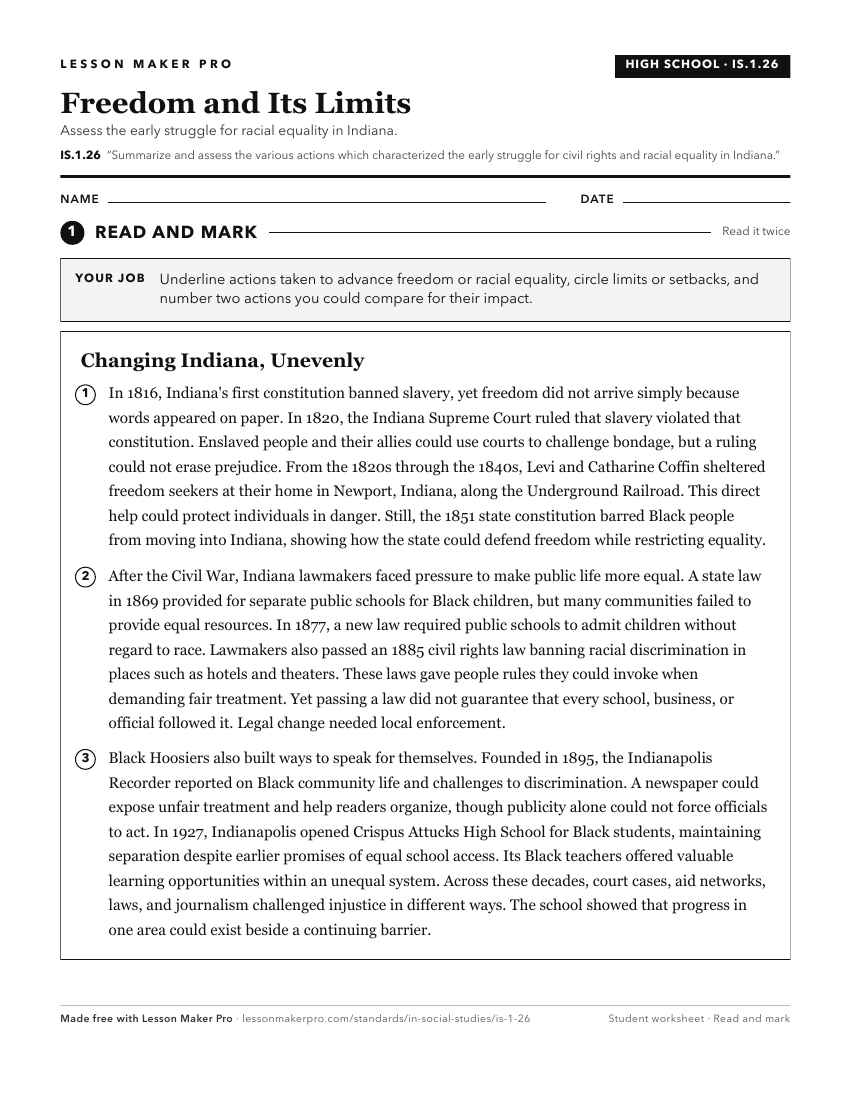
A ready-to-print activity worksheet aligned to IS.1.26, with an answer key for the teacher on its own page. No account needed.
PDF, US Letter, prints cleanly in black and white.
Download the worksheetKeep exploring
Related Standards
- IS.1.27
Examine the impact of the Civil Rights Movement of the 1960s and 1970s in Indiana through the actions of leaders and groups that were active in the movement.
- 4.H.11
Identify and describe important events and movements that changed life in Indiana from the mid-twentieth century to the present.
- IS.4.10
Summarize the impact of industrialization and immigration on social movements in Indiana from 1870-1900, including contributions of specific individuals and gro...
- IS.1.13
Identify "separate but equal" policies and "Black Codes" in Indiana prior to the Plessy v. Ferguson case (1896). Analyze the impact of these policies on civil r...
Turn this exact standard into a lesson
Grade, subject, topic, and the complete standard are prefilled. Create one free, no account needed.
Also for this standard:Make a WorksheetMake a QuizMake a Sub Lesson