Indiana Social Studies USH.4.2
The Standard
Assess the causes of the resurgence of social movements, reform movements, and vigilante groups, including the Ku Klux Klan, the Red Scare, and Prohibition.
2026 Indiana Academic Standards: K-12 Social Studies · Students are expected to trace and analyze chronological periods and examine the significant themes and concepts in U.S. History. Students develop historical thinking and research skills using primary and secondary sources to explore topical issues to understand the cause for changes in the nation over time.
Teacher's field guide
What This Standard Means
What Students Need to Do
- Students explain why the Ku Klux Klan grew, why fear of communism led to the Red Scare, and why temperance groups won support for Prohibition. They use sources to weigh causes such as racism, labor unrest, and changing social norms.
What Mastery Looks Like
- A student can use a strike headline, a report on Klan activity, and a temperance poster to explain what drove each response. They can name a cause for each without treating the three as the same kind of movement.
Common Misconceptions
- Students may treat the Red Scare as a reform movement rather than a wave of fear and government raids. They may think the Klan targeted only Black Americans, overlooking its attacks on Catholics, Jews, and immigrants. They may also think Prohibition came from one sudden vote rather than decades of organizing.
How to Assess It
- On an exit ticket, ask: “What drove the Red Scare, the Klan’s growth, and Prohibition? Give one cause and one supporting historical detail for each.”
Lesson moves
Ways to Teach It
Pairs sort three printed sources, a 1919 strike headline, a report of Klan intimidation, and a temperance poster, under cause labels.
Ask: “Why might a 1919 strike alarm some Americans while a temperance poster won support?” Require one detail from each source.
Play a card match with events, causes, and source excerpts about strikes, Klan recruitment, and temperance petitions; students explain each match.
Compare a 1920s liquor raid report with current state alcohol sales rules; ask what each law restricts and who enforces it.
Free download
Printable USH.4.2 Worksheet
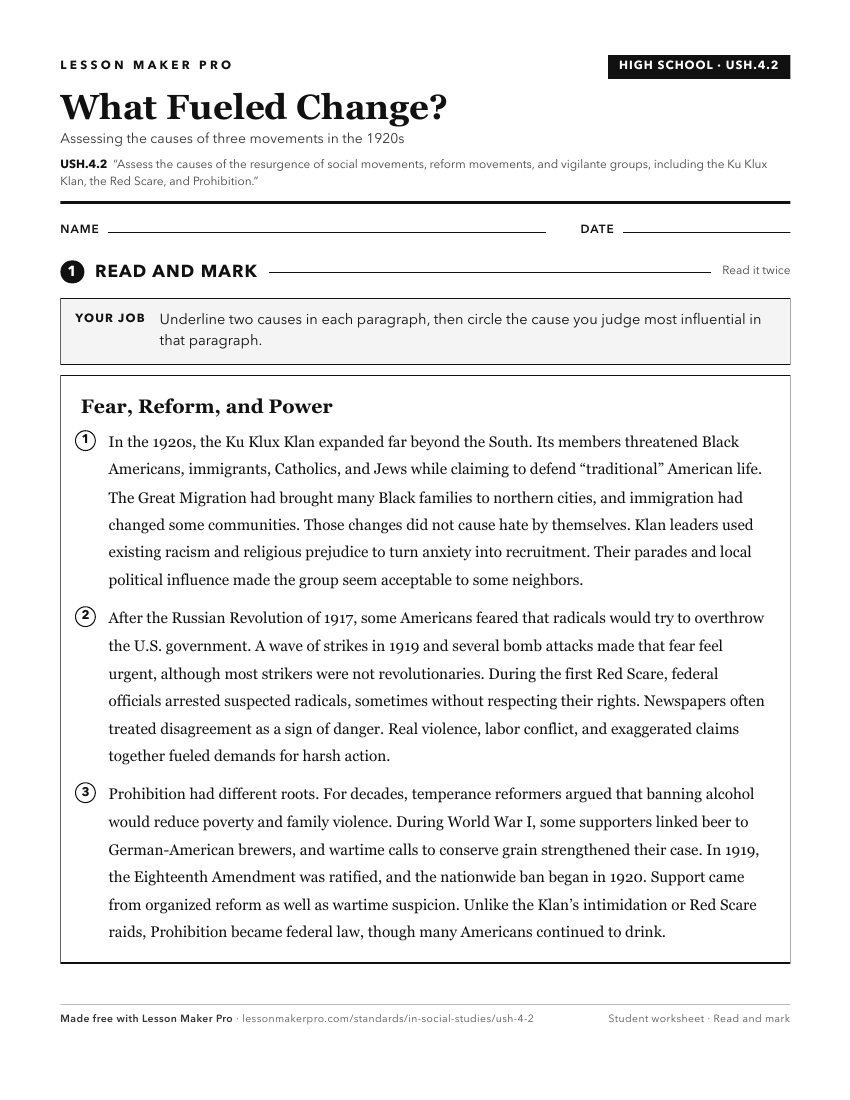
A ready-to-print activity worksheet aligned to USH.4.2, with an answer key for the teacher on its own page. No account needed.
PDF, US Letter, prints cleanly in black and white.
Download the worksheetKeep exploring
Related Standards
- 8.H.21
Analyze the influence of early individual social reformers and movements such as the abolitionist, feminist, and social reform movements.
- USH.1.2
Identify and summarize the causes and effects of slavery, the Civil War, abolitionism, social reform movements, and Reconstruction.
- IS.1.18
Assess the social and cultural impacts of the Red Scare, Prohibition, Religious Fundamentalism, the KKK, New Morality, and the New Woman in the post-WWI era as ...
- USH.7.8
Evaluate and compare various social and political movements from 1980 to the present.
Turn this exact standard into a lesson
Grade, subject, topic, and the complete standard are prefilled. Create one free, no account needed.
Also for this standard:Make a WorksheetMake a QuizMake a Sub Lesson