Indiana Social Studies USH.3.2
The Standard
Explain the impact of political, social, and cultural movements of the Progressive Era, including significant individuals/groups such as Booker T. Washington, Ida B. Wells, W.E.B. DuBois, NAACP, muckrakers, and Upton Sinclair, and including movements such as the Harlem Renaissance, Women’s Suffrage, labor movements, and socialist movement.
2026 Indiana Academic Standards: K-12 Social Studies · Students are expected to trace and analyze chronological periods and examine the significant themes and concepts in U.S. History. Students develop historical thinking and research skills using primary and secondary sources to explore topical issues to understand the cause for changes in the nation over time.
Teacher's field guide
What This Standard Means
What Students Need to Do
- Students connect activists, writers, unions, socialists, and suffragists to the problems they challenged. They compare Washington, Du Bois, and Wells on racial justice and explain how the NAACP organized for civil rights. They place the Harlem Renaissance mainly in the 1920s and explain what its artists expressed.
What Mastery Looks Like
- A student can explain how Wells campaigned against lynching and how Sinclair's writing helped spur food safety laws. They can contrast Washington's focus on vocational education with Du Bois's demand for full civil rights. They can explain what suffragists won in 1920 and how unions, socialists, and Harlem Renaissance artists pushed for change.
Common Misconceptions
- Students may treat Washington and Du Bois as calling for the same strategy. They may think the Nineteenth Amendment ended voting barriers for all women or place the Harlem Renaissance before World War I. Some assume Sinclair wrote only about food safety, not workers' conditions.
How to Assess It
- Exit ticket: Explain one change Wells sought and one suffragists won, then name a voting barrier Black women still faced in 1920.
Lesson moves
Ways to Teach It
Give groups excerpts from Southern Horrors, The Jungle, and Hughes's 'I, Too'; have them sort each by date, problem, and intended audience.
Ask: Which approach offered quicker access to voting rights, Washington's vocational education or Du Bois's demand for equal rights? Defend your answer.
Play a card match: pair Wells, the NAACP, suffragists, labor unions, socialists, and Hughes with a specific goal or action.
Compare a current voter registration form with a 1915 suffrage poster; identify one gained right and one barrier Black women still faced.
Free download
Printable USH.3.2 Worksheet
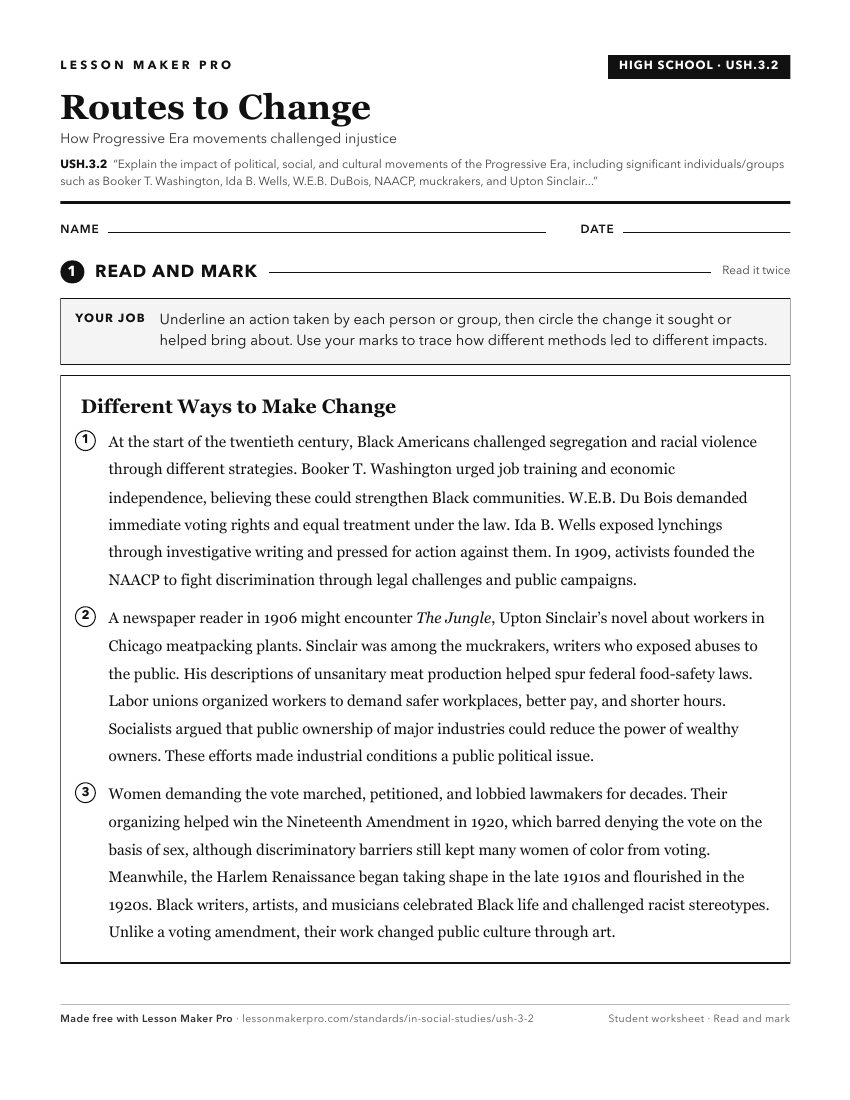
A ready-to-print activity worksheet aligned to USH.3.2, with an answer key for the teacher on its own page. No account needed.
PDF, US Letter, prints cleanly in black and white.
Download the worksheetKeep exploring
Related Standards
- 8.H.21
Analyze the influence of early individual social reformers and movements such as the abolitionist, feminist, and social reform movements.
- USH.1.2
Identify and summarize the causes and effects of slavery, the Civil War, abolitionism, social reform movements, and Reconstruction.
- IS.1.14
Explain the origins, goals, achievements, and limitations of the Progressive Movement in addressing political, economic, and social reform in Indiana.
- IS.1.10
Summarize the impact immigration had on social movements of the era including the contributions of specific individuals and groups.
Turn this exact standard into a lesson
Grade, subject, topic, and the complete standard are prefilled. Create one free, no account needed.
Also for this standard:Make a WorksheetMake a QuizMake a Sub Lesson