Indiana Social Studies USG.5.3
The Standard
Identify and describe the civil and constitutional rights found in the United States Constitution and Bill of Rights, and describe how they are expanded by decisions of the United States Supreme Court.
2026 Indiana Academic Standards: K-12 Social Studies · Students understand the nature of citizenship, politics, and governments, understanding the rights and responsibilities of citizens and how these are part of local, state, and national government. Students examine how the United States Constitution protects rights and provides the structure and functions of various levels of government. Students examine how the United States interacts with other nations as well as the government's role in world affairs will be examined.
Teacher's field guide
What This Standard Means
What Students Need to Do
- Students identify rights such as free speech, the right to a lawyer, and equal protection. They match each right to an amendment and explain how a Supreme Court ruling changed its application.
What Mastery Looks Like
- A student can connect a real situation to a right and a Court ruling. For example, they can explain that Gideon required states to provide lawyers to people facing felony charges who could not afford one.
Common Misconceptions
- Students may think every right has no limits. They may assume the Bill of Rights always applied to state governments, or that a Court ruling changes the words of an amendment.
How to Assess It
- Exit ticket: A person charged with a felony in state court cannot afford a lawyer. Name the amendment and Supreme Court case that apply, then explain what the state must do.
Lesson moves
Ways to Teach It
Give pairs nine cards with situations, amendments, and rulings for Gideon, Brown, and Tinker; have them build three matching sets.
Ask students to write how Brown changed public schools, using one fact from a one-paragraph case summary.
Run a two-minute match: students pair five rights scenarios with amendment cards, then check answers with a partner.
Put “Protect Our Park” on a T-shirt mock-up; have students apply Tinker's substantial-disruption test to a school ban on the shirt.
Free download
Printable USG.5.3 Worksheet
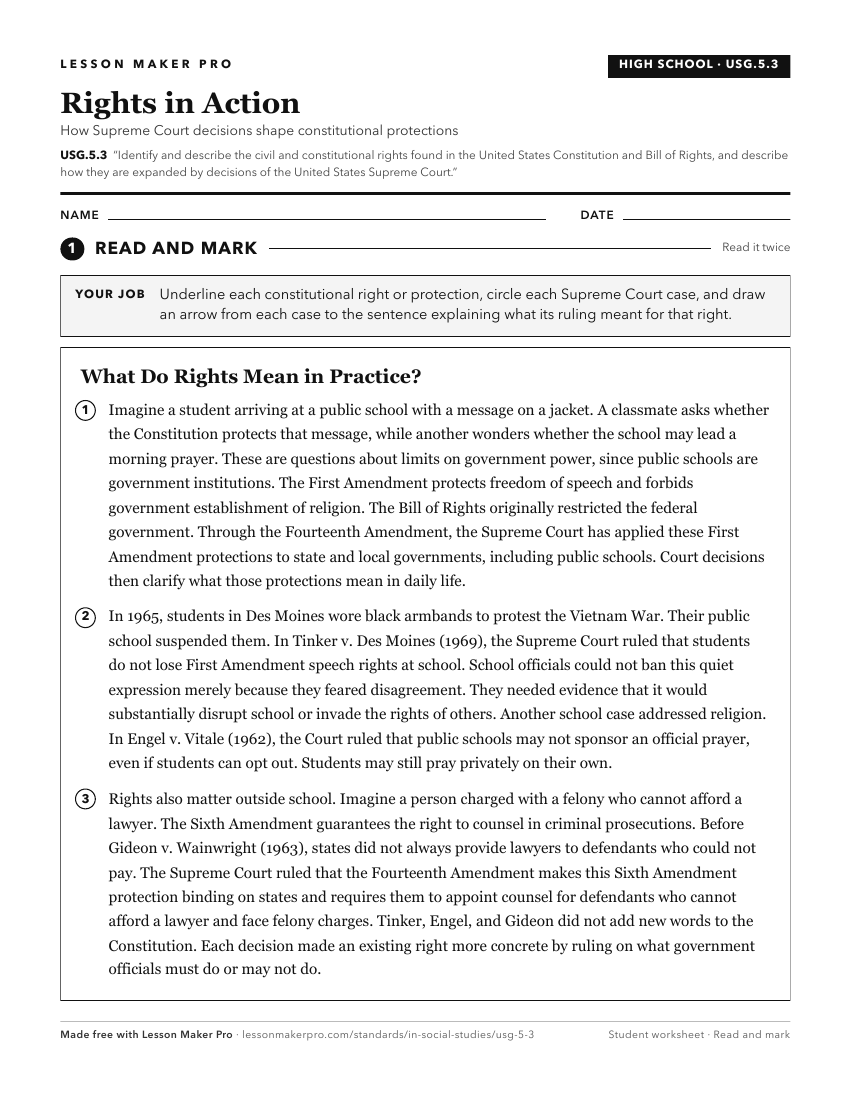
A ready-to-print activity worksheet aligned to USG.5.3, with an answer key for the teacher on its own page. No account needed.
PDF, US Letter, prints cleanly in black and white.
Download the worksheetKeep exploring
Related Standards
- 8.C.1
Identify and explain essential ideas of constitutional government, which include limited government; rule of law; due process of law; separated and shared power...
- USG.5.9
Analyze and evaluate landmark Supreme Court opinions concerning civil rights and civil liberties, and explain their constitutional foundations, historical conte...
- USG.1.6
Define and provide historical and contemporary examples of constitutionalism, rule of law, limited government, and popular sovereignty in the United States Cons...
- 5.C.3
Identify and explain key ideas about government as noted in the Declaration of Independence, Articles of Confederation, Northwest Ordinance, United States Const...
Turn this exact standard into a lesson
Grade, subject, topic, and the complete standard are prefilled. Create one free, no account needed.
Also for this standard:Make a WorksheetMake a QuizMake a Sub Lesson