Indiana Social Studies USG.3.8
The Standard
Explain the electoral process in terms of election laws and election systems on the national, state, and local level.
2026 Indiana Academic Standards: K-12 Social Studies · Students understand the nature of citizenship, politics, and governments, understanding the rights and responsibilities of citizens and how these are part of local, state, and national government. Students examine how the United States Constitution protects rights and provides the structure and functions of various levels of government. Students examine how the United States interacts with other nations as well as the government's role in world affairs will be examined.
Teacher's field guide
What This Standard Means
What Students Need to Do
- Students trace how primaries select candidates and general elections fill offices. They compare direct elections for local, state, and congressional offices with the Electoral College process for president. They identify election rules that vary by state and locality.
What Mastery Looks Like
- Given a sample ballot and election rules, a student can identify which offices are being filled and whether a primary or runoff applies. They can explain how votes choose a governor and how most states award presidential electoral votes.
Common Misconceptions
- Students may think the nationwide popular vote directly chooses the president. They may assume every state has the same registration deadline or that a primary fills an office.
How to Assess It
- Exit ticket: A town elects its mayor by direct vote, and a state awards its presidential electoral votes to its statewide winner. Explain how each result is decided and name one election rule that could differ elsewhere.
Lesson moves
Ways to Teach It
Have groups cast paper presidential ballots in three mock states, award each state's electoral votes to its winner, and compare both totals.
Ask: How could a registration deadline or a runoff rule affect who votes or wins a mayoral race?
Give pairs four election scenarios and cards labeled primary, general election, runoff, and Electoral College; have them match each card to a scenario.
Open your county election office's sample ballot and registration page; find one local race and the registration deadline.
Free download
Printable USG.3.8 Worksheet
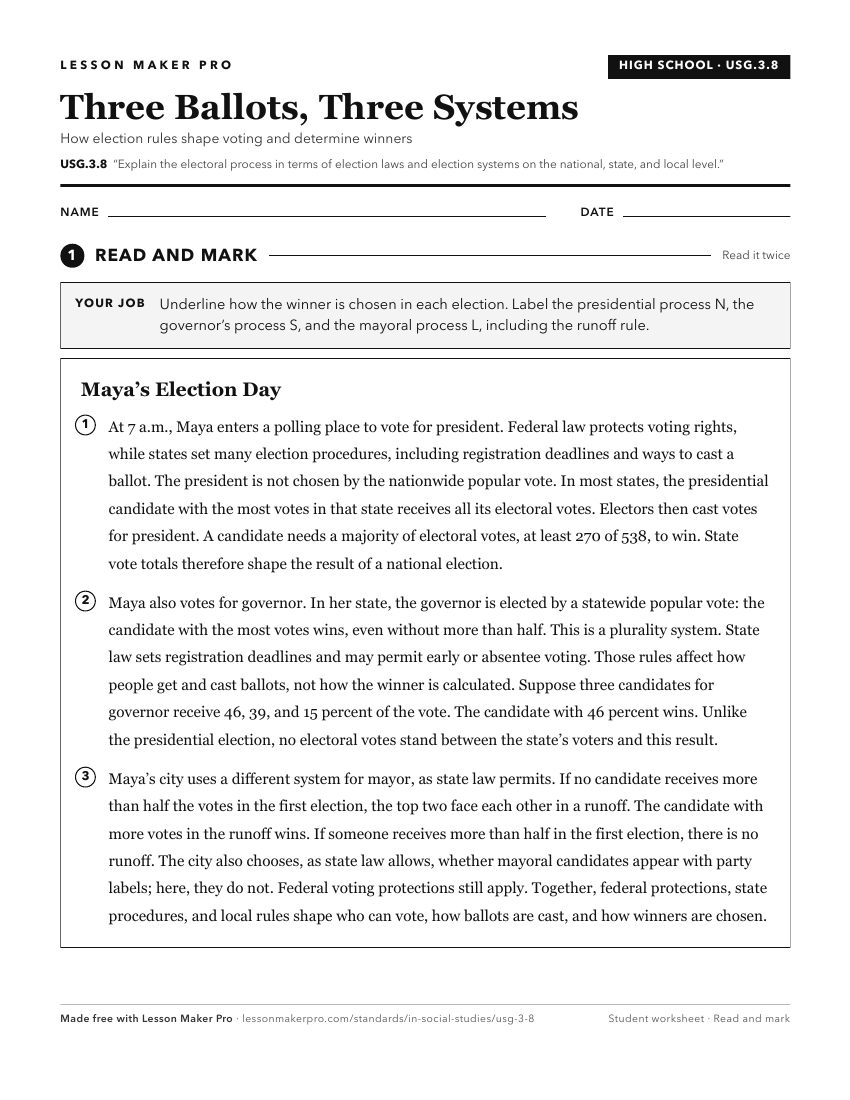
A ready-to-print activity worksheet aligned to USG.3.8, with an answer key for the teacher on its own page. No account needed.
PDF, US Letter, prints cleanly in black and white.
Download the worksheetKeep exploring
Related Standards
- 3.C.2
Identify and explain the duties of and selection process for local and state government officials who make, implement, and enforce laws.
- 8.C.6
Explain ways that citizens can participate in the election process (e.g., political parties, campaigns, and elections) at the federal, state, and local levels.
- 5.C.4
Describe the primary and general election processes for local, state, and federal offices, including those used to select congressional and presidential office ...
- USG.3.11
Analyze the functions of political parties in elections and government at national, state, and local levels of the federal system.
Turn this exact standard into a lesson
Grade, subject, topic, and the complete standard are prefilled. Create one free, no account needed.
Also for this standard:Make a WorksheetMake a QuizMake a Sub Lesson