Indiana Social Studies USG.3.1
The Standard
Analyze the United States Constitution, and explain characteristics of government in the United States, which define it as a federal, presidential, constitutional, and representative democracy.
2026 Indiana Academic Standards: K-12 Social Studies · Students understand the nature of citizenship, politics, and governments, understanding the rights and responsibilities of citizens and how these are part of local, state, and national government. Students examine how the United States Constitution protects rights and provides the structure and functions of various levels of government. Students examine how the United States interacts with other nations as well as the government's role in world affairs will be examined.
Teacher's field guide
What This Standard Means
What Students Need to Do
- Students explain how power is divided between state and national governments. They identify the president's separate role, the limits set by the Constitution, and how voters choose lawmakers to act for them.
What Mastery Looks Like
- A student can use the Tenth Amendment to explain why states have powers of their own. They can use Articles I and II to distinguish Congress from the president, then point to the First Amendment as a limit on government.
Common Misconceptions
- Students may think the national government controls every state decision or that the president can make laws alone. They may also confuse electing representatives with voting directly on every law.
How to Assess It
- Give students short excerpts from Articles I, II, and VI, plus the First and Tenth Amendments. Ask them to match each of the four government features to an excerpt and explain each choice.
Lesson moves
Ways to Teach It
Give pairs excerpt cards from Articles I, II, and VI and the First and Tenth Amendments; have them sort the cards under four feature labels.
Ask students to write: What can Congress do if the president vetoes a bill, and what does that tell us about their roles?
Call out 'state runs schools,' 'voters pick lawmakers,' 'president vetoes bill,' and 'speech protected'; students move to the matching labeled corner.
Show an Indiana driver's license form and a U.S. passport form; students identify which government handles each and connect their answers to divided powers.
Free download
Printable USG.3.1 Worksheet
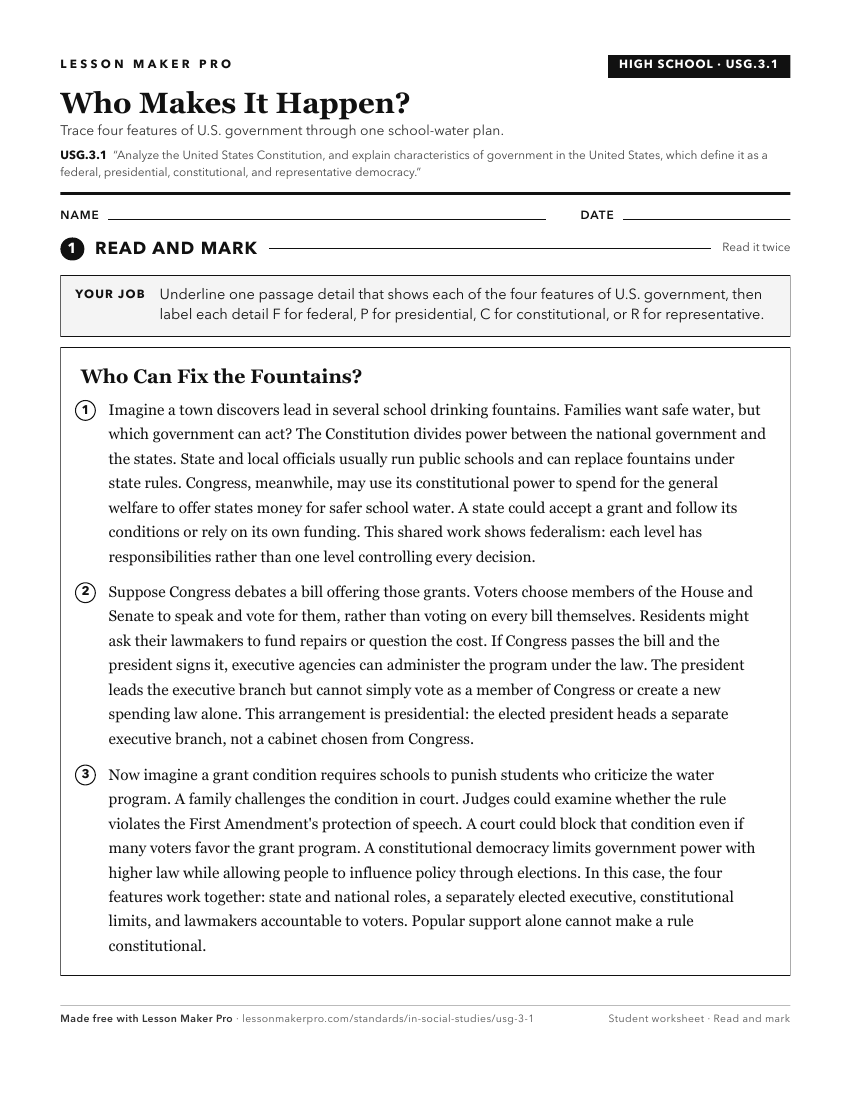
A ready-to-print activity worksheet aligned to USG.3.1, with an answer key for the teacher on its own page. No account needed.
PDF, US Letter, prints cleanly in black and white.
Download the worksheetKeep exploring
Related Standards
- 8.C.1
Identify and explain essential ideas of constitutional government, which include limited government; rule of law; due process of law; separated and shared power...
- USG.1.6
Define and provide historical and contemporary examples of constitutionalism, rule of law, limited government, and popular sovereignty in the United States Cons...
- 5.C.3
Identify and explain key ideas about government as noted in the Declaration of Independence, Articles of Confederation, Northwest Ordinance, United States Const...
- USG.2.3
Analyze and interpret central ideas on government, individual rights, and the common good in founding documents of the United States.
Turn this exact standard into a lesson
Grade, subject, topic, and the complete standard are prefilled. Create one free, no account needed.
Also for this standard:Make a WorksheetMake a QuizMake a Sub Lesson