Indiana Social Studies S.6.8
The Standard
Define different types of groups (involuntary, voluntary, coercive, reference).
2026 Indiana Academic Standards: K-12 Social Studies
Teacher's field guide
What This Standard Means
What Students Need to Do
- Students identify whether people join a group by choice, by circumstance, or by force. They also identify groups people use as models or points of comparison, even when they are not members.
What Mastery Looks Like
- A student can label a chess club as voluntary and a birth family as involuntary. They can explain why a student might use the honor society as a reference group without belonging to it.
Common Misconceptions
- Students may call any group they did not choose coercive, including a birth family. They may think someone must belong to a reference group to compare themselves with it.
How to Assess It
- Give students four cases: birth family, chess club, prison work crew, and a student comparing grades with honor society members. Ask them to label each group type and explain the last case.
Lesson moves
Ways to Teach It
Have pairs sort four scenario cards: birth family, chess club sign-up, prison work crew, and a student comparing grades with honor society members.
Ask, 'Can a club be voluntary for its members and a reference group for students who want to join? Why?'
Read new group scenarios aloud; students hold up labeled cards and explain one choice to a partner.
Show a school club sign-up sheet and an assigned advisory roster; students write how choice affects membership in each group.
Free download
Printable S.6.8 Worksheet
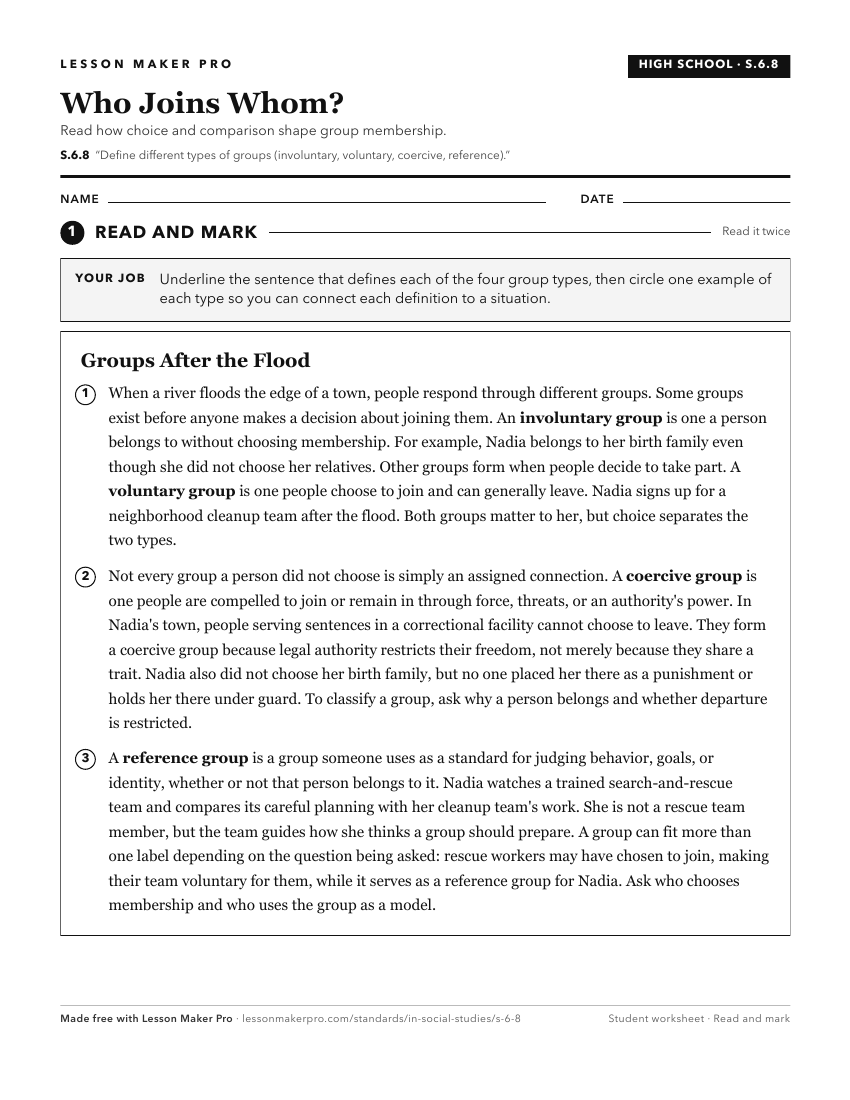
A ready-to-print activity worksheet aligned to S.6.8, with an answer key for the teacher on its own page. No account needed.
PDF, US Letter, prints cleanly in black and white.
Download the worksheetKeep exploring
Related Standards
- S.6.4
Explain the functions of groups both for individual group members and for society.
- S.6.2
Distinguish between primary groups and secondary groups with examples of each.
- S.6.3
Explore reasons for group formation; distinguish instrumental from expressive needs.
- S.10.2
Identify formal and informal, as well as positive and negative forms of social control employed in our society.
Turn this exact standard into a lesson
Grade, subject, topic, and the complete standard are prefilled. Create one free, no account needed.
Also for this standard:Make a WorksheetMake a QuizMake a Sub Lesson