Indiana Social Studies S.6.2
The Standard
Distinguish between primary groups and secondary groups with examples of each.
2026 Indiana Academic Standards: K-12 Social Studies
Teacher's field guide
What This Standard Means
What Students Need to Do
- Students identify groups built on close personal ties and groups organized around a task or role. They use details from a scenario to explain their choices.
What Mastery Looks Like
- A student identifies close friends as a primary group because members know and support one another personally. They identify a student council budget committee as a secondary group because members meet to complete a task, even if some are friends.
Common Misconceptions
- Students may think “primary” means first or more important. They may label every sports team the same way, missing that teammates can also form close personal bonds.
How to Assess It
- Exit ticket: Classify a group of close friends and a student council budget committee. Give one reason for each based on relationships or shared tasks.
Lesson moves
Ways to Teach It
Give pairs six scenario cards, such as siblings, close friends, and a debate tournament committee; have them sort the cards and defend two choices.
Ask: Can your basketball team be both kinds of group? Write two sentences about the team's relationships and goals.
Read short scenarios aloud, and have students hold up P, S, or Both cards and explain their choices.
Have students compare a lunch table with a part-time work shift, noting how personal ties and shared tasks shape each group.
Free download
Printable S.6.2 Worksheet
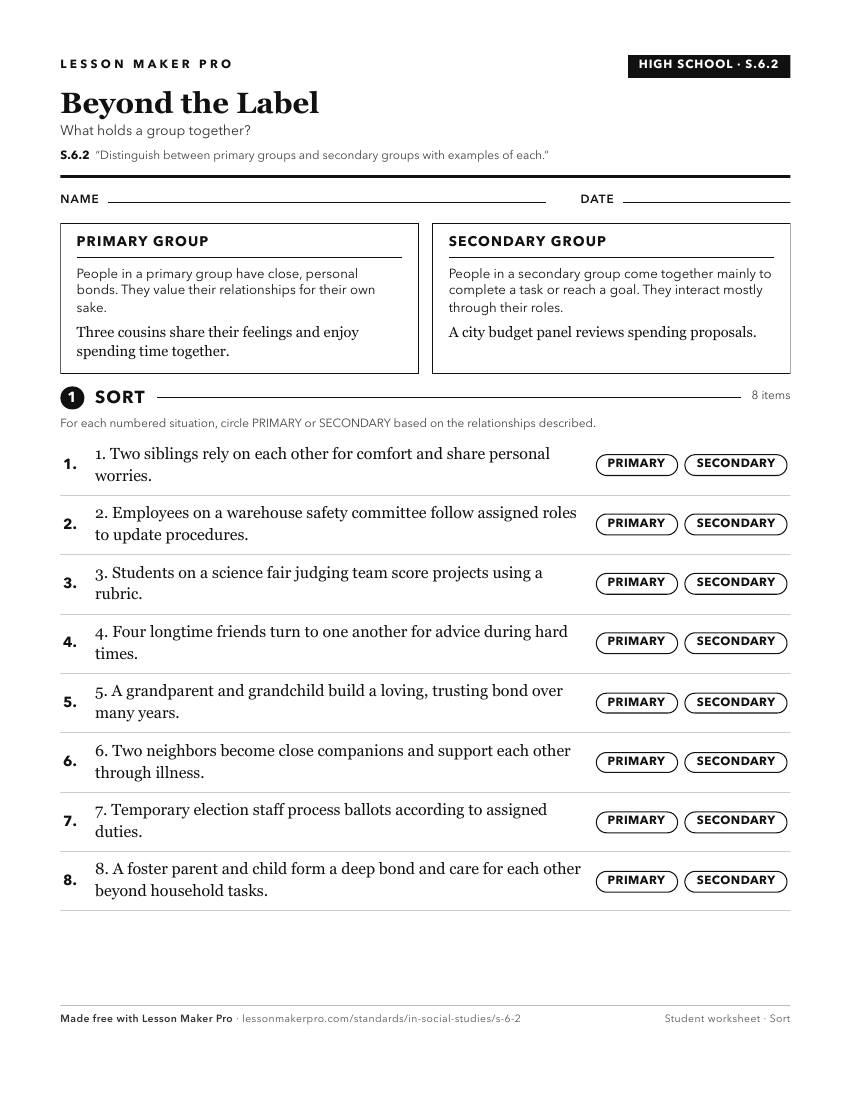
A ready-to-print activity worksheet aligned to S.6.2, with an answer key for the teacher on its own page. No account needed.
PDF, US Letter, prints cleanly in black and white.
Download the worksheetKeep exploring
Related Standards
- S.8.5
Distinguish major differences between social movements and collective behavior with examples.
- S.6.4
Explain the functions of groups both for individual group members and for society.
- S.6.5
Explain how the importance of primary and secondary groups have changed over time, particularly in relation to pre-industrial and industrial society.
- S.6.8
Define different types of groups (involuntary, voluntary, coercive, reference).
Turn this exact standard into a lesson
Grade, subject, topic, and the complete standard are prefilled. Create one free, no account needed.
Also for this standard:Make a WorksheetMake a QuizMake a Sub Lesson