Indiana Social Studies S.6.5
The Standard
Explain how the importance of primary and secondary groups have changed over time, particularly in relation to pre-industrial and industrial society.
2026 Indiana Academic Standards: K-12 Social Studies
Teacher's field guide
What This Standard Means
What Students Need to Do
- Students tell close personal groups from larger, task-based groups. They compare how people relied on these groups in farming villages and industrial cities. They connect the change to factory work and migration.
What Mastery Looks Like
- A student can identify the group types in a family, a factory crew, and a labor union. They can explain why formal groups gained influence without claiming that families stopped mattering.
Common Misconceptions
- Students may think factories replaced families or that farming villages had no formal groups. Some call any small group primary, even a factory shift whose members barely know each other.
How to Assess It
- Exit ticket: A farmer relies on relatives to harvest; a factory worker joins a union. Name each group type, explain why the worker might need a union, and say whether relatives stopped mattering.
Lesson moves
Ways to Teach It
Give pairs family, village council, factory crew, and union cards; have them place each on primary-secondary and preindustrial-industrial scales, explaining overlaps.
Ask students: How might a factory worker rely on relatives and a union, while a village farmer relied more on kin and neighbors?
Play matching rounds: pair family and union cards with group types, then pair factory work and migration cards with changes in group reliance.
Have students list family ties, school clubs, and workplace teams in their town, then compare them with ties in a farming village.
Free download
Printable S.6.5 Worksheet
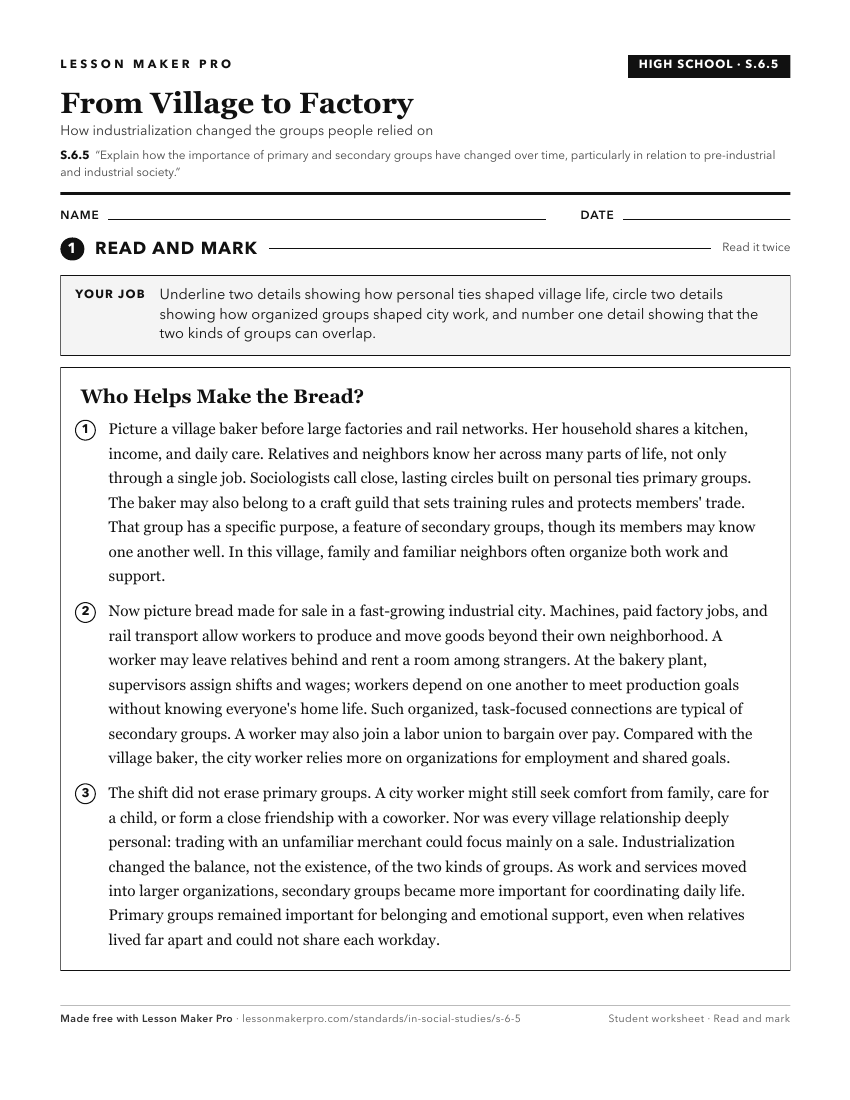
A ready-to-print activity worksheet aligned to S.6.5, with an answer key for the teacher on its own page. No account needed.
PDF, US Letter, prints cleanly in black and white.
Download the worksheetKeep exploring
Related Standards
- S.6.4
Explain the functions of groups both for individual group members and for society.
- S.9.2
Describe how social problems have changed over time.
- 1.H.1
Identify the impact the past has on the present way of life in the community using primary sources.
- S.6.2
Distinguish between primary groups and secondary groups with examples of each.
Turn this exact standard into a lesson
Grade, subject, topic, and the complete standard are prefilled. Create one free, no account needed.
Also for this standard:Make a WorksheetMake a QuizMake a Sub Lesson