Indiana Social Studies S.10.2
The Standard
Identify formal and informal, as well as positive and negative forms of social control employed in our society.
2026 Indiana Academic Standards: K-12 Social Studies
Teacher's field guide
What This Standard Means
What Students Need to Do
- Students identify how people encourage or discourage behavior. They sort examples by whether the response comes from an official rule or a social reaction, and whether it rewards or discourages an action.
What Mastery Looks Like
- A student can label a school award as formal and positive, and a friend's disapproving look as informal and negative. They can explain each label using details from the example.
Common Misconceptions
- Students may think formal responses only come from the government, even though schools and workplaces have official rules. They may also think positive means morally good and negative means unfair, rather than reward and penalty.
How to Assess It
- Exit ticket: Label a parking ticket and a teammate's praise on both axes. Explain what makes each formal or informal and positive or negative.
Lesson moves
Ways to Teach It
Give pairs four cards: school award, parking ticket, friend's compliment, and disapproving look; have them sort the cards into a four-square grid.
Ask students to write how a teammate's praise differs from a referee's yellow card, then label each on both axes.
Read six short scenarios aloud; students hold up two label cards for each, then explain one choice to a partner.
Have students compare a posted library late fee with a neighbor's thank-you note, labeling each on both axes.
Free download
Printable S.10.2 Worksheet
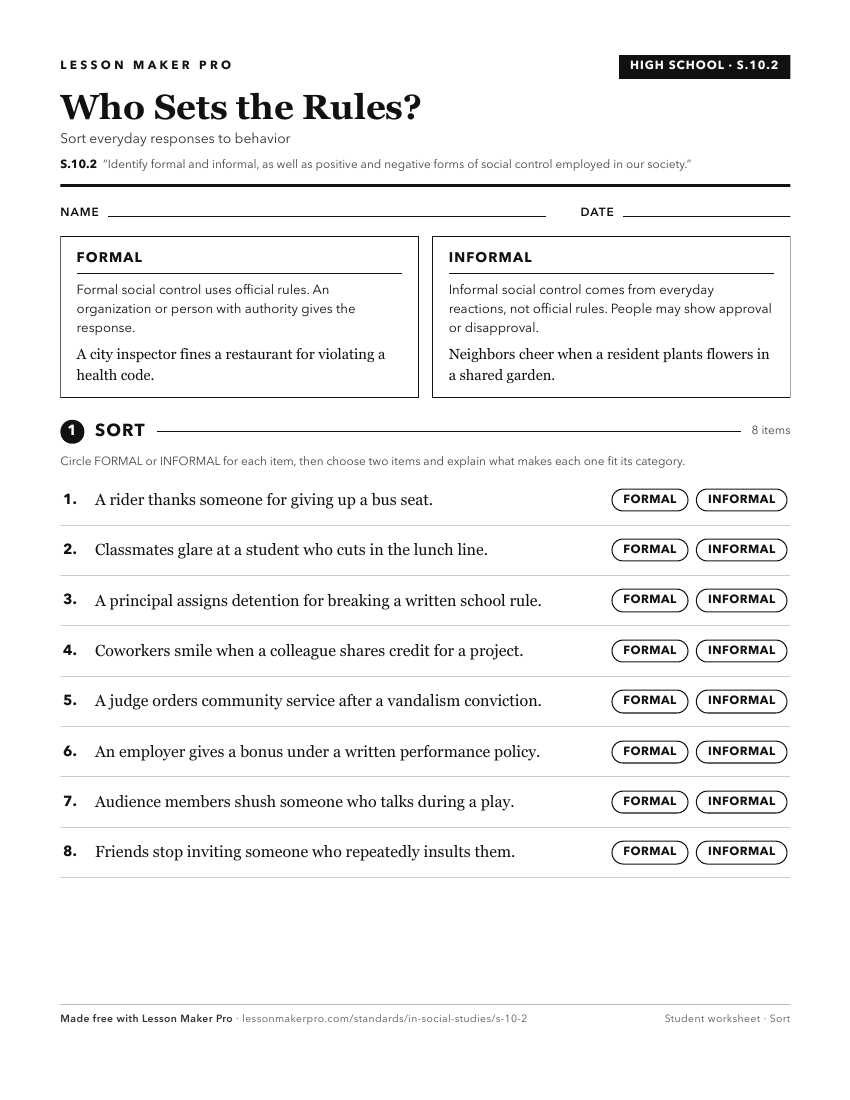
A ready-to-print activity worksheet aligned to S.10.2, with an answer key for the teacher on its own page. No account needed.
PDF, US Letter, prints cleanly in black and white.
Download the worksheetKeep exploring
Related Standards
- S.10.3
Explore explanations of deviance such as the Strain Theory, the Differential Association Theory, and the Control Theory.
- S.8.6
Investigate the consequences of change to society.
- P.7.1
Understand and identify social norms and how they differ across cultures.
- S.3.5
Identify the major agents of socialization and evaluate the role each plays (family, play group, peer group, school, mass media, job, religion, total institutio...
Turn this exact standard into a lesson
Grade, subject, topic, and the complete standard are prefilled. Create one free, no account needed.
Also for this standard:Make a WorksheetMake a QuizMake a Sub Lesson