Indiana Social Studies P.7.1
The Standard
Understand and identify social norms and how they differ across cultures.
2026 Indiana Academic Standards: K-12 Social Studies
Teacher's field guide
What This Standard Means
What Students Need to Do
- Students identify unwritten expectations for behavior, such as how people greet others or take turns speaking. They compare expectations in different settings and cultures without assuming everyone in a group acts the same way.
What Mastery Looks Like
- A student can name the expected behavior in a specific situation and point to a clue that supports it. They can explain how the expectation might change in another setting and name a possible exception.
Common Misconceptions
- Students may confuse social norms with laws or personal preferences. They may also assume a custom applies to every person in a culture, or judge an unfamiliar custom by their own habits.
How to Assess It
- On an exit ticket, describe a student greeting a teacher by first name and another using a title. Ask: What expectation might each student be following, and why should we avoid assuming either practice applies to everyone?
Lesson moves
Ways to Teach It
Give pairs cards showing greetings in two fictional communities; have them sort expected behaviors, optional choices, and rules, then explain their choices.
Ask students to write: When might direct eye contact show respect, and when might someone read it differently?
Play a scenario match game: students pair greeting cards with setting cards, then name one reason a person might act differently.
Compare your school's lunch line with a travel guide's advice on queuing; have students mark which expectations are written and which are assumed.
Free download
Printable P.7.1 Worksheet
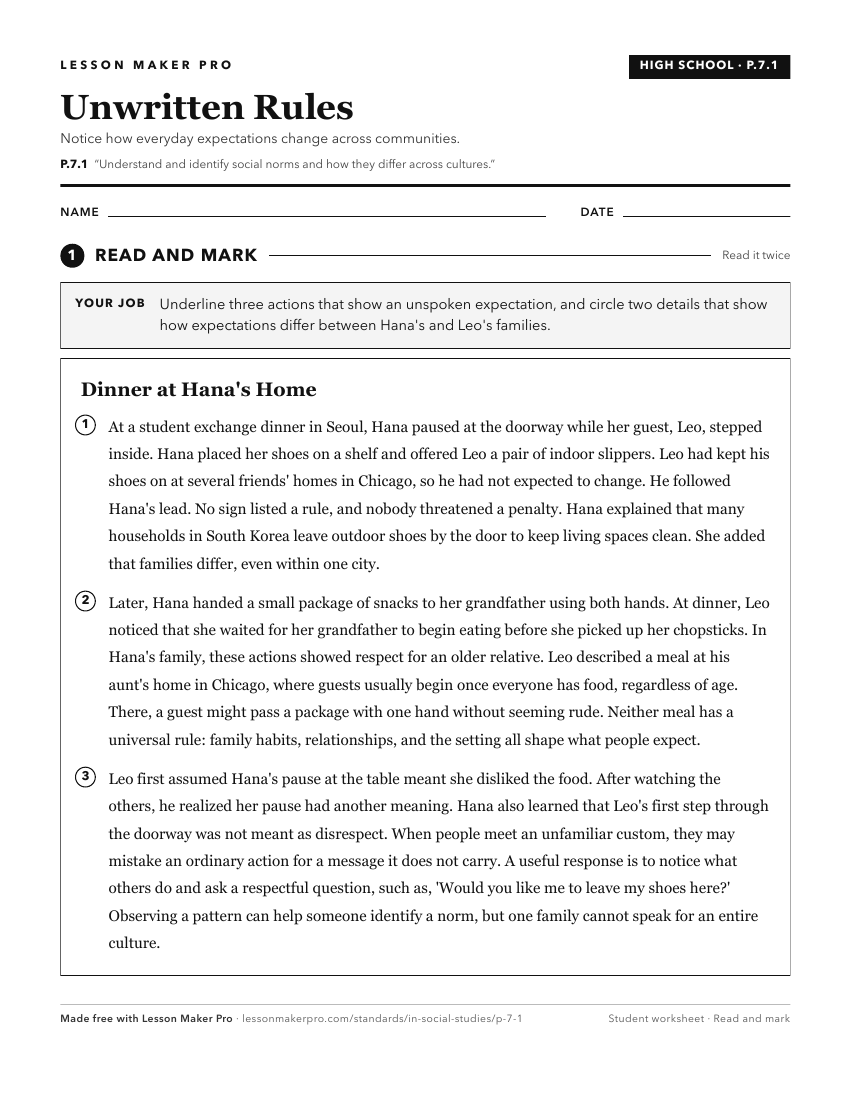
A ready-to-print activity worksheet aligned to P.7.1, with an answer key for the teacher on its own page. No account needed.
PDF, US Letter, prints cleanly in black and white.
Download the worksheetKeep exploring
Related Standards
- S.2.6
Explain the relationship between norms and values; explain how norms develop and change in a society; distinguish between folkways, mores, and taboos.
- S.2.4
Identify American cultural values; differentiate between a heterogeneous society and homogenous society.
- S.2.5
Identify examples of culture similarities and differences.
- S.5.4
Explore how gender roles differ in different societies and how they change over time.
Turn this exact standard into a lesson
Grade, subject, topic, and the complete standard are prefilled. Create one free, no account needed.
Also for this standard:Make a WorksheetMake a QuizMake a Sub Lesson