Indiana Social Studies S.2.6
The Standard
Explain the relationship between norms and values; explain how norms develop and change in a society; distinguish between folkways, mores, and taboos.
2026 Indiana Academic Standards: K-12 Social Studies
Teacher's field guide
What This Standard Means
What Students Need to Do
- Students connect shared values to the behavior people expect from one another. They explain how people learn these expectations and how they can change. They sort examples into folkways, mores, and taboos.
What Mastery Looks Like
- Given a community example, a student names the expected behavior and the value behind it. They classify the norm by how strongly the group reacts when someone breaks it. They explain one plausible reason the norm might change.
Common Misconceptions
- Some students mistake a shared norm for a personal preference or assume all norms are written laws. Others call any broken rule a taboo, missing the difference between mild disapproval, moral anger, and strong prohibition. They may assume norms never change.
How to Assess It
- Exit ticket: Classify shaking hands in greeting, lying to a friend, and eating a sacred animal in a community that forbids it as folkway, more, or taboo. Name a value behind one example and explain how that norm might change.
Lesson moves
Ways to Teach It
Give groups scenario cards showing greetings, lies, and forbidden foods in named communities; have them sort the cards and defend each choice.
Ask students to write: How has phone use at dinner changed in your household, and what value might explain the rule?
Play a three-corner sort: read a scenario, have students move to folkway, more, or taboo, then explain the likely response.
Compare graduation photos from the same school ten years apart; identify a clothing norm that changed and a value that may explain it.
Free download
Printable S.2.6 Worksheet
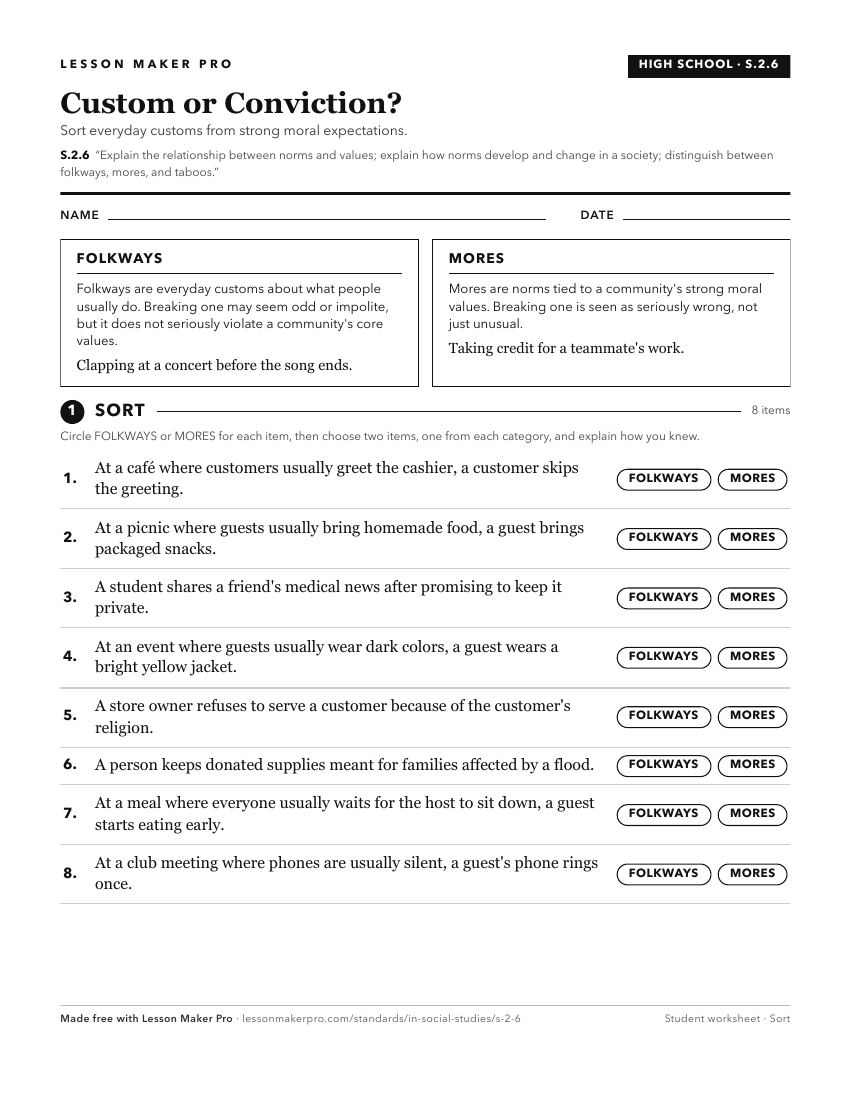
A ready-to-print activity worksheet aligned to S.2.6, with an answer key for the teacher on its own page. No account needed.
PDF, US Letter, prints cleanly in black and white.
Download the worksheetKeep exploring
Related Standards
- P.7.1
Understand and identify social norms and how they differ across cultures.
- S.6.9
Explore the formation of group norms.
- S.7.2
Identify basic social institutions and explain their impact on individuals, groups, and organizations within society and how they transmit the values of society...
- S.7.1
Define social institutions as being made up of norms and values, and explain their importance to society.
Turn this exact standard into a lesson
Grade, subject, topic, and the complete standard are prefilled. Create one free, no account needed.
Also for this standard:Make a WorksheetMake a QuizMake a Sub Lesson