Indiana Social Studies S.6.7
The Standard
Define ethnocentrism and cultural relativism and explain how they can be beneficial or destructive to a culture.
2026 Indiana Academic Standards: K-12 Social Studies
Teacher's field guide
What This Standard Means
What Students Need to Do
- Students spot when someone judges another group by their own customs and when someone tries to understand a custom in its setting. They explain how each response can help or hurt a group.
What Mastery Looks Like
- A student can label two reactions to an unfamiliar greeting and explain the difference. They can show how shared customs build belonging but can also exclude outsiders. They can explain why learning the context reduces bias without requiring approval of harm.
Common Misconceptions
- Students may think pride in their own group always means hostility toward others. Others may think understanding a custom means they must approve of it, even when it harms someone.
How to Assess It
- Exit ticket: Label each response to an unfamiliar holiday: 'Our way is best' and 'Let's learn why they celebrate that way.' Give one benefit and one possible harm of each response.
Lesson moves
Ways to Teach It
Show photos of bowing and handshakes; students mark first impressions on sticky notes, then revise them after reading cards explaining each greeting.
Ask students to write: When can pride in a family tradition bring people together, and when might it shut others out?
Play a card sort with statements about greetings; teams label each view and point to the words that support their choice.
Use a school lunch menu debate; students suggest how to keep familiar foods while making room for classmates' food traditions.
Free download
Printable S.6.7 Worksheet
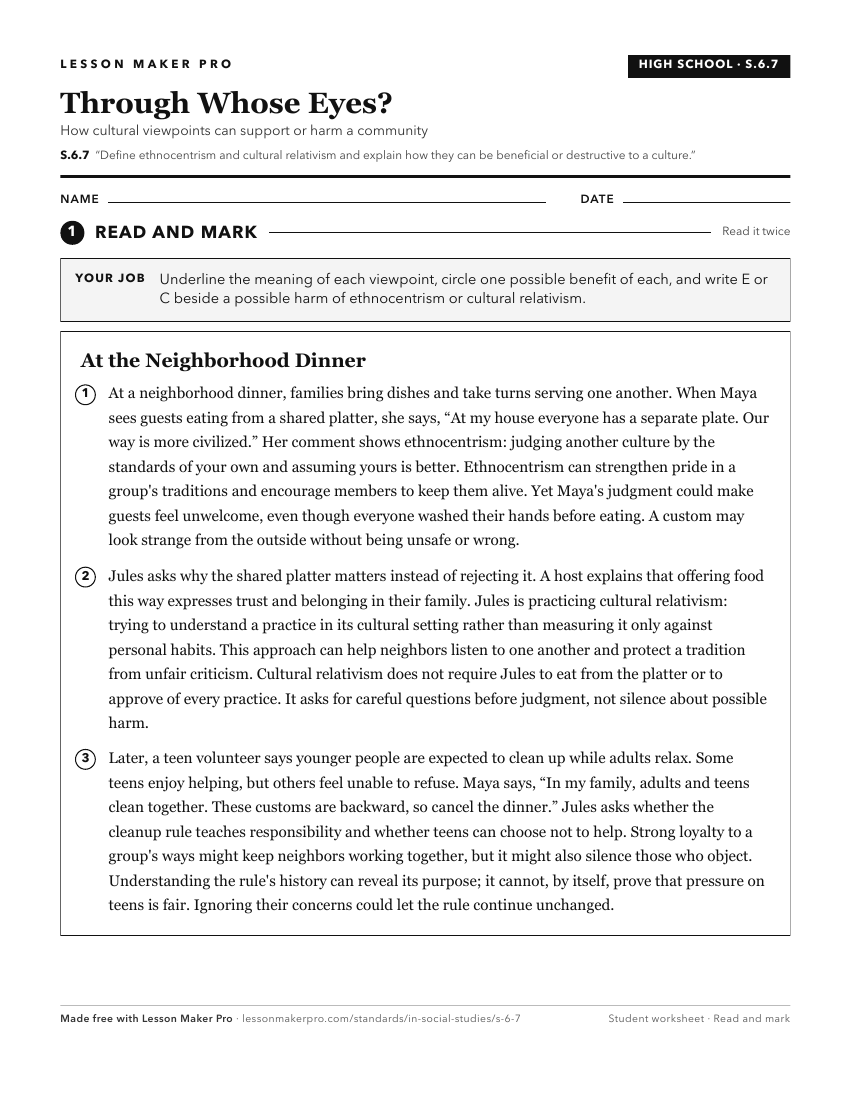
A ready-to-print activity worksheet aligned to S.6.7, with an answer key for the teacher on its own page. No account needed.
PDF, US Letter, prints cleanly in black and white.
Download the worksheetKeep exploring
Related Standards
- WG.2.2
Analyze and provide examples of ways in which people's changing views of places and regions reflect cultural changes; explain how people's views of physical fea...
- S.2.2
Explain the differences between the concepts: culture and society.
- S.2.4
Identify American cultural values; differentiate between a heterogeneous society and homogenous society.
- 7.G.8
Explain how ethnocentrism influenced the way different groups in Africa, Asia, and the Southwest Pacific interacted and treated one another.
Turn this exact standard into a lesson
Grade, subject, topic, and the complete standard are prefilled. Create one free, no account needed.
Also for this standard:Make a WorksheetMake a QuizMake a Sub Lesson