Indiana Social Studies 7.G.8
The Standard
Explain how ethnocentrism influenced the way different groups in Africa, Asia, and the Southwest Pacific interacted and treated one another.
2026 Indiana Academic Standards: K-12 Social Studies
Teacher's field guide
What This Standard Means
What Students Need to Do
- Students spot when one group judges another group's customs by its own rules. They explain how those judgments affected schooling, land claims, or treatment of people in Africa, Asia, and the Southwest Pacific.
What Mastery Looks Like
- A student can name a cultural judgment, describe an action it led to, and explain its effect on another group. They can also tell when profit or a struggle for control played a part.
Common Misconceptions
- Students may call any disagreement between groups ethnocentrism, even when no cultural judgment is involved. They may assume everyone in a group held the same views, or that cultural bias was the only cause of an action.
How to Assess It
- Exit ticket: British settlers called Aboriginal land unowned despite Aboriginal communities living there. What belief about land might explain that claim, and how could it affect Aboriginal people?
Lesson moves
Ways to Teach It
Pairs match printed belief, action, and effect strips about English schooling in India, Belgian rule in Congo, and Aboriginal land claims in Australia.
Ask, 'When British settlers called Aboriginal land unowned, whose rules for owning land were they using, and who was affected?'
Play 'belief or motive': read 'English schools are better' and 'rubber brings profit'; students raise culture or money cards and explain.
Show two school lunch menus from different countries; students replace 'weird food' with a description that does not judge either culture.
Free download
Printable 7.G.8 Worksheet
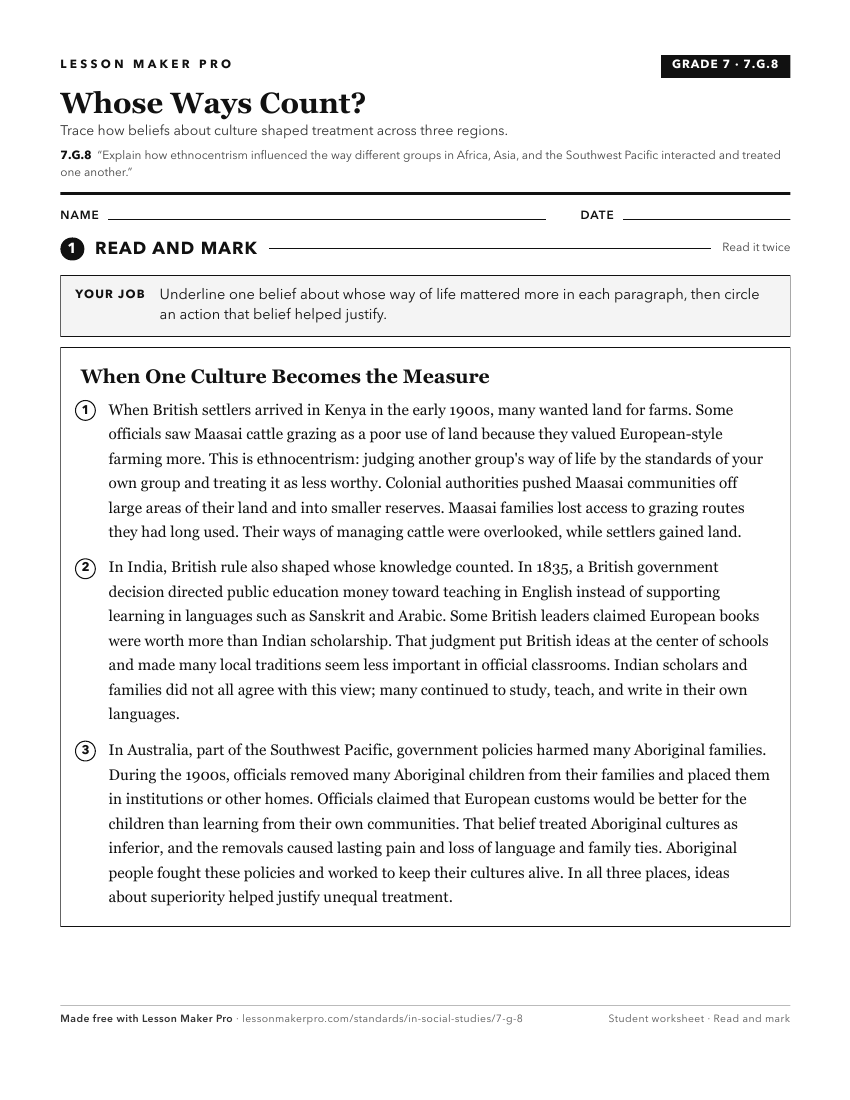
A ready-to-print activity worksheet aligned to 7.G.8, with an answer key for the teacher on its own page. No account needed.
PDF, US Letter, prints cleanly in black and white.
Download the worksheetKeep exploring
Related Standards
- 7.H.11
Explain the reasons for European colonization of Africa, Asia, and the Southwest Pacific and analyze the impact that colonization, imperialism, and slavery had ...
- 7.E.2
Identify ways that societies deal with helpful and harmful externalities in Africa, Asia, and the Southwest Pacific.
- 7.G.2
Describe and compare major cultural characteristics of regions in Africa, Asia, and the Southwest Pacific.
- USH.3.5
Describe the experiences of migrants from Europe, Asia, and the southern United States as they encountered and interacted with their new communities.
Turn this exact standard into a lesson
Grade, subject, topic, and the complete standard are prefilled. Create one free, no account needed.
Also for this standard:Make a WorksheetMake a QuizMake a Sub Lesson