Indiana Social Studies 7.E.2
The Standard
Identify ways that societies deal with helpful and harmful externalities in Africa, Asia, and the Southwest Pacific.
2026 Indiana Academic Standards: K-12 Social Studies
Teacher's field guide
What This Standard Means
What Students Need to Do
- Students identify when an action helps or harms people who were not involved in it. They explain how societies in Africa, Asia, and the Southwest Pacific encourage benefits or reduce harm.
What Mastery Looks Like
- A student can name who benefits from tree planting in Kenya and who is harmed by factory runoff in India. They can suggest a seed grant for the trees or a wastewater rule for the factory, and explain why each fits.
Common Misconceptions
- Students may count a farmer's own harvest as a benefit to someone else. They may think these effects are always harmful, or suggest fining people for tree planting.
How to Assess It
- Exit ticket: Hillside trees help neighbors in Kenya, a factory pollutes a river in India, and volunteers clean a reef in Fiji. For each case, name someone affected who was not involved and suggest one way the community could respond.
Lesson moves
Ways to Teach It
Pairs pin Kenya tree planting, India factory runoff, and Fiji reef cleanup cards on a map, then label the people affected.
Students write two sentences explaining who pays for polluted river water near an Indian factory and how a treatment rule changes that cost.
Play response match: teams pair Kenya tree planting with seed grants, India factory runoff with treatment rules, and Fiji reef cleanup with community funding.
Show a photo of litter near school and a Fiji reef cleanup photo; students name who benefits from each cleanup and who could pay.
Free download
Printable 7.E.2 Worksheet
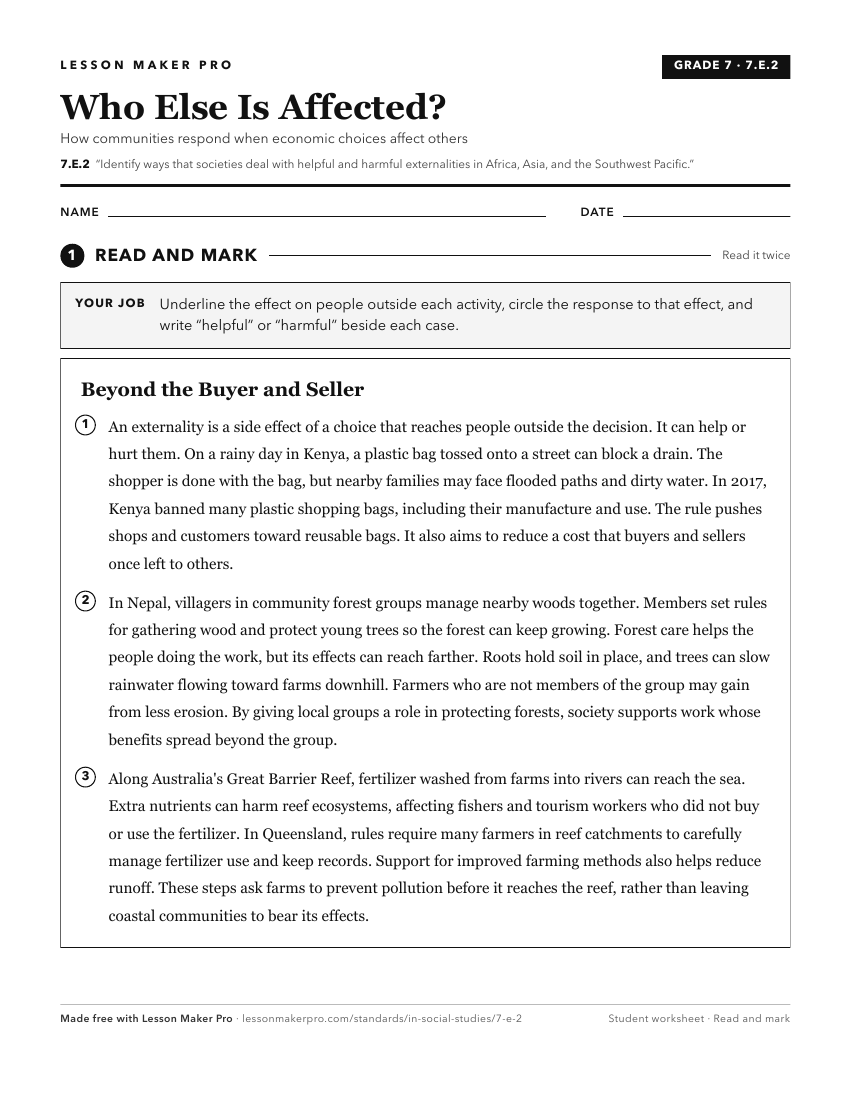
A ready-to-print activity worksheet aligned to 7.E.2, with an answer key for the teacher on its own page. No account needed.
PDF, US Letter, prints cleanly in black and white.
Download the worksheetKeep exploring
Related Standards
- 7.G.5
Compare and contrast the distribution of natural resources in Africa, Asia, and the Southwest Pacific; describe how natural resource distribution can impact the...
- 7.E.1
Evaluate the benefits and opportunity costs of voluntary trade and specialization on the standards of living in Africa, Asia, and the Southwest Pacific.
- WG.5.5
Identify examples from different world regions, involving the use and management of resources. Explain how different points of view influence policies relating ...
- 7.G.9
Analyze current issues and developments related to the environment in selected countries in Africa, Asia, and the Southwest Pacific.
Turn this exact standard into a lesson
Grade, subject, topic, and the complete standard are prefilled. Create one free, no account needed.
Also for this standard:Make a WorksheetMake a QuizMake a Sub Lesson