Indiana Social Studies 7.E.1
The Standard
Evaluate the benefits and opportunity costs of voluntary trade and specialization on the standards of living in Africa, Asia, and the Southwest Pacific.
2026 Indiana Academic Standards: K-12 Social Studies
Teacher's field guide
What This Standard Means
What Students Need to Do
- Students explain why people choose to trade goods they specialize in producing. They identify the next-best use of land, work hours, or resources given up. They judge how these choices affect jobs, food, and buying power in Africa, Asia, and the Southwest Pacific.
What Mastery Looks Like
- Given short accounts of Ghanaian cocoa, Vietnamese shirts, and Fijian tuna exports, a student identifies a benefit and a forgone use of resources in each place. They explain who may gain income or goods and who may miss out.
Common Misconceptions
- Students may call the price of an imported good its opportunity cost, rather than naming what else the resources could have produced. They may also assume export income reaches every household or that more trade always improves daily life.
How to Assess It
- Exit ticket: For Ghanaian cocoa, Vietnamese shirts, and Fijian tuna exports, fill in one benefit, one next-best use of resources given up, and one possible effect on daily life.
Lesson moves
Ways to Teach It
Give groups 12 land counters to divide between Ghanaian cocoa and food crops, then exchange cocoa cards for rice cards.
Ask: A Vietnamese worker sews shirts for export instead of growing food. How might the family's meals and income change?
Play a card sort matching Ghanaian cocoa, Vietnamese shirts, and Fijian tuna to export benefits, forgone uses, and household effects.
Read a shirt's made-in label; map the country, then name a possible benefit and a forgone use of time for its maker.
Free download
Printable 7.E.1 Worksheet
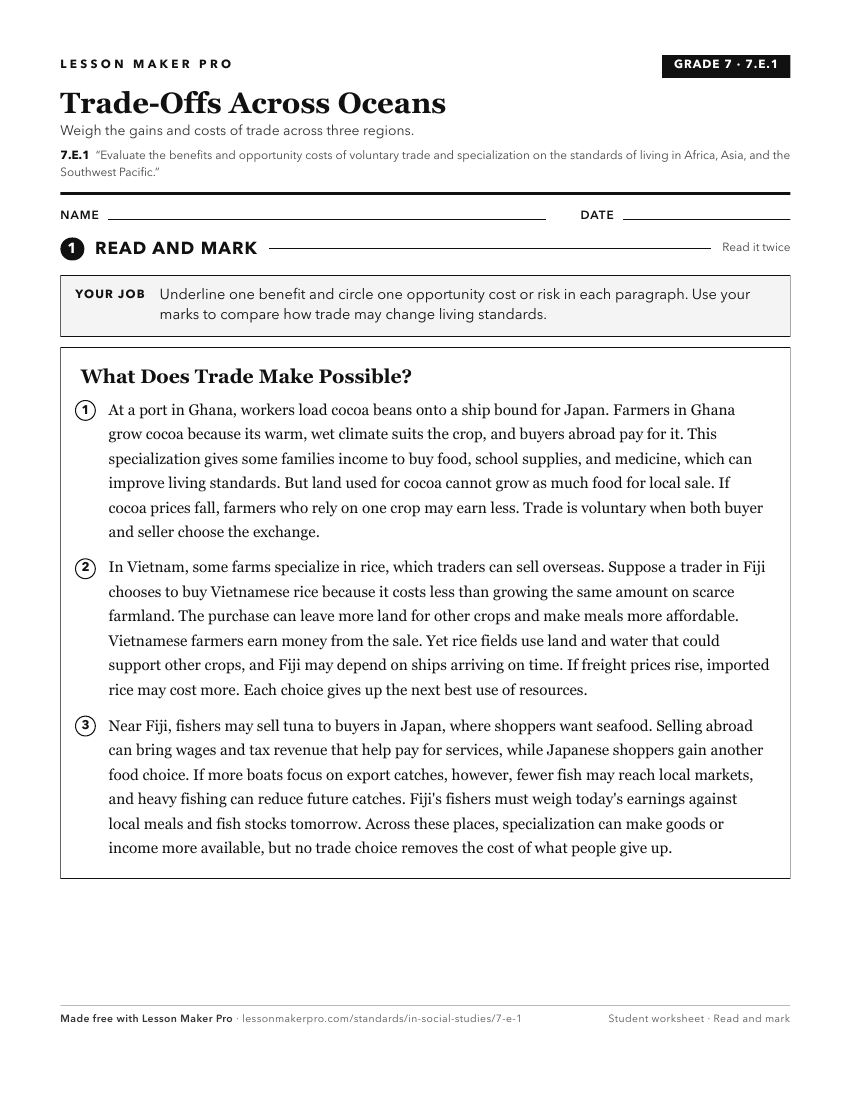
A ready-to-print activity worksheet aligned to 7.E.1, with an answer key for the teacher on its own page. No account needed.
PDF, US Letter, prints cleanly in black and white.
Download the worksheetKeep exploring
Related Standards
- 7.G.5
Compare and contrast the distribution of natural resources in Africa, Asia, and the Southwest Pacific; describe how natural resource distribution can impact the...
- GE.8.2
Compare and contrast the arguments for and against free trade.
- 7.E.2
Identify ways that societies deal with helpful and harmful externalities in Africa, Asia, and the Southwest Pacific.
- GE.4.6
Evaluate the effects of trade agreements among nations and barriers to trade.
Turn this exact standard into a lesson
Grade, subject, topic, and the complete standard are prefilled. Create one free, no account needed.
Also for this standard:Make a WorksheetMake a QuizMake a Sub Lesson