Indiana Social Studies GE.4.6
The Standard
Evaluate the effects of trade agreements among nations and barriers to trade.
2026 Indiana Academic Standards: K-12 Social Studies
Teacher's field guide
What This Standard Means
What Students Need to Do
- Students explain how trade agreements, tariffs, and quotas change what countries buy and sell. They use evidence to judge the effects on shoppers, businesses, and workers in each country.
What Mastery Looks Like
- Given a shoe trade deal, a student uses price and sales figures to explain likely gains for buyers and exporters. They can also explain why competing local factories might lose sales, and how a tariff or quota could change the outcome.
Common Misconceptions
- Students may assume a trade deal helps every worker or that a foreign government pays a tariff. They may confuse a quota, which limits the amount imported, with a tariff, which adds a cost.
How to Assess It
- Exit ticket: Two countries remove a tariff on imported shoes, and the price falls from $60 to $50. Name one group likely to gain and one likely to lose, and explain each answer.
Lesson moves
Ways to Teach It
Give buyers $12 in play money, local shoe cards priced $12, and import cards priced $10; add a $5 tariff and tally sales.
Ask students to write who gains and who loses when two countries remove shoe tariffs, using the price cards as evidence.
Have pairs sort six scenario cards into tariff, quota, or trade agreement, then predict one likely effect of each.
Show a clothing tag with its country of origin and a price; ask how an import tariff might affect its price.
Free download
Printable GE.4.6 Worksheet
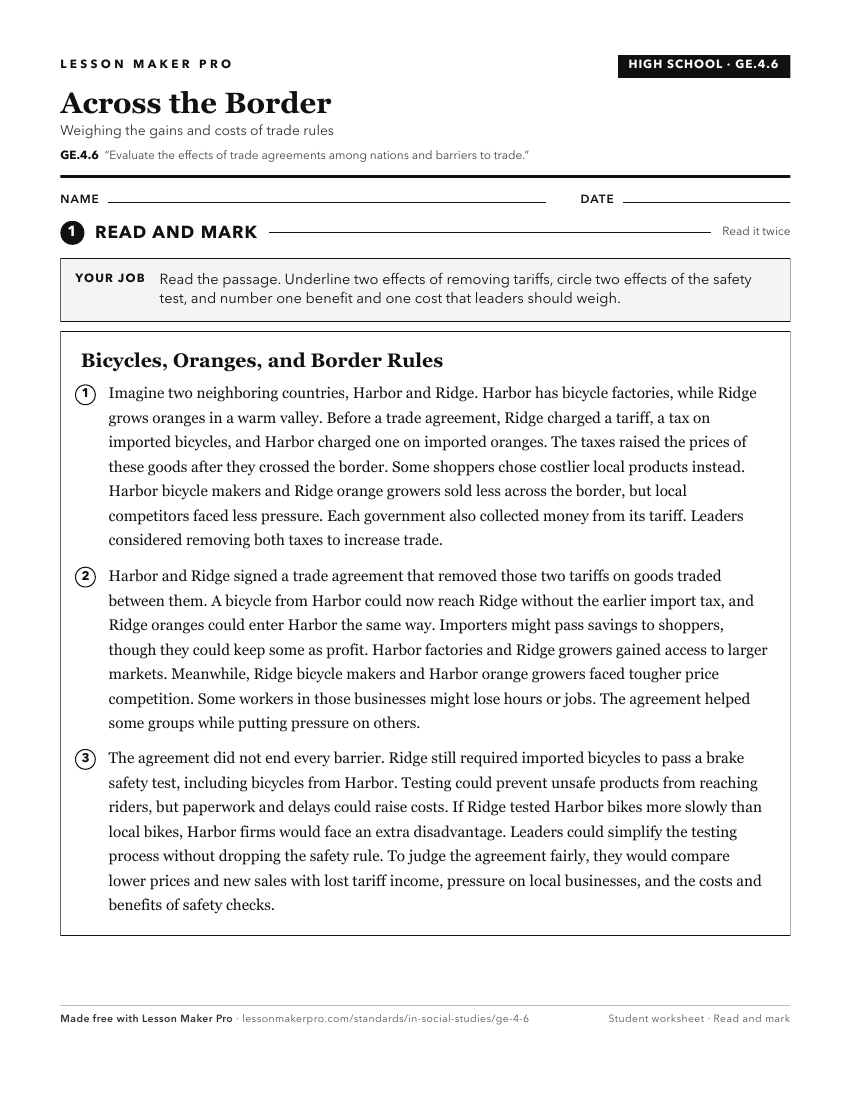
A ready-to-print activity worksheet aligned to GE.4.6, with an answer key for the teacher on its own page. No account needed.
PDF, US Letter, prints cleanly in black and white.
Download the worksheetKeep exploring
Related Standards
- GE.8.1
Define and explain the impact of trade barriers, such as quotas and tariffs, and analyze why countries erect them.
- GE.8.2
Compare and contrast the arguments for and against free trade.
- 5.E.4
Define types of trade barriers and predict the effect of changes in supply and demand on price.
- 7.E.1
Evaluate the benefits and opportunity costs of voluntary trade and specialization on the standards of living in Africa, Asia, and the Southwest Pacific.
Turn this exact standard into a lesson
Grade, subject, topic, and the complete standard are prefilled. Create one free, no account needed.
Also for this standard:Make a WorksheetMake a QuizMake a Sub Lesson