Indiana Social Studies WG.5.5
The Standard
Identify examples from different world regions, involving the use and management of resources. Explain how different points of view influence policies relating to the use of these resources.
2026 Indiana Academic Standards: K-12 Social Studies
Teacher's field guide
What This Standard Means
What Students Need to Do
- Students identify how forests in colonial India and rubber in the Congo were used and controlled. They explain why officials, companies, and local communities wanted different rules for those resources.
What Mastery Looks Like
- A student can name who set India's forest rules and Congo's rubber quotas, and who gained control or bore the costs. They can explain how each group's goals shaped the rule it supported.
Common Misconceptions
- Students may see forest reserves as only a way to protect trees, missing the demand for railway timber. They may assume local people agreed with colonial officials or had equal power to set the rules.
How to Assess It
- Exit ticket: For India's forest reserves and Congo's rubber quotas, name the resource and rule, then explain why officials and local people viewed one rule differently.
Lesson moves
Ways to Teach It
Give pairs paper forest-use tokens and role cards for Indian villagers, railway builders, and British officials; have them set access rules.
Ask: Who benefited from India's 1878 forest reserves, and who lost access to firewood? Write a rule that addresses both viewpoints.
Give teams claim cards about railway timber, village firewood, rubber profits, and forced collection; have them match each to a policy and viewpoint.
Show a park's 'No firewood collection' sign; have students compare visitor and ranger viewpoints with villagers and officials in colonial India.
Free download
Printable WG.5.5 Worksheet
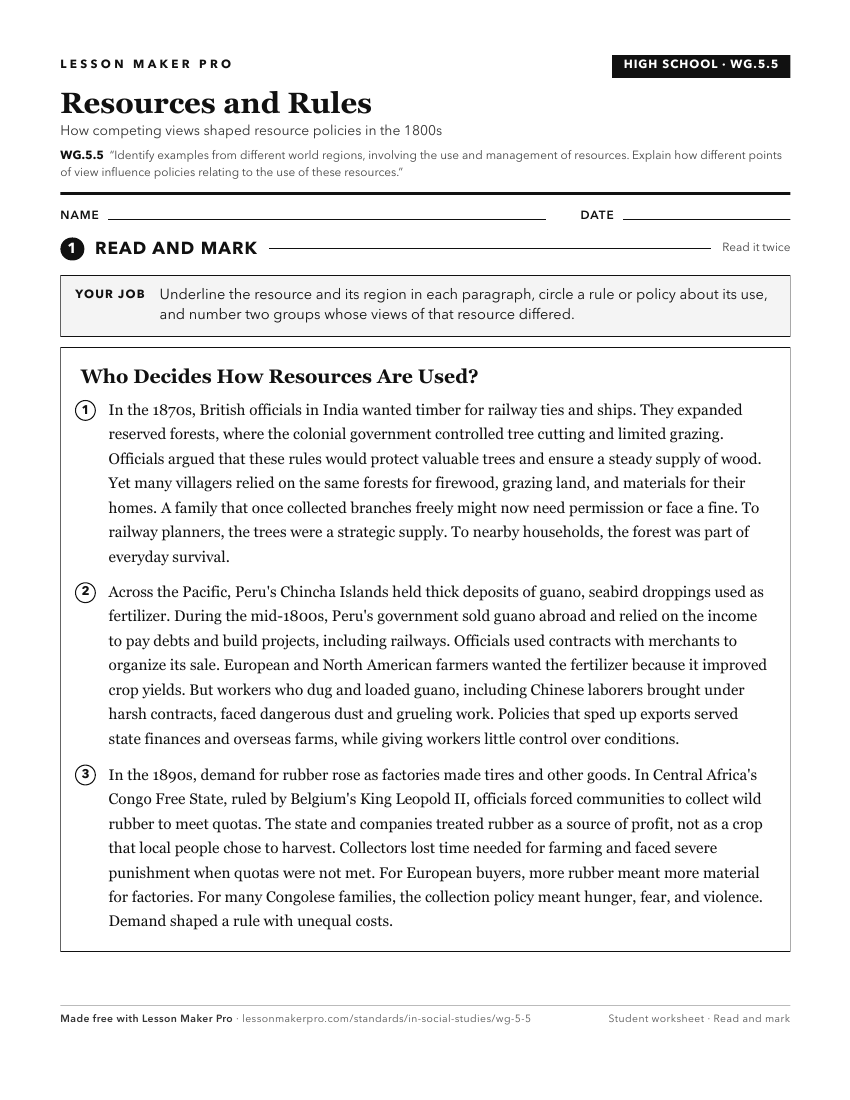
A ready-to-print activity worksheet aligned to WG.5.5, with an answer key for the teacher on its own page. No account needed.
PDF, US Letter, prints cleanly in black and white.
Download the worksheetKeep exploring
Related Standards
- 7.G.5
Compare and contrast the distribution of natural resources in Africa, Asia, and the Southwest Pacific; describe how natural resource distribution can impact the...
- WG.5.6
Create basic policies designed to guide the use and management of Earth’s resources and that reflect multiple points of view.
- WG.5.4
Identify patterns of world resource distribution and utilization, and explain the impacts of using renewable and nonrenewable resources.
- GHW.8.1
Use maps to show the location and distribution of Earth’s resources, and analyze how this distribution changes over time and affects trade among countries, regi...
Turn this exact standard into a lesson
Grade, subject, topic, and the complete standard are prefilled. Create one free, no account needed.
Also for this standard:Make a WorksheetMake a QuizMake a Sub Lesson