Indiana Social Studies S.3.2
The Standard
Explore the contributions of George Herbert Mead and Charles Horton Cooley to the development of theories of self-concept and how the self-concept is formed.
2026 Indiana Academic Standards: K-12 Social Studies
Teacher's field guide
What This Standard Means
What Students Need to Do
- Students explain how interactions with other people shape how someone sees themselves. They use Mead's ideas about role-taking and the 'I' and 'me,' along with Cooley's looking-glass self, to explain everyday choices.
What Mastery Looks Like
- Given a classroom example, students can identify a spontaneous response as Mead's 'I' and a learned social expectation as the 'me.' They can explain how an imagined judgment from others might change someone's self-image.
Common Misconceptions
- Students may think Cooley's looking-glass self is about physical appearance. They may assume an imagined judgment is what others actually think, or treat Mead's 'I' and 'me' as two separate people.
How to Assess It
- Exit ticket: A student wants to speak in a new club but stays quiet, thinking others will call the idea silly. Explain the student's response using Mead's 'I' and 'me,' then explain the imagined judgment using Cooley's idea.
Lesson moves
Ways to Teach It
Give pairs role cards for a first-day class introduction; have them act it out, then mark spontaneous responses and expected peer reactions.
Ask students to explain a classmate dropping a favorite jacket after a friend laughs, using Mead's 'me' and Cooley's imagined judgment.
Run a two-minute annotation race with a lunch-table story: circle a spontaneous response, underline a learned social rule, and box an imagined judgment.
Show a sample group chat message about a missed party; students write how imagined replies might change the sender's next post.
Free download
Printable S.3.2 Worksheet
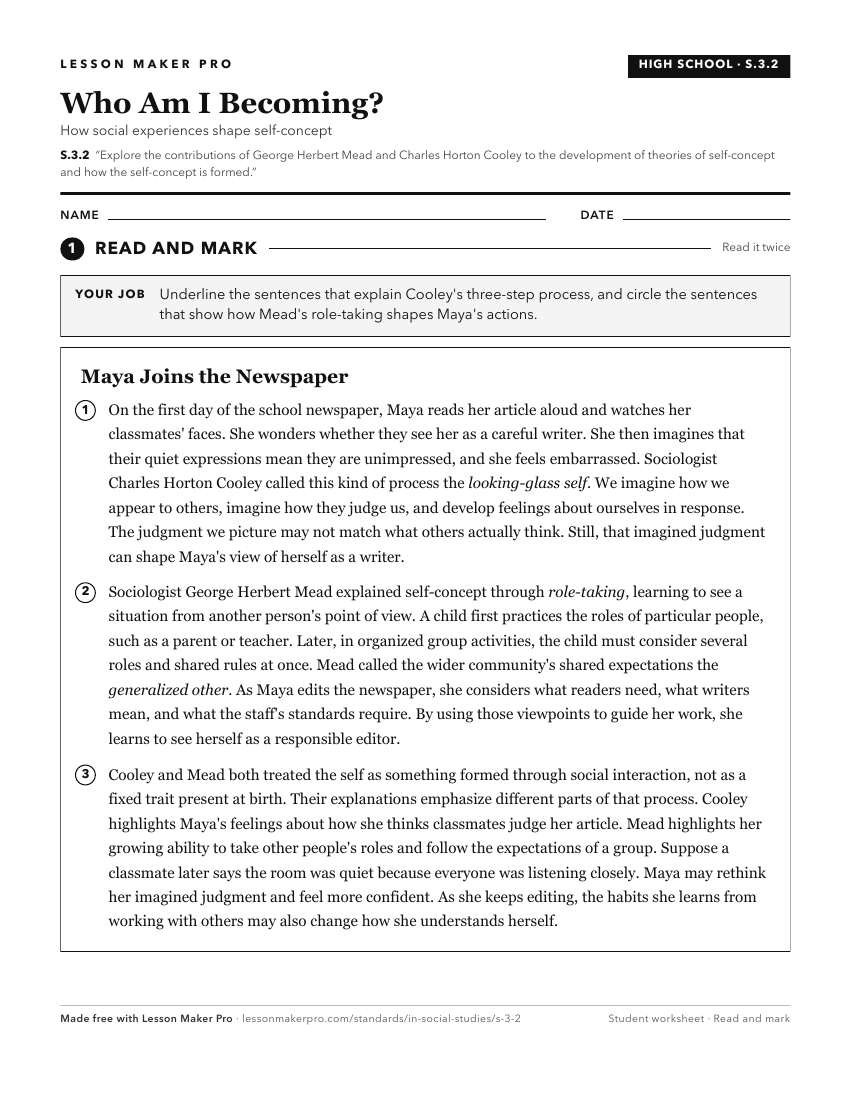
A ready-to-print activity worksheet aligned to S.3.2, with an answer key for the teacher on its own page. No account needed.
PDF, US Letter, prints cleanly in black and white.
Download the worksheetKeep exploring
Related Standards
- S.8.7
Discuss theories that attempt to explain collective behavior.
- P.5.6
Evaluate the influences of variables, such as culture (belonging to an individualist or collectivist culture), family, and genetics, on personality development ...
- P.4.8
Identify key psychologists in the fields of learning and cognition, including Pavlov, Skinner, and Bandura and explain the impact of their contributions.
- P.3.6
Describe the theories of various developmental psychologists such as Piaget, Vygotsky, Freud, and Erikson.
Turn this exact standard into a lesson
Grade, subject, topic, and the complete standard are prefilled. Create one free, no account needed.
Also for this standard:Make a WorksheetMake a QuizMake a Sub Lesson