Indiana Social Studies IS.1.15
The Standard
Assess the impact of the Women’s Suffrage Movement on the residents of Indiana.
2026 Indiana Academic Standards: K-12 Social Studies · Progressive Era Politics, Economics, and Social Reform in Indiana: 1888 to 1920
Teacher's field guide
What This Standard Means
What Students Need to Do
- Students trace Indiana's 1917 voting law, its court reversal, and the state's 1920 ratification of the Nineteenth Amendment. They explain how women's suffrage changed who could vote in Indiana and who remained excluded.
What Mastery Looks Like
- Given voter lists from 1916 and 1920, students can identify who could vote in each election and explain why. They can explain why the 1917 law did not settle the issue.
Common Misconceptions
- Students may think the 1917 law stayed in force or that a vote in Congress gave Indiana women the vote right away. Some assume every woman could vote in 1920, regardless of age or citizenship.
How to Assess It
- On an exit ticket, ask: “How did suffrage change who could vote in Indiana state elections between 1916 and November 1920? Name one person who still could not vote.”
Lesson moves
Ways to Teach It
Give pairs Indiana resident role cards and paper ballots labeled 1916 and 1920; have them sort eligible voters and count the ballots.
Show short accounts from an Indiana suffrage supporter and opponent; ask students to write who each thought would be affected and how.
Play a timeline relay: teams order cards for the 1917 law, its court reversal, and 1920 ratification, then explain the order.
Compare a teacher-made 1920 Indiana voter rule card with Indiana's current registration rules; have students mark the voting-age change.
Free download
Printable IS.1.15 Worksheet
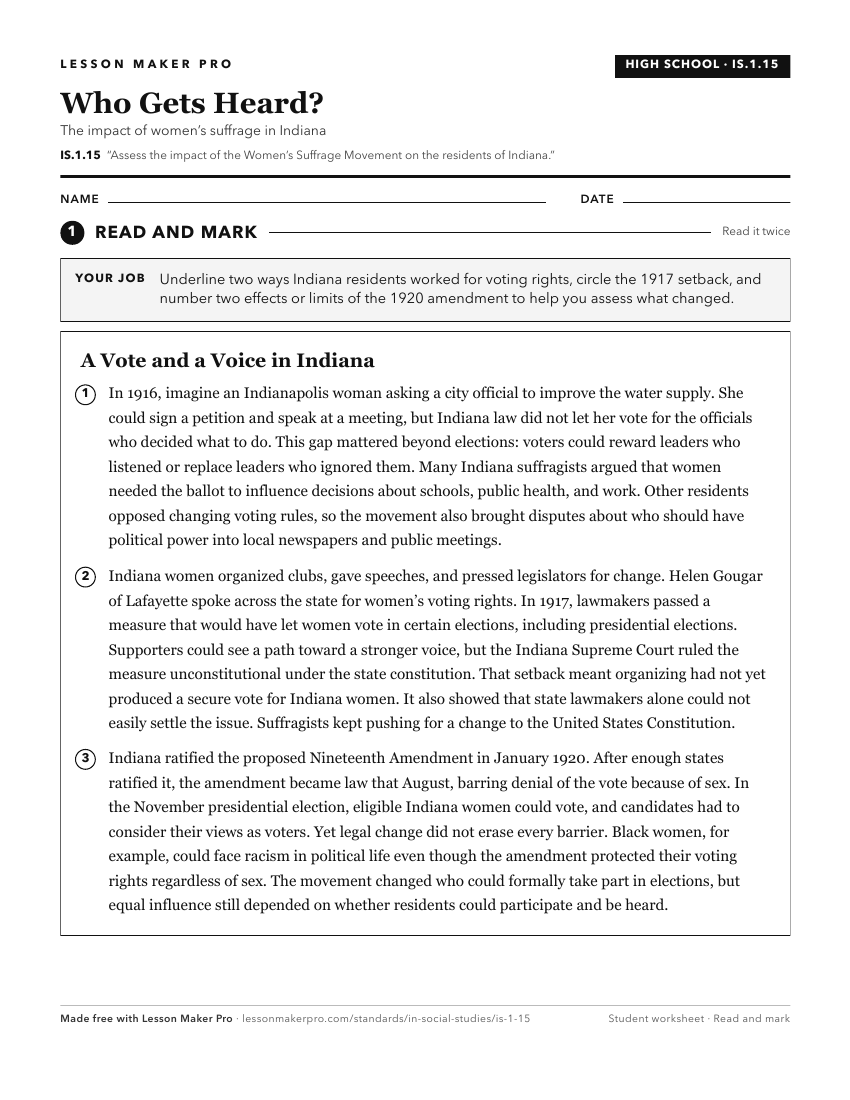
A ready-to-print activity worksheet aligned to IS.1.15, with an answer key for the teacher on its own page. No account needed.
PDF, US Letter, prints cleanly in black and white.
Download the worksheetKeep exploring
Related Standards
- IS.1.26
Summarize and assess the various actions which characterized the early struggle for civil rights and racial equality in Indiana.
- IS.1.27
Examine the impact of the Civil Rights Movement of the 1960s and 1970s in Indiana through the actions of leaders and groups that were active in the movement.
- IS.1.18
Assess the social and cultural impacts of the Red Scare, Prohibition, Religious Fundamentalism, the KKK, New Morality, and the New Woman in the post-WWI era as ...
- IS.1.17
Identify the social, political, economic, and cultural movements of the 1920s and analyze how these movements reflected and shaped Indiana society.
Turn this exact standard into a lesson
Grade, subject, topic, and the complete standard are prefilled. Create one free, no account needed.
Also for this standard:Make a WorksheetMake a QuizMake a Sub Lesson