Indiana Social Studies GE.6.7
The Standard
Demonstrate how supply and demand determine equilibrium price and quantity in the financial markets.
2026 Indiana Academic Standards: K-12 Social Studies
Teacher's field guide
What This Standard Means
What Students Need to Do
- Students treat the interest rate as the price of borrowing money and the amount lent as the quantity. They use the supply of savings and the demand for loans to find the market rate and amount lent.
What Mastery Looks Like
- On a graph, students mark the interest rate and amount lent where the lines cross. If more people save, they shift supply right and predict a lower rate and more lending.
Common Misconceptions
- Some students call the amount borrowed the price instead of the interest rate. Others think a higher rate makes people borrow more, or shift the wrong line when savings change.
How to Assess It
- At rates of 3%, 5%, and 7%, lenders offer $20,000, $40,000, and $60,000, while borrowers want $60,000, $40,000, and $20,000. Ask students to name the market rate and amount lent.
Lesson moves
Ways to Teach It
Give half the class $100 lender cards with minimum rates and half borrower cards with maximum rates; let them bargain and tally completed loans.
Ask, 'If more households save at each interest rate, what happens to the rate and amount lent?' Have students sketch their answer.
Give teams three loan-market graphs; call out 'more savers,' 'fewer borrowers,' and 'more borrowers,' then have them mark each new intersection.
Show mock car-loan ads at 4% and 9%; ask which rate would make more buyers seek a loan and why.
Free download
Printable GE.6.7 Worksheet
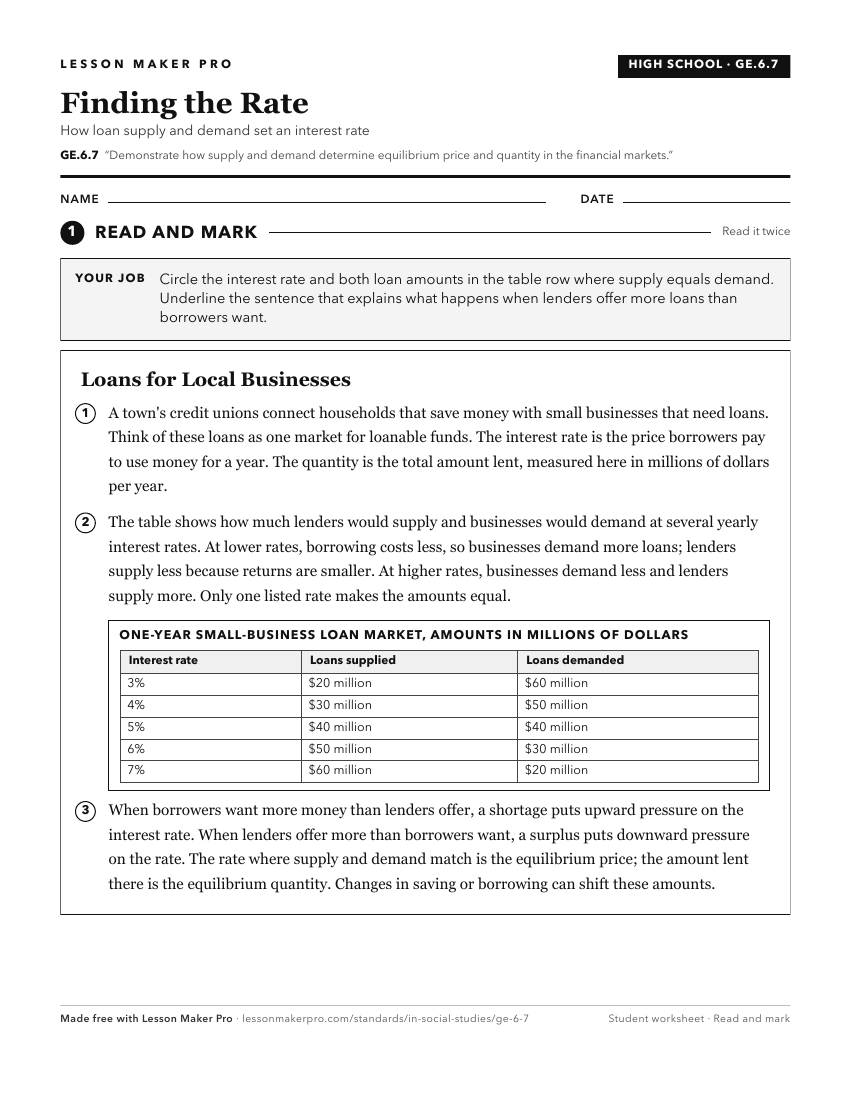
A ready-to-print activity worksheet aligned to GE.6.7, with an answer key for the teacher on its own page. No account needed.
PDF, US Letter, prints cleanly in black and white.
Download the worksheetKeep exploring
Related Standards
- GE.3.2
Analyze the relationships between price, quantity, supply, demand, and equilibrium.
- E.2.4
Identify factors that cause changes in market supply and demand and how these changes affect price and quantity in a competitive market.
- E.2.3
Provide examples of how supply and demand determine equilibrium price and quantity.
- E.3.3
Explain how competition in markets affects price and quantity.
Turn this exact standard into a lesson
Grade, subject, topic, and the complete standard are prefilled. Create one free, no account needed.
Also for this standard:Make a WorksheetMake a QuizMake a Sub Lesson