Indiana Social Studies GE.3.2
The Standard
Analyze the relationships between price, quantity, supply, demand, and equilibrium.
2026 Indiana Academic Standards: K-12 Social Studies
Teacher's field guide
What This Standard Means
What Students Need to Do
- Students use a graph or table to find the price where buyers want to buy the same quantity sellers want to sell. They predict how price and quantity change when demand or supply changes.
What Mastery Looks Like
- Given a table, students find the price where quantity demanded equals quantity supplied. They move the correct curve on a graph and predict the new price and quantity. They explain why prices above that point cause surpluses and prices below it cause shortages.
Common Misconceptions
- Students may think a higher price increases demand, rather than reducing the quantity demanded. They may shift the whole supply curve when only price changes. Some think equilibrium means a fair price, rather than a price where quantities match.
How to Assess It
- Ask students to sketch supply and demand for concert tickets, shift demand right, circle the new crossing, and state how price and quantity change.
Lesson moves
Ways to Teach It
Give pairs price cards with buyer and seller quantities; have them line up matching prices and flag where the quantities match.
Ask: Why might a concert ticket sell out at $20 but sit unsold at $200? Have students explain using supply and demand.
Call out a supply or demand change; teams sketch the shifted curve and write the new direction of price and quantity.
Show grocery flyers with egg prices from two weeks; ask students to suggest a supply or demand change that could explain the difference.
Free download
Printable GE.3.2 Worksheet
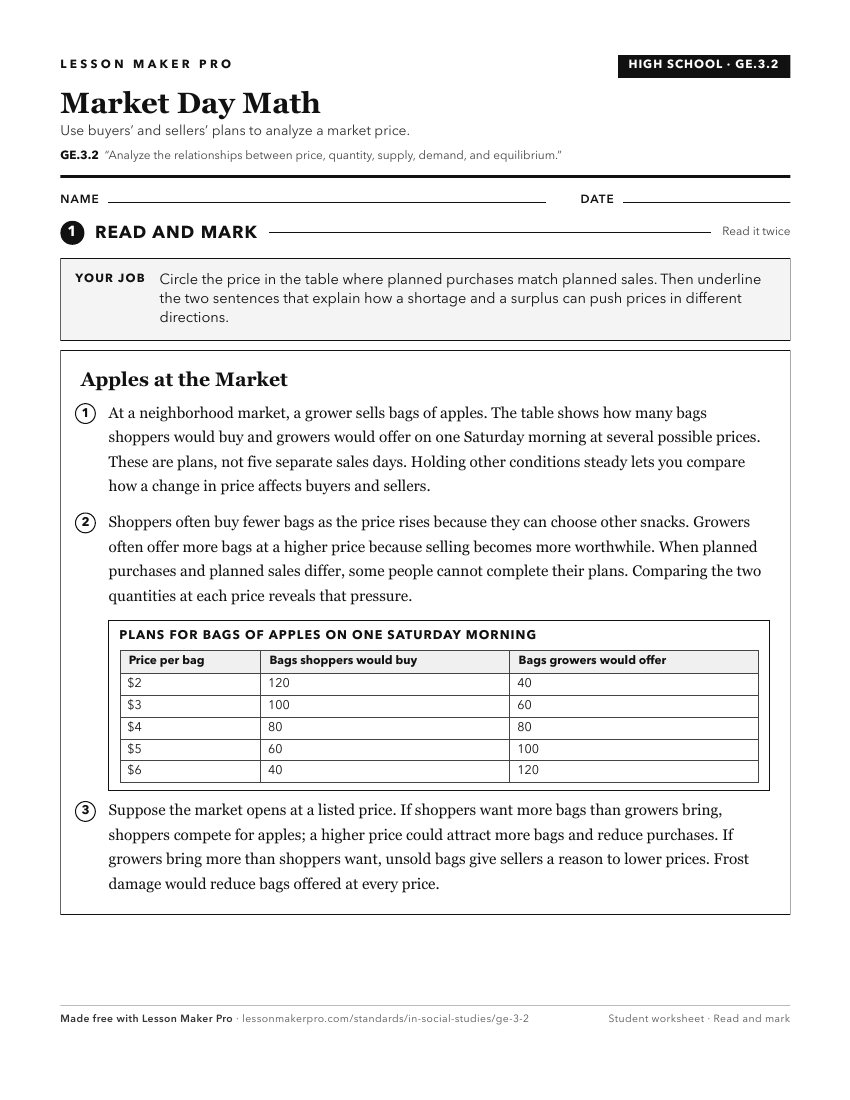
A ready-to-print activity worksheet aligned to GE.3.2, with an answer key for the teacher on its own page. No account needed.
PDF, US Letter, prints cleanly in black and white.
Download the worksheetKeep exploring
Related Standards
- GE.6.7
Demonstrate how supply and demand determine equilibrium price and quantity in the financial markets.
- E.2.4
Identify factors that cause changes in market supply and demand and how these changes affect price and quantity in a competitive market.
- E.2.3
Provide examples of how supply and demand determine equilibrium price and quantity.
- 4.E.3
Explain that prices change as a result of changes in supply and demand for specific products.
Turn this exact standard into a lesson
Grade, subject, topic, and the complete standard are prefilled. Create one free, no account needed.
Also for this standard:Make a WorksheetMake a QuizMake a Sub Lesson