Indiana Social Studies E.2.3
The Standard
Provide examples of how supply and demand determine equilibrium price and quantity.
2026 Indiana Academic Standards: K-12 Social Studies · Students explain that because resources are limited, people must make choices, understanding the role that supply, demand, prices, and profits play in a market economy. Key elements of the course include study of scarcity and economic reasoning, supply and demand, market structures, the role of government, national economic performance, the role of financial institutions, economic stabilization, and trade.
Teacher's field guide
What This Standard Means
What Students Need to Do
- Students compare how many buyers want an item and how many sellers offer it at different prices. They find the price where those amounts match and name the number sold. They use examples to show what changes when buyers want more or sellers offer less.
What Mastery Looks Like
- Given a ticket price table, a student finds where tickets wanted equal tickets offered. They report both the price and the number of tickets sold. They explain why a shortage puts pressure on the price to rise.
Common Misconceptions
- Students may pick the lowest price, even when more buyers want tickets than sellers offer. They may mix up a shortage and a surplus. Some predict that more buyers will raise the price but leave the number sold unchanged.
How to Assess It
- Exit ticket: At $5, buyers want 80 tickets and sellers offer 20. At $10, both amounts are 50. At $15, buyers want 20 and sellers offer 80. What are the equilibrium price and quantity, and why would $5 not last?
Lesson moves
Ways to Teach It
Hand out buyer maximum-price and seller minimum-price cards, then tally willing buyers and sellers at $5, $10, and $15.
Ask: More students want smoothies at lunch; what happens to the price and number sold if vendors can make more?
Run a price-match game: pairs find equal quantities in ticket supply and demand tables, then explain one shortage or surplus.
Show a strawberry price in a grocery flyer, then give students a note about crop damage and ask them to predict the new price and quantity sold.
Free download
Printable E.2.3 Worksheet
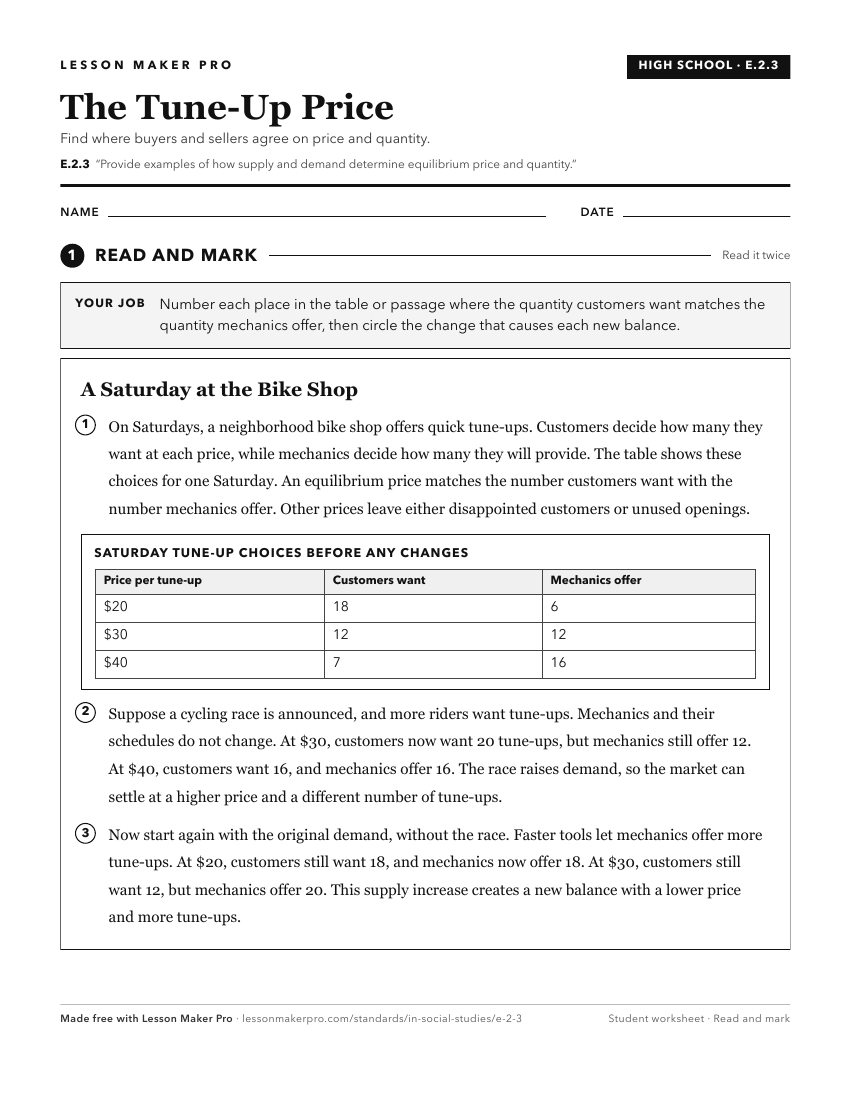
A ready-to-print activity worksheet aligned to E.2.3, with an answer key for the teacher on its own page. No account needed.
PDF, US Letter, prints cleanly in black and white.
Download the worksheetKeep exploring
Related Standards
- GE.3.2
Analyze the relationships between price, quantity, supply, demand, and equilibrium.
- GE.6.7
Demonstrate how supply and demand determine equilibrium price and quantity in the financial markets.
- E.2.4
Identify factors that cause changes in market supply and demand and how these changes affect price and quantity in a competitive market.
- E.3.3
Explain how competition in markets affects price and quantity.
Turn this exact standard into a lesson
Grade, subject, topic, and the complete standard are prefilled. Create one free, no account needed.
Also for this standard:Make a WorksheetMake a QuizMake a Sub Lesson