Indiana Social Studies GE.6.3
The Standard
Demonstrate how banks create money through the principle of fractional reserve banking.
2026 Indiana Academic Standards: K-12 Social Studies
Teacher's field guide
What This Standard Means
What Students Need to Do
- Students trace a deposit, a loan, and the next deposit across banks. They calculate how lending adds to bank deposits under a stated classroom reserve rule.
What Mastery Looks Like
- With a $100 deposit and a hypothetical 10% reserve rule, students show a $90 loan followed by an $81 loan. They explain that deposit balances grow, but no new paper bills are printed.
Common Misconceptions
- Students may think banks print cash when they lend, or that the same $100 can be lent repeatedly without being recorded as deposits. They may mistake the classroom reserve percentage for a rule every bank must follow.
How to Assess It
- Exit ticket: A bank receives a $100 deposit and keeps 10% under a classroom rule. Show the next two loans if each loan is deposited at another bank, then name what increases.
Lesson moves
Ways to Teach It
Give three groups bank ledgers and deposit slips; have them record a $100 deposit, then $90 and $81 loans under a hypothetical 10% rule.
Ask: “When a bank makes a $90 loan, did it print $90 in cash?” Have students explain where the deposit appears.
Run a bank relay: teams calculate the next loan from a deposit card using a 10% classroom rule, then check another team’s ledger.
Draw how a mortgage loan becomes the home seller’s bank deposit when the buyer pays for the house.
Free download
Printable GE.6.3 Worksheet
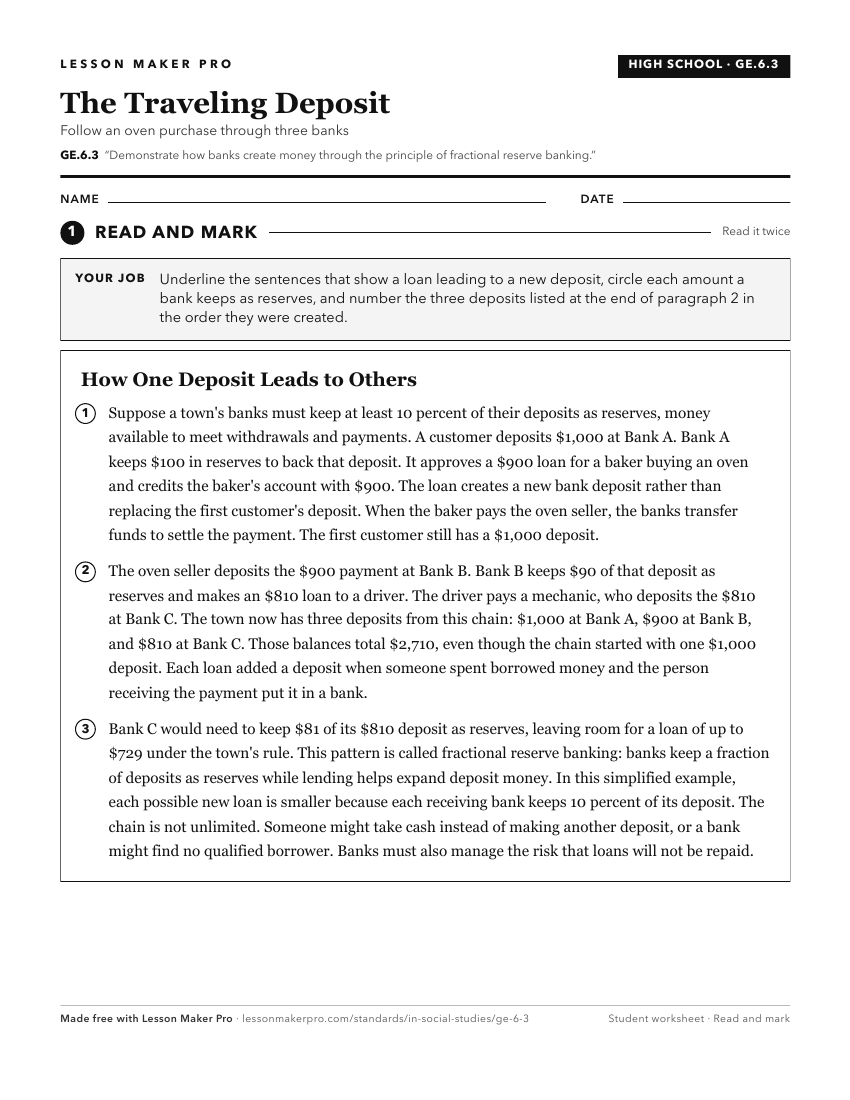
A ready-to-print activity worksheet aligned to GE.6.3, with an answer key for the teacher on its own page. No account needed.
PDF, US Letter, prints cleanly in black and white.
Download the worksheetKeep exploring
Related Standards
- GE.7.5
Analyze how the Federal Reserve uses monetary policy to promote price stability, full employment, and economic growth.
- GE.5.1
Explain the role of the Federal Reserve in the U.S. economy, as well as the functions of its counterparts in other countries.
- GE.6.7
Demonstrate how supply and demand determine equilibrium price and quantity in the financial markets.
- GE.6.1
Explain the basic functions of money.
Turn this exact standard into a lesson
Grade, subject, topic, and the complete standard are prefilled. Create one free, no account needed.
Also for this standard:Make a WorksheetMake a QuizMake a Sub Lesson