Indiana Social Studies GE.6.1
The Standard
Explain the basic functions of money.
2026 Indiana Academic Standards: K-12 Social Studies
Teacher's field guide
What This Standard Means
What Students Need to Do
- Students explain how money lets people trade without barter, compare prices, and save value for later. They identify these uses in everyday situations.
What Mastery Looks Like
- A student can label money as a medium of exchange, a unit of account, or a store of value in a given example. They can explain why inflation may reduce what saved money can buy.
Common Misconceptions
- Students may think money means only cash, even though bank deposits can serve the same functions. They may think saved dollars will always buy the same amount later.
How to Assess It
- Exit ticket: You buy a $4 snack, compare it with a $6 sandwich, and save $3 for Friday. Name the function of money shown in each action.
Lesson moves
Ways to Teach It
Give pairs item cards and have them try to barter, then repeat the trades using paper money.
Ask students to write why a menu lists prices in dollars instead of listing what each meal could be traded for.
Have teams sort scenario cards labeled buying, comparing prices, or saving into the three functions of money.
Use a grocery receipt to compare two prices, then ask what might change the cost of those items next year.
Free download
Printable GE.6.1 Worksheet
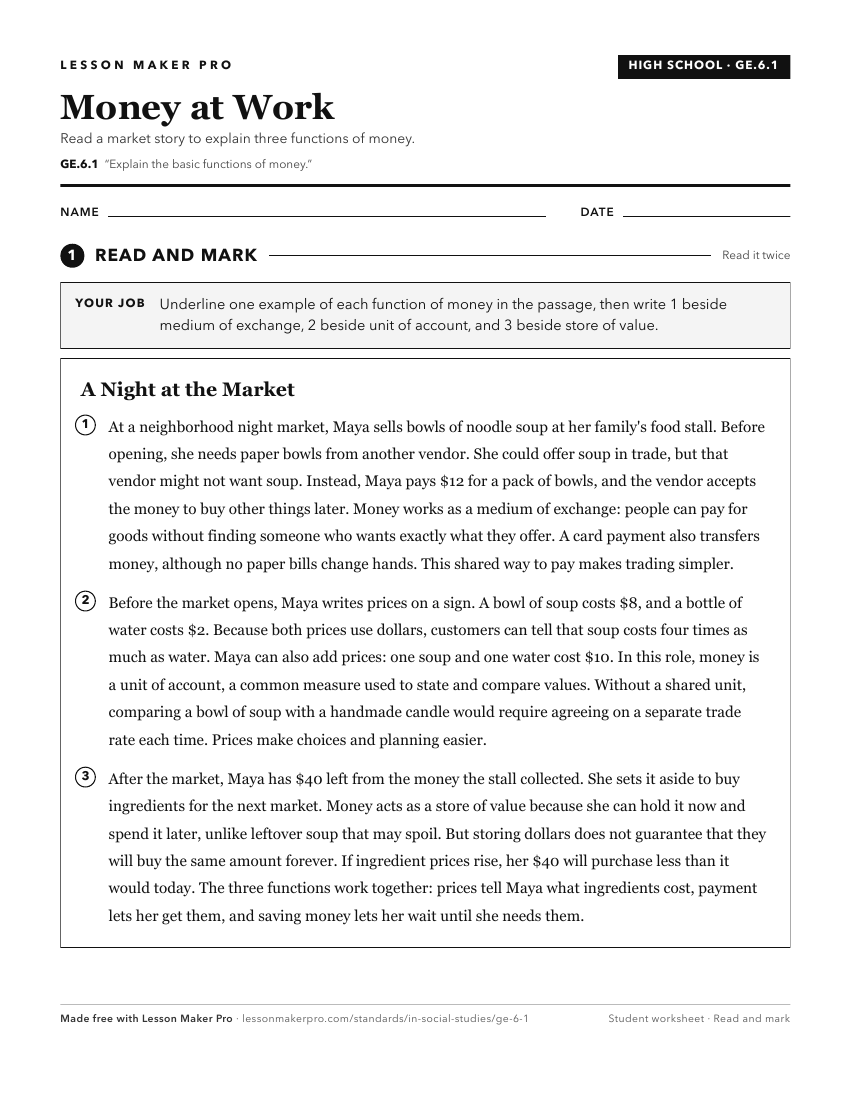
A ready-to-print activity worksheet aligned to GE.6.1, with an answer key for the teacher on its own page. No account needed.
PDF, US Letter, prints cleanly in black and white.
Download the worksheetKeep exploring
Related Standards
- GE.5.3
Define money and explain why it has value.
- 3.E.5
List the characteristics of money, and explain how money makes trade and the purchase of goods easier.
- 2.E.4
Explain why people trade for goods and services, and explain how money makes trade easier.
- 4.E.4
List the functions of money, and compare and contrast things that have been used as money in the past in Indiana, the United States, and the world.
Turn this exact standard into a lesson
Grade, subject, topic, and the complete standard are prefilled. Create one free, no account needed.
Also for this standard:Make a WorksheetMake a QuizMake a Sub Lesson