Indiana Social Studies GE.4.4
The Standard
Use the concepts of absolute advantage and comparative advantage to determine why a country may choose to produce a particular commodity rather than another.
2026 Indiana Academic Standards: K-12 Social Studies
Teacher's field guide
What This Standard Means
What Students Need to Do
- Students compare how much of two goods each country can make with the same resources. They find which country produces more outright and which gives up less to make each good. Then they explain why each country might choose one good to produce.
What Mastery Looks Like
- Given a two-country output table, a student identifies who can produce more of each good and calculates what each country gives up to make it. They can explain why a country might produce a good even when another country can make more of both.
Common Misconceptions
- Students may think the country that makes more of both goods should produce both. They may compare output totals without calculating what each country gives up. Some assume the country that produces less has nothing to gain from trade.
How to Assess It
- Exit ticket: In one day, A can make 12 bags of rice or 6 bolts of cloth; B can make 8 bags of rice or 2 bolts of cloth. Name each country's absolute and comparative advantages, then recommend one good for each to produce.
Lesson moves
Ways to Teach It
Give pairs output cards, A: 12 rice or 6 cloth, B: 8 rice or 2 cloth; have them build token piles and compare trade-offs.
Ask partners to explain why A might buy rice from B even though A can make more of both goods.
For a speed round, show A: 10 wheat or 5 shirts; B: 6 wheat or 2 shirts; have teams label each advantage.
Show Brazilian coffee and Canadian wheat labels; ask which output figures would test whether each export has a lower opportunity cost.
Free download
Printable GE.4.4 Worksheet
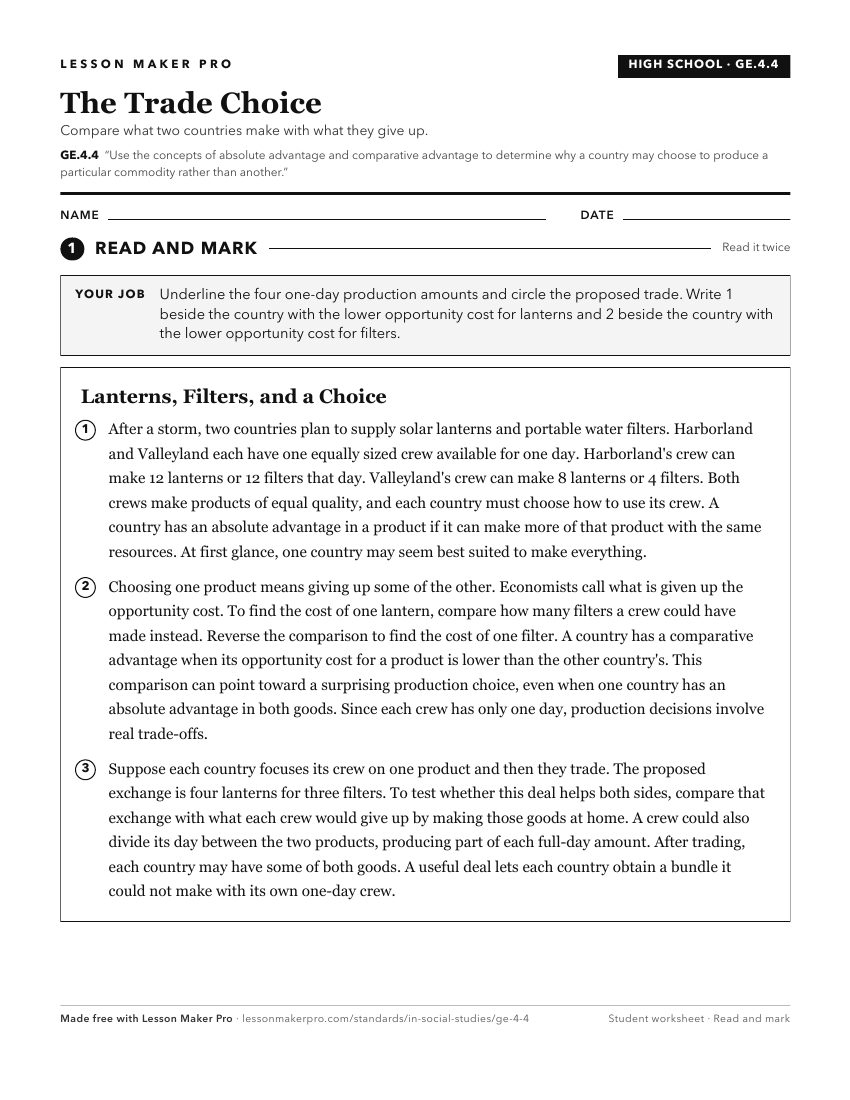
A ready-to-print activity worksheet aligned to GE.4.4, with an answer key for the teacher on its own page. No account needed.
PDF, US Letter, prints cleanly in black and white.
Download the worksheetKeep exploring
Related Standards
- 3.E.7
Illustrate how people compare benefits and costs when making choices and decisions as consumers and producers.
- E.2.2
Provide examples of how consumers ultimately determine what is produced in a market economy.
- E.1.5
Use a production possibilities curve to explain the concepts of choice, scarcity, opportunity cost, trade offs, efficiency, productivity, and growth.
- GE.1.4
Illustrate a production possibilities curve to explain the concepts of choice, scarcity, opportunity cost, trade-offs, unemployment, productivity, and growth.
Turn this exact standard into a lesson
Grade, subject, topic, and the complete standard are prefilled. Create one free, no account needed.
Also for this standard:Make a WorksheetMake a QuizMake a Sub Lesson