Indiana Social Studies 3.E.7
The Standard
Illustrate how people compare benefits and costs when making choices and decisions as consumers and producers.
2026 Indiana Academic Standards: K-12 Social Studies
Teacher's field guide
What This Standard Means
What Students Need to Do
- Students weigh what they gain against the money, time, or effort they give up. They explain choices as buyers and as people making goods to sell.
What Mastery Looks Like
- A student can choose between two priced snacks and explain what they gain and give up. They can also compare the cost of making two products with the money each might bring in.
Common Misconceptions
- Students may count only the price tag as a cost and forget time or materials. They may think the product with the higher selling price always earns more, even if it costs more to make.
How to Assess It
- Exit ticket: A buyer has $3 and can buy a $2 apple or $3 berries. A baker can make muffins for $4 and sell them for $7, or make cookies for $2 and sell them for $4. Ask students to choose for each person and name one benefit and one cost of each choice.
Lesson moves
Ways to Teach It
Give pairs paper and crayons to make $1 plain and $3 decorated bookmarks; time each and decide which is worth making.
Ask, 'Would you buy a $2 apple or a $3 orange? What do you gain, and what do you give up?'
Run a two-round shop with toy price cards and $5 play bills; have students pick purchases and write one tradeoff.
Show a bake sale price list and ingredient costs; have students choose a treat to make and calculate what they would earn.
Free download
Printable 3.E.7 Worksheet
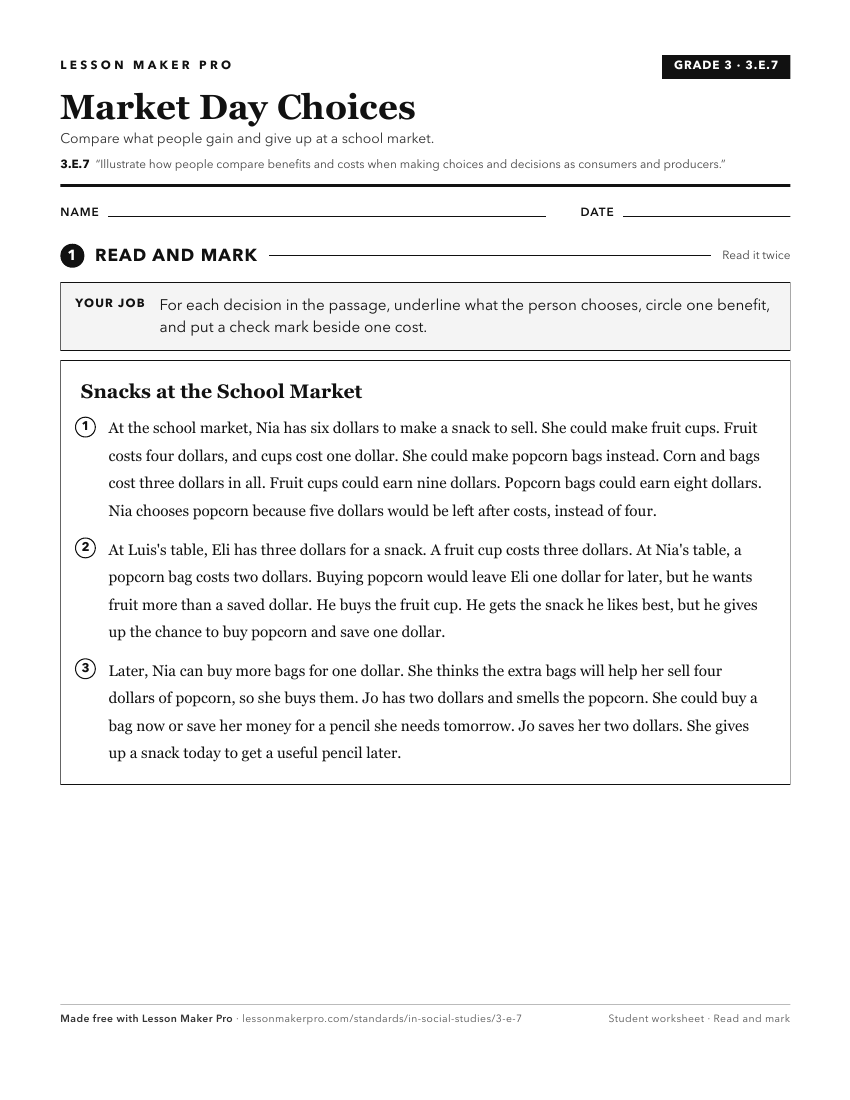
A ready-to-print activity worksheet aligned to 3.E.7, with an answer key for the teacher on its own page. No account needed.
PDF, US Letter, prints cleanly in black and white.
Download the worksheetKeep exploring
Related Standards
- E.2.2
Provide examples of how consumers ultimately determine what is produced in a market economy.
- E.1.5
Use a production possibilities curve to explain the concepts of choice, scarcity, opportunity cost, trade offs, efficiency, productivity, and growth.
- 2.E.1
Explain the price of and the product received from goods and services and the impact on consumers.
- GE.1.4
Illustrate a production possibilities curve to explain the concepts of choice, scarcity, opportunity cost, trade-offs, unemployment, productivity, and growth.
Turn this exact standard into a lesson
Grade, subject, topic, and the complete standard are prefilled. Create one free, no account needed.
Also for this standard:Make a WorksheetMake a QuizMake a Sub Lesson