Indiana Social Studies GE.2.6
The Standard
Explain and evaluate how and why government control influences businesses and individuals through laws and taxes.
2026 Indiana Academic Standards: K-12 Social Studies
Teacher's field guide
What This Standard Means
What Students Need to Do
- Students explain why governments set business rules and collect taxes. They trace how those choices may affect business costs, prices, wages, and household spending, then weigh benefits against costs.
What Mastery Looks Like
- Given a wage rule and a sales tax, a student can trace their different effects on a business and a household. They can explain each policy's goal and support a judgment with figures from the example.
Common Misconceptions
- Students may think a sales tax always comes out of a store's profits, rather than being collected from customers. They may assume a wage increase always causes layoffs, or that it never changes a business's costs.
How to Assess It
- Exit ticket: A café pays three workers $12 an hour for 20 hours each; a new law raises pay to $15, and a 5% sales tax applies to a $20 meal. Calculate the added weekly wage cost and the meal's tax, then name one goal and one tradeoff for each policy.
Lesson moves
Ways to Teach It
Give pairs a mock café budget, a minimum wage rule, and a sales tax rate; have them recalculate labor costs and a customer's bill.
Ask: Should a city raise sales tax to fund buses? Use a sample receipt and bus budget to argue who benefits and who pays.
Deal minimum wage, food safety, and sales tax cards; have teams match each to a business cost, a household effect, and a government goal.
Use a local sales tax receipt and city budget page to trace what a shopper pays, what the store collects, and what the city funds.
Free download
Printable GE.2.6 Worksheet
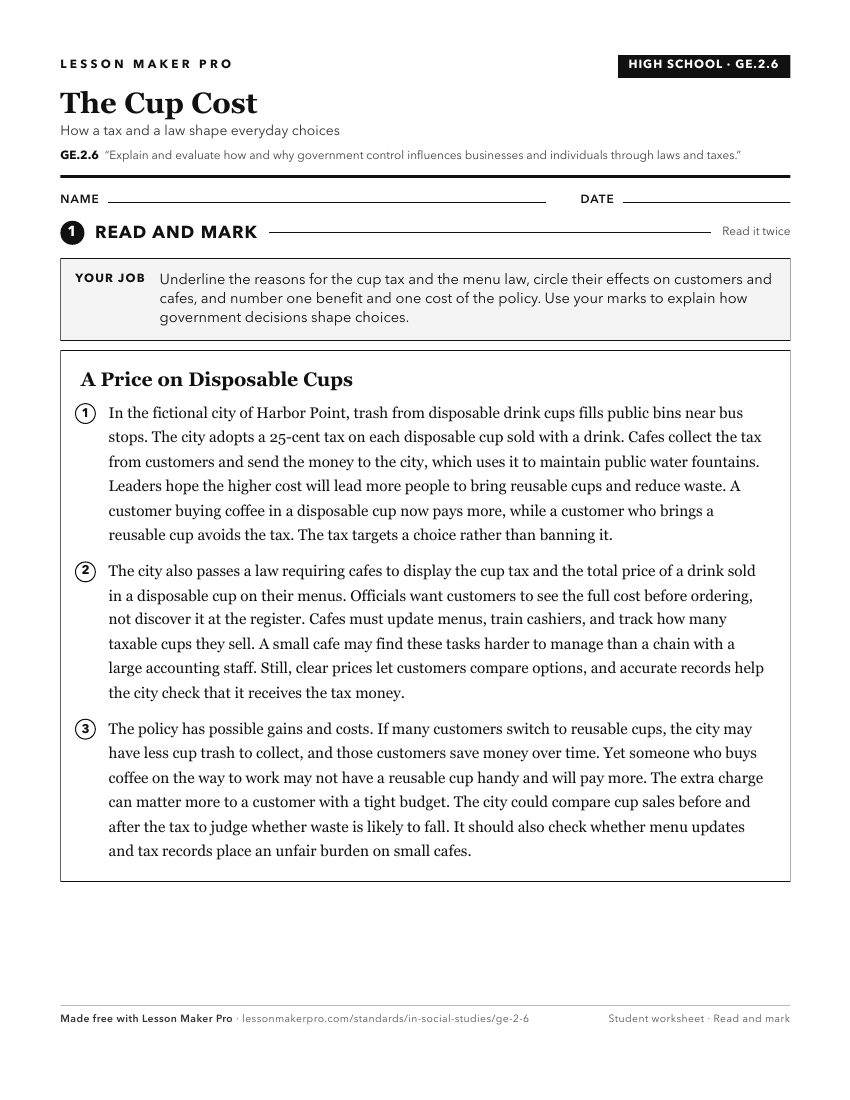
A ready-to-print activity worksheet aligned to GE.2.6, with an answer key for the teacher on its own page. No account needed.
PDF, US Letter, prints cleanly in black and white.
Download the worksheetKeep exploring
Related Standards
- 8.E.2
Explain how federal, state, and local governments are involved in the economy of the United States.
- E.4.2
Describe how the government taxes negative externalities (spillovers) and subsidizes positive externalities to resolve the inefficiencies they cause.
- GE.2.4
Explain the fundamental role, if any, of government in the various economic systems.
- GE.5.9
Analyze and discuss the structure of, the purpose for, and the effects of government taxation.
Turn this exact standard into a lesson
Grade, subject, topic, and the complete standard are prefilled. Create one free, no account needed.
Also for this standard:Make a WorksheetMake a QuizMake a Sub Lesson