Indiana Social Studies E.2.5
The Standard
Describe how price elasticity of supply and price elasticity of demand send signals to buyers and sellers.
2026 Indiana Academic Standards: K-12 Social Studies · Students explain that because resources are limited, people must make choices, understanding the role that supply, demand, prices, and profits play in a market economy. Key elements of the course include study of scarcity and economic reasoning, supply and demand, market structures, the role of government, national economic performance, the role of financial institutions, economic stabilization, and trade.
Teacher's field guide
What This Standard Means
What Students Need to Do
- Students compare how much purchases and production change when a price changes. They explain what those reactions tell sellers about sales and buyers about how quickly more goods may become available.
What Mastery Looks Like
- Given a 10% price rise, students identify a 30% drop in purchases as elastic demand and a 2% rise in output as inelastic supply. They explain that sellers may lose many sales, while buyers should not expect much more stock soon.
Common Misconceptions
- Students may call demand elastic just because a price rises, without comparing percentage changes. They may also assume sellers can make more goods right away, even when production takes time.
How to Assess It
- Exit ticket: A 10% price rise cuts purchases 25% but raises output 3%. Label demand and supply as elastic or inelastic, then write one takeaway for buyers and one for sellers.
Lesson moves
Ways to Teach It
Give pairs buyer and seller cards showing quantities at $5 and $6; have them calculate and compare each side's percentage change.
Ask: Why might a pizza shop lose more customers after a price hike than a water utility?
Post four price-and-quantity cards; teams race to sort the demand and supply responses as elastic or inelastic.
Compare how households cut gasoline use after a price jump with how much tomato farmers can increase next week's harvest.
Free download
Printable E.2.5 Worksheet
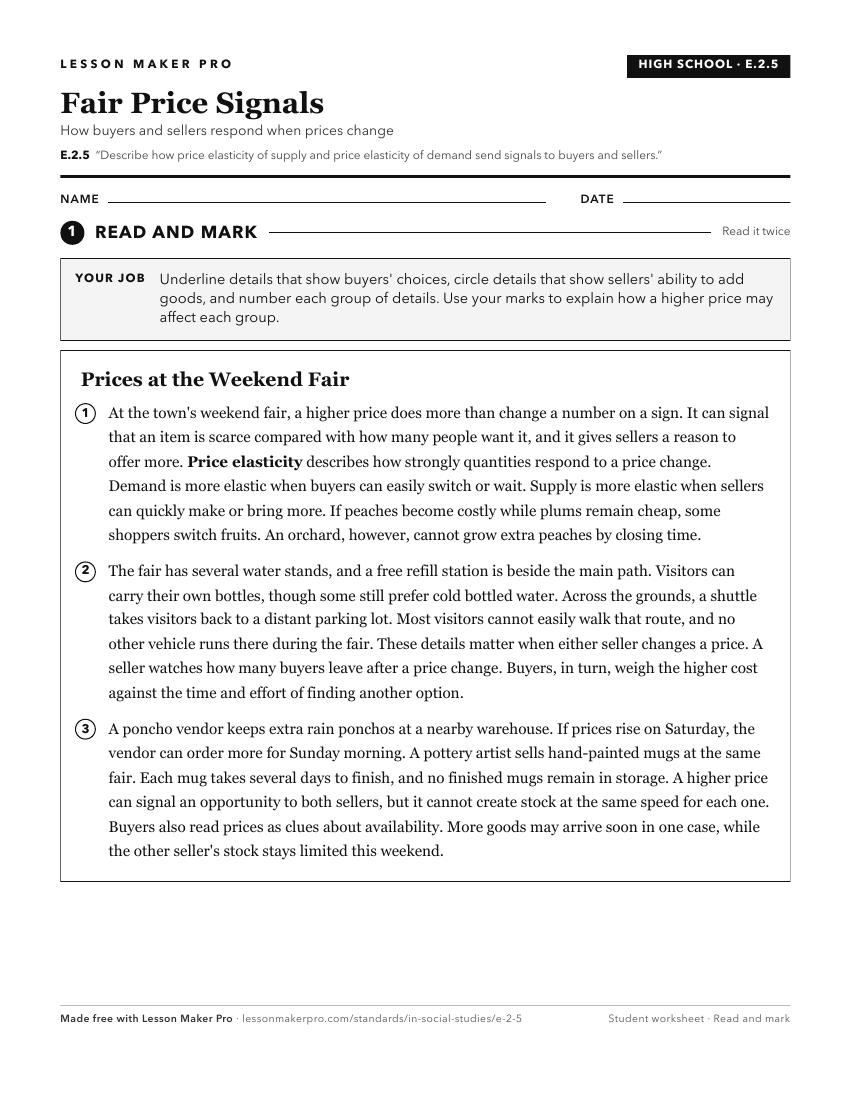
A ready-to-print activity worksheet aligned to E.2.5, with an answer key for the teacher on its own page. No account needed.
PDF, US Letter, prints cleanly in black and white.
Download the worksheetKeep exploring
Related Standards
- E.2.4
Identify factors that cause changes in market supply and demand and how these changes affect price and quantity in a competitive market.
- E.2.3
Provide examples of how supply and demand determine equilibrium price and quantity.
- 4.E.3
Explain that prices change as a result of changes in supply and demand for specific products.
- 3.E.6
Explain that prices are influenced by interactions between buyers and sellers in markets.
Turn this exact standard into a lesson
Grade, subject, topic, and the complete standard are prefilled. Create one free, no account needed.
Also for this standard:Make a WorksheetMake a QuizMake a Sub Lesson