Indiana Social Studies 3.E.6
The Standard
Explain that prices are influenced by interactions between buyers and sellers in markets.
2026 Indiana Academic Standards: K-12 Social Studies
Teacher's field guide
What This Standard Means
What Students Need to Do
- Students explain how buyers and sellers affect prices. They use examples to show why a price may change when more buyers want an item or more sellers offer it.
What Mastery Looks Like
- A student can explain why a seller may ask for more when many buyers want the last few items. They can also explain why sellers may lower prices when buyers have other places to shop.
Common Misconceptions
- Some students think sellers can name any price and buyers must pay it. Others think prices stay the same even when buyers stop purchasing or an item becomes hard to find.
How to Assess It
- Exit ticket: A shop has two toy cars and eight buyers. What might the seller do with the price, and why?
Lesson moves
Ways to Teach It
Give six buyers coins to shop at one seller with two paper apples; add three sellers with apples and compare asking prices.
Ask: If eight classmates want the last two pencils at a class shop, what might the seller do with the price?
Give pairs cards showing two apples for eight buyers or ten apples for two buyers; sort each under 'price may rise' or 'price may fall.'
Show two grocery ads for the same cereal and ask which store might lower its price to attract buyers.
Free download
Printable 3.E.6 Worksheet
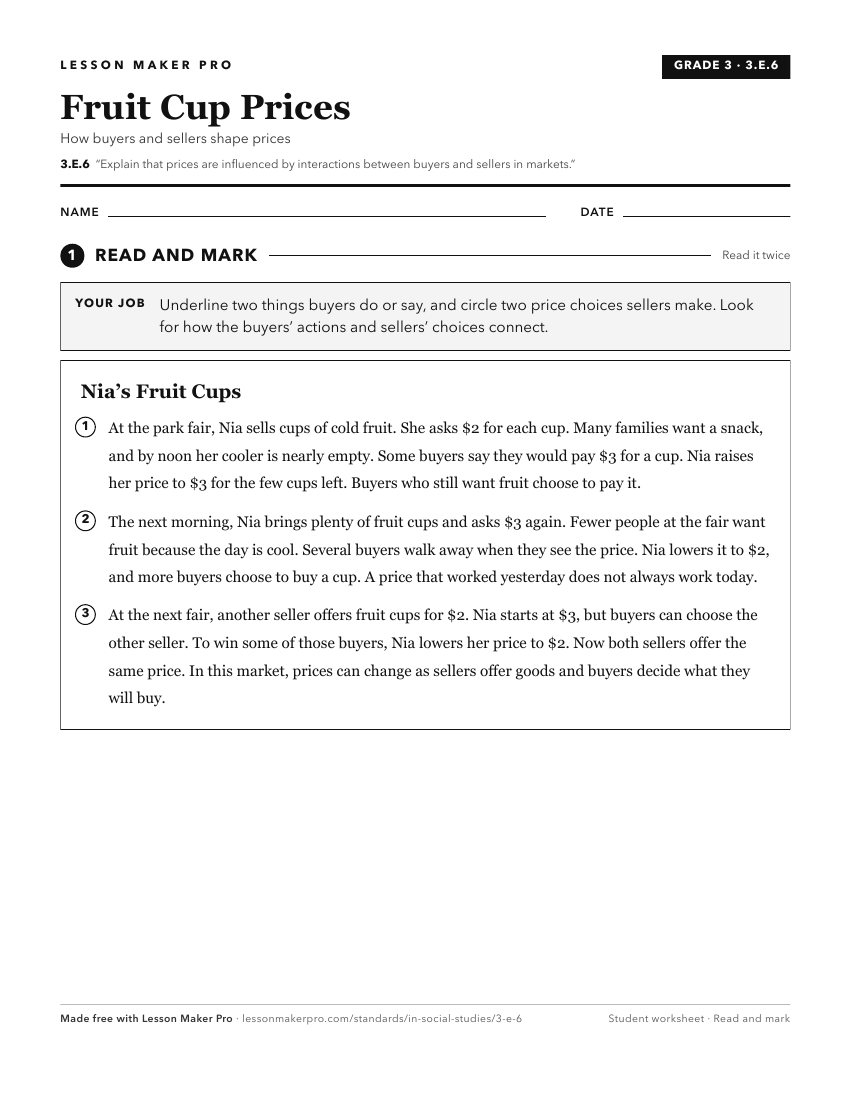
A ready-to-print activity worksheet aligned to 3.E.6, with an answer key for the teacher on its own page. No account needed.
PDF, US Letter, prints cleanly in black and white.
Download the worksheetKeep exploring
Related Standards
- GE.6.7
Demonstrate how supply and demand determine equilibrium price and quantity in the financial markets.
- E.2.4
Identify factors that cause changes in market supply and demand and how these changes affect price and quantity in a competitive market.
- E.3.3
Explain how competition in markets affects price and quantity.
- 4.E.3
Explain that prices change as a result of changes in supply and demand for specific products.
Turn this exact standard into a lesson
Grade, subject, topic, and the complete standard are prefilled. Create one free, no account needed.
Also for this standard:Make a WorksheetMake a QuizMake a Sub Lesson