Indiana Social Studies E.2.1
The Standard
Define supply and demand, and explain the causes of the Law of Supply and the Law of Demand.
2026 Indiana Academic Standards: K-12 Social Studies · Students explain that because resources are limited, people must make choices, understanding the role that supply, demand, prices, and profits play in a market economy. Key elements of the course include study of scarcity and economic reasoning, supply and demand, market structures, the role of government, national economic performance, the role of financial institutions, economic stabilization, and trade.
Teacher's field guide
What This Standard Means
What Students Need to Do
- Students describe supply as how much sellers are willing and able to sell at different prices. They describe demand as how much buyers are willing and able to buy. They explain why higher prices usually lead sellers to offer more and buyers to buy less.
What Mastery Looks Like
- Given a price increase, a student predicts more units offered by sellers and fewer units bought by buyers, assuming nothing else changes. They explain that a higher price can cover the cost of making more units, while buyers may skip the purchase or choose something cheaper.
Common Misconceptions
- Students may count everyone who wants an item as demand, even if they cannot pay for it. They may think a higher price makes sellers offer less because fewer customers will buy.
How to Assess It
- Exit ticket: Muffin prices rise from $2 to $4. Define supply and demand, then predict what buyers and sellers will do at the new price and give one reason for each.
Lesson moves
Ways to Teach It
Hand out pencil buyer-value and seller-cost cards marked $1, $3, or $5; call each price and count willing buyers and sellers.
Ask: Why might a baker offer more muffins at $4 than $2 while a customer buys fewer? Have students name one reason per side.
Pairs race to match $1 and $3 price cards to buyer quantities (five, three) and seller quantities (two, four), then explain each match.
Show $2 and $5 smoothie menu signs; students predict orders and how many drinks a stand would be willing to make at each price.
Free download
Printable E.2.1 Worksheet
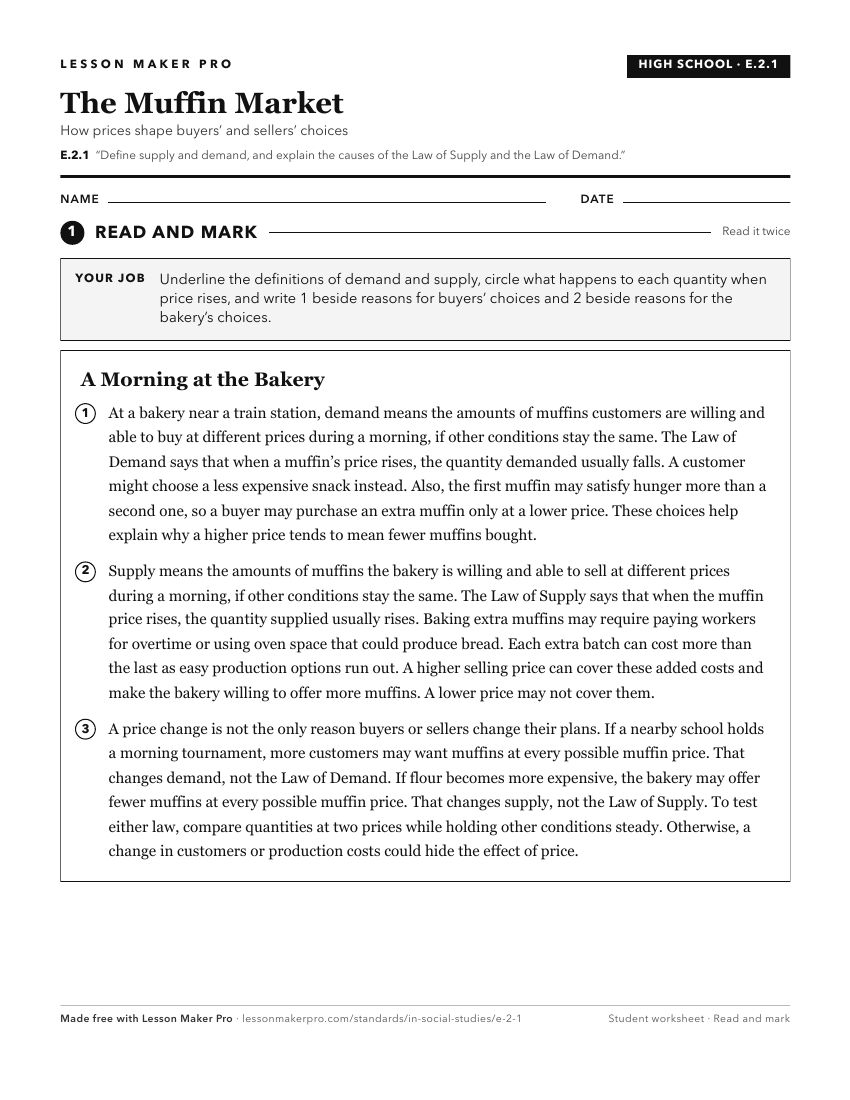
A ready-to-print activity worksheet aligned to E.2.1, with an answer key for the teacher on its own page. No account needed.
PDF, US Letter, prints cleanly in black and white.
Download the worksheetKeep exploring
Related Standards
- GE.3.2
Analyze the relationships between price, quantity, supply, demand, and equilibrium.
- E.2.4
Identify factors that cause changes in market supply and demand and how these changes affect price and quantity in a competitive market.
- E.2.3
Provide examples of how supply and demand determine equilibrium price and quantity.
- 4.E.3
Explain that prices change as a result of changes in supply and demand for specific products.
Turn this exact standard into a lesson
Grade, subject, topic, and the complete standard are prefilled. Create one free, no account needed.
Also for this standard:Make a WorksheetMake a QuizMake a Sub Lesson