Indiana Social Studies 7.H.9
The Standard
Identify the cause and effect relationship leading to Japan becoming independent from earlier Chinese influences to develop their own political, religious, social, and artistic traditions.
2026 Indiana Academic Standards: K-12 Social Studies
Teacher's field guide
What This Standard Means
What Students Need to Do
- Students explain how Japan borrowed ideas from China, then made its own choices as official contact slowed. They connect those choices to changes in government, religion, social life, and art.
What Mastery Looks Like
- A student places the end of missions to Tang China before Heian literature and later samurai rule. They explain that kana grew from Chinese characters and that Buddhism continued alongside Shinto. They can describe how power later shifted from court nobles to warrior leaders.
Common Misconceptions
- Some students think China ruled Japan and that Japan won independence in a war. Others think Japan rejected Buddhism or stopped using Chinese characters altogether.
How to Assess It
- On an exit ticket, ask: “After official missions to Tang China ended, how did one Japanese tradition develop? Name one Chinese influence Japan kept.”
Lesson moves
Ways to Teach It
Give pairs cards for Tang-style laws, Buddhist temples, Shinto shrines, kana poems, and samurai rule; have them sort borrowed, adapted, and local traditions.
Ask students to write: “If Japan kept Buddhism but also honored Shinto shrines, was it copying China or making its own choices? Why?”
Have teams order cards for the end of Tang missions in 894, The Tale of Genji, and the first shogunate, then explain one change.
Show photos of a modern Japanese Buddhist temple and Shinto shrine; ask students how both traditions remain visible in Japan today.
Free download
Printable 7.H.9 Worksheet
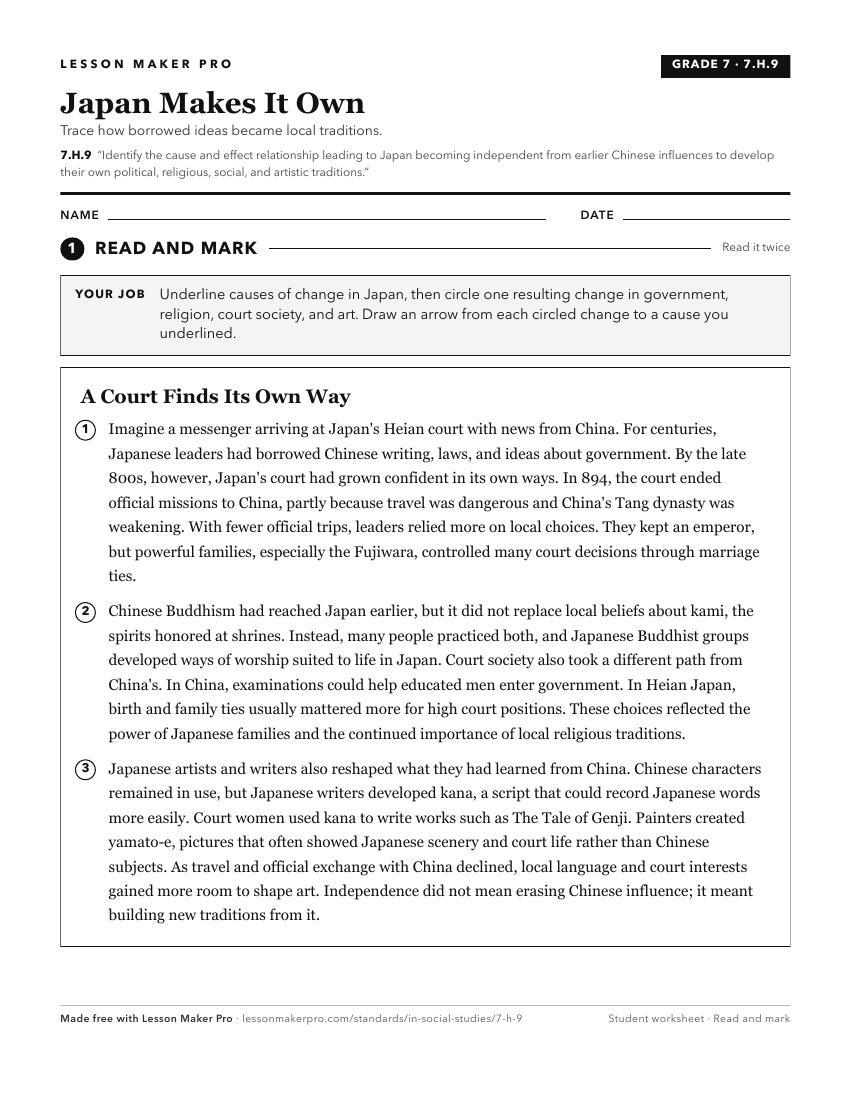
A ready-to-print activity worksheet aligned to 7.H.9, with an answer key for the teacher on its own page. No account needed.
PDF, US Letter, prints cleanly in black and white.
Download the worksheetKeep exploring
Related Standards
- 7.H.12
Analyze Japan’s rapid transformation (1868-1945) from an isolated feudal society to a global industrial power, and evaluate the causes and consequences of its i...
- WH.3.8
Examine the development of feudalism in Japan and its impact on Japanese society and government.
- WH.3.9
Examine the role of the Tang and Song Chinese dynasties in establishing political, social, economic, and cultural trends in China.
- WH.6.1
Identify and explain the impact of nationalism, imperialism, militarism, and alliances on relationships between countries.
Turn this exact standard into a lesson
Grade, subject, topic, and the complete standard are prefilled. Create one free, no account needed.
Also for this standard:Make a WorksheetMake a QuizMake a Sub Lesson