Indiana Social Studies 7.H.12
The Standard
Analyze Japan’s rapid transformation (1868-1945) from an isolated feudal society to a global industrial power, and evaluate the causes and consequences of its involvement in World War II.
2026 Indiana Academic Standards: K-12 Social Studies
Teacher's field guide
What This Standard Means
What Students Need to Do
- Students trace how Japan built factories, railroads, schools, and a modern army after 1868. They explain why Japanese leaders expanded into neighboring lands and entered World War II. They assess the costs for Japan and its neighbors.
What Mastery Looks Like
- A student uses dated evidence to link Meiji reforms to industrial and military growth. They explain how militarism and resource pressures fueled expansion. They describe the harm in occupied lands and the effects of defeat on Japan.
Common Misconceptions
- Some students think Japan had no foreign contact before 1868, though limited trade continued. Others treat industrial growth as the only cause of war. They may overlook violence in occupied lands or Japan's civilian losses.
How to Assess It
- Exit ticket: Name one Meiji reform and explain how it strengthened Japan. Then connect one reason for wartime expansion to one consequence for Japan or an occupied country.
Lesson moves
Ways to Teach It
Pin cards for 1868 reforms, the 1872 railway, the 1931 Manchuria invasion, and the 1945 surrender to string; add two cause-and-effect arrows.
Give students a 1931 Manchuria map and short excerpts on resources and army leadership; ask which factor better explains the invasion.
Play a matching game: pair school reform with skilled workers, army growth with expansion, and defeat with occupation; explain each link.
Compare an 1872 Tokyo-Yokohama rail map with a current Tokyo rail map; name one lasting effect of early railway building.
Free download
Printable 7.H.12 Worksheet
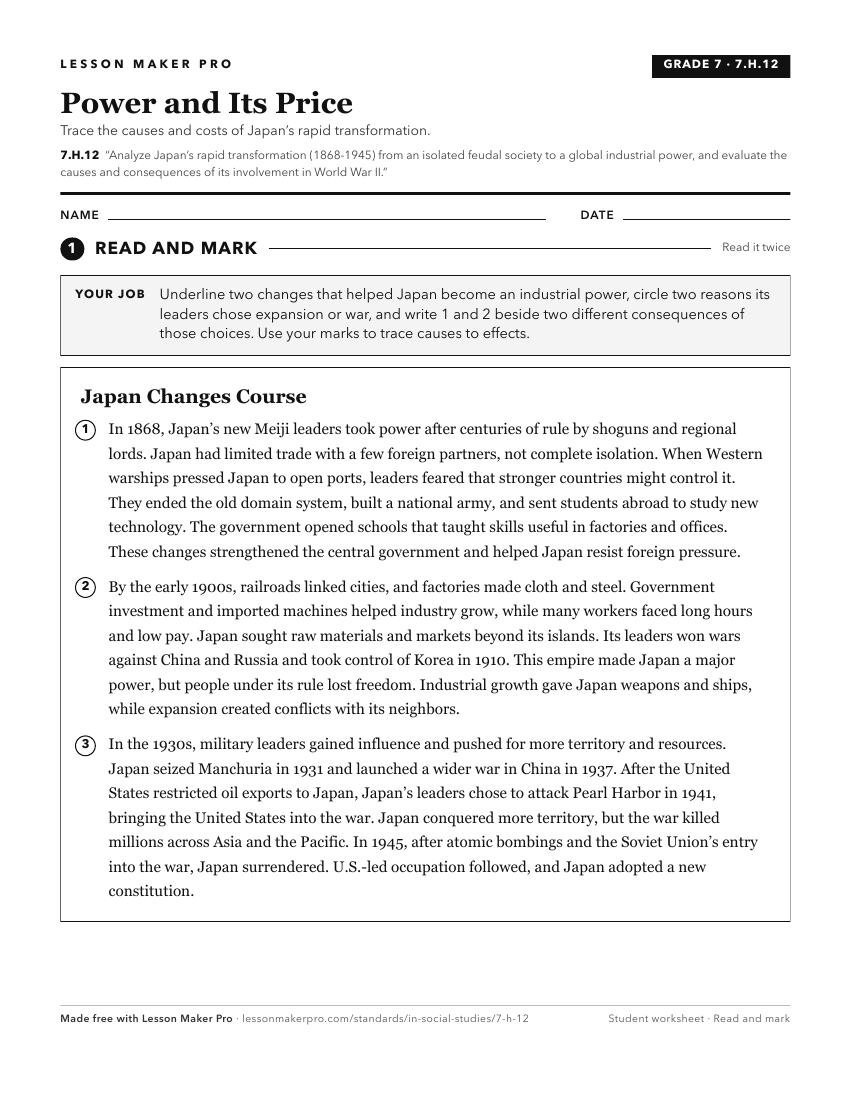
A ready-to-print activity worksheet aligned to 7.H.12, with an answer key for the teacher on its own page. No account needed.
PDF, US Letter, prints cleanly in black and white.
Download the worksheetKeep exploring
Related Standards
- WH.5.5
Analyze the causes and consequences of 19th century imperialism for Asia, Africa, and the Americas, including resistance movements to imperial control.
- WH.3.8
Examine the development of feudalism in Japan and its impact on Japanese society and government.
- IS.1.23
Examine the causes and course of World War II, the effects of the war on Indiana’s society and culture, and the consequences of the war on United States involve...
- WH.6.4
Identify the causes (i.e., social, political, militaristic, and economic) and key events of World War II, and analyze the impact this war had on the global comm...
Turn this exact standard into a lesson
Grade, subject, topic, and the complete standard are prefilled. Create one free, no account needed.
Also for this standard:Make a WorksheetMake a QuizMake a Sub Lesson