Indiana Social Studies 6.C.2
The Standard
Explain how the elements and foundations of Greek direct democracy can be found in modern systems of government.
2026 Indiana Academic Standards: K-12 Social Studies
Teacher's field guide
What This Standard Means
What Students Need to Do
- Compare how citizens voted on decisions in ancient Athens with how voters decide ballot measures today. Tell the difference between voting on an issue and electing someone to decide it.
What Mastery Looks Like
- A student can connect an Athenian assembly vote to a modern ballot measure. They can explain why electing a city council is different and name groups excluded from voting in Athens.
Common Misconceptions
- Students may call every election direct democracy, even when voters only choose representatives. They may assume women and enslaved people could vote in Athens, or that every modern law goes to a public vote.
How to Assess It
- Exit ticket: Compare an Athenian assembly vote with a city ballot measure. Who could vote in each, and why is electing a city council different?
Lesson moves
Ways to Teach It
Give students paper ballots on a proposed school lunch change, tally the votes, then compare the process with an Athenian assembly vote.
Ask partners whether voters decide a park rule directly when they elect council members who later vote on it.
Give pairs cards labeled Athenian assembly, ballot measure, mayoral election, and council vote to sort into direct and representative decisions.
Show California's 2024 Proposition 2 ballot summary and ask who voted on the school bond and who could have voted in Athens.
Free download
Printable 6.C.2 Worksheet
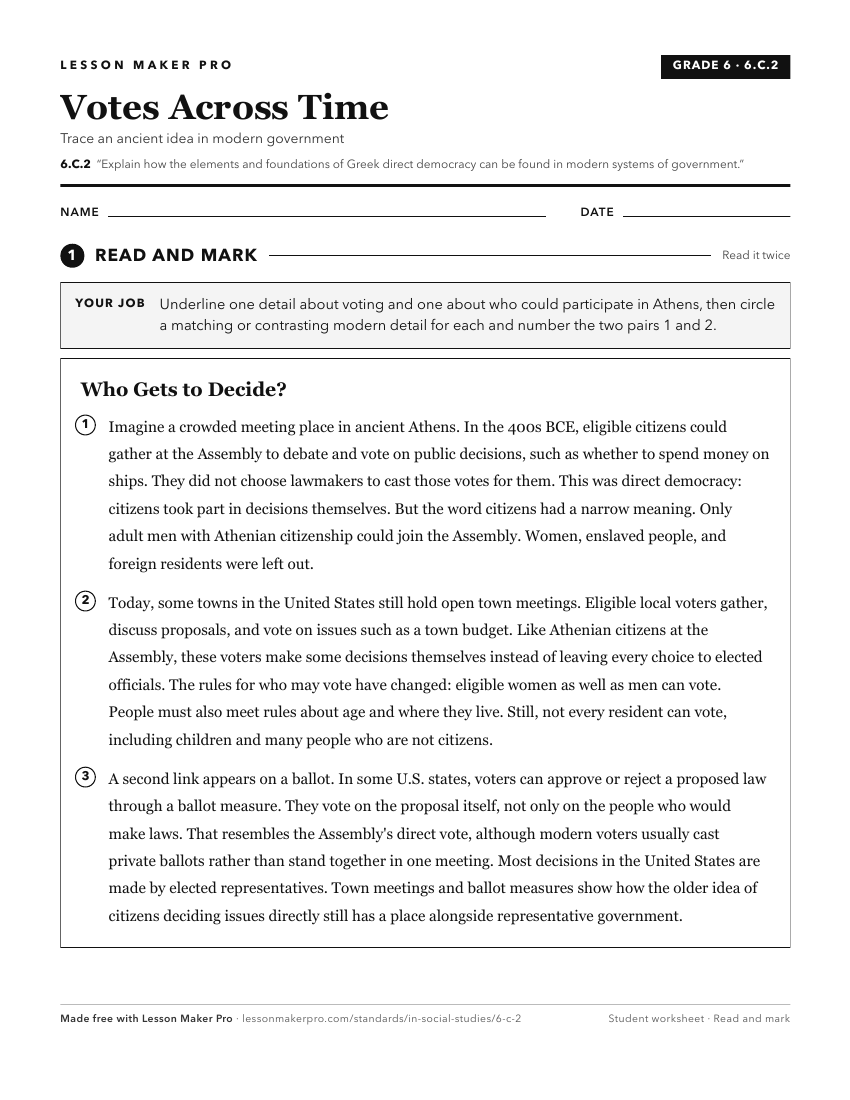
A ready-to-print activity worksheet aligned to 6.C.2, with an answer key for the teacher on its own page. No account needed.
PDF, US Letter, prints cleanly in black and white.
Download the worksheetKeep exploring
Related Standards
- 6.C.3
Explain how the elements and foundations of Roman representative democracy are present in modern systems of government.
- USG.2.5
Explain how a shared American civic identity is grounded in Founding Era principles and values such as liberty, equality, justice, popular sovereignty, individu...
- USG.2.4
Explain and analyze historical and contemporary examples of Founding Era principles of American government including natural rights, federalism, social contract...
- USG.1.4
Compare and contrast types of government including representative democracy, monarchy, oligarchy, totalitarianism, and anarchy.
Turn this exact standard into a lesson
Grade, subject, topic, and the complete standard are prefilled. Create one free, no account needed.
Also for this standard:Make a WorksheetMake a QuizMake a Sub Lesson