Indiana Social Studies 5.G.5
The Standard
Identify the major manufacturing and agricultural regions in colonial America, and summarize the ways that agriculture and manufacturing changed between 1600 and 1800.
2026 Indiana Academic Standards: K-12 Social Studies
Teacher's field guide
What This Standard Means
What Students Need to Do
- Students locate where colonists grew grain, tobacco, and rice, and where they built ships and made iron goods. They explain how farming and manufacturing changed from 1600 to 1800.
What Mastery Looks Like
- On a map, students place grain farms and ironworks in the Middle Colonies, shipyards in New England, and tobacco and rice plantations in the South. They describe the spread of cash crops and enslaved labor on Southern plantations, along with the growth of water-powered mills.
Common Misconceptions
- Students may put all farming in the South and miss grain farms in the Middle Colonies. They may think large factories existed throughout the colonial period or that cotton was the South's main crop in 1600.
How to Assess It
- Give students a blank map of the 13 colonies. Ask them to label two farming regions and one manufacturing region with products, then name one change in each type of work by 1800.
Lesson moves
Ways to Teach It
Give pairs a blank colonies map and colored pencils; shade New England shipyards, Middle Colony grain farms and ironworks, and Southern plantations.
Ask: Why did Pennsylvania farmers grow wheat while Virginia farmers grew tobacco? Have students use climate and soil notes to explain.
Give pairs cards naming regions, products, and dates; have them match tobacco plantations, grain farms, shipyards, and late-1700s textile mills.
Show a flour bag, then trace wheat from a Middle Colony farm through a water-powered mill to a port on a printed map.
Free download
Printable 5.G.5 Worksheet
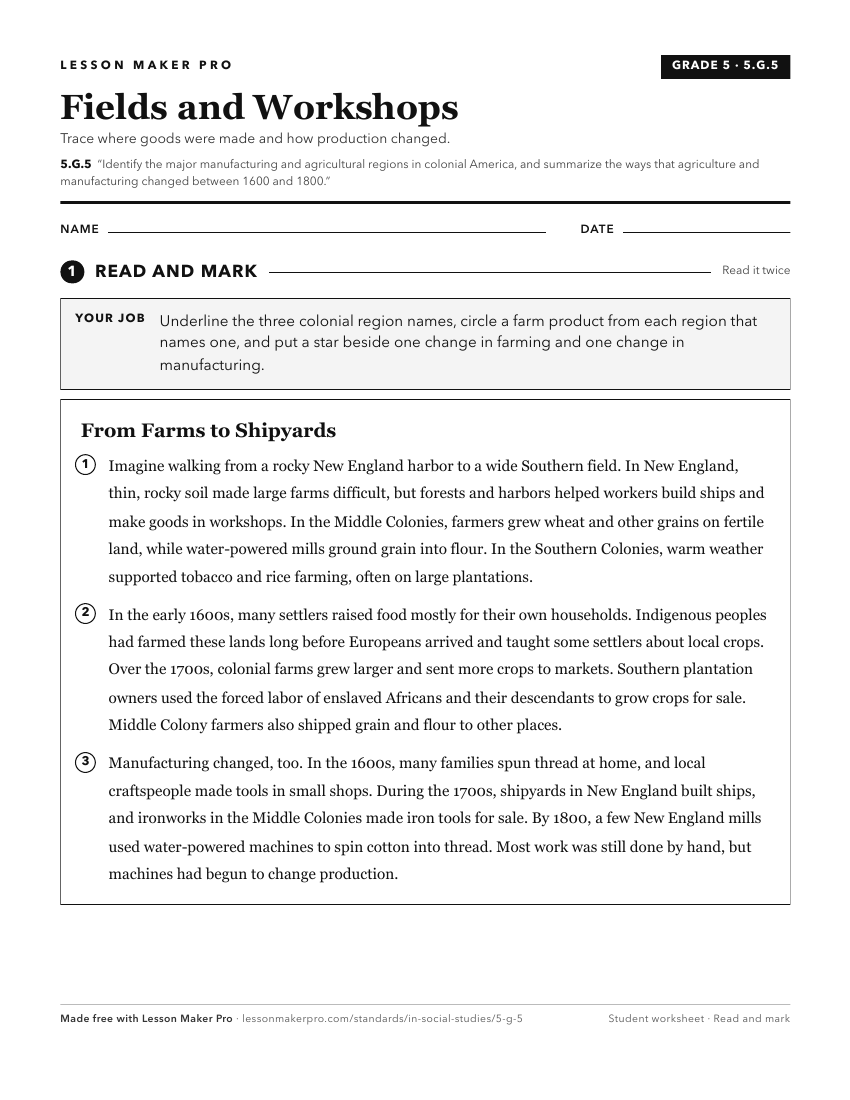
A ready-to-print activity worksheet aligned to 5.G.5, with an answer key for the teacher on its own page. No account needed.
PDF, US Letter, prints cleanly in black and white.
Download the worksheetKeep exploring
Related Standards
- 8.H.11
Compare and contrast the ways of life in the northern and southern states, including the growth of towns and cities, the growth of industry in the North, and th...
- 5.G.10
Explain the economic organization of each region (i.e., New England, Middle, Southern) that comprised the 13 British colonies.
- 8.E.3
Relate how new technology and inventions brought about changes in labor productivity in the United States in the eighteenth and nineteenth centuries.
- 8.G.3
Identify the agricultural regions of the United States. Give explanations for how the land was used and developed during the growth of the United States.
Turn this exact standard into a lesson
Grade, subject, topic, and the complete standard are prefilled. Create one free, no account needed.
Also for this standard:Make a WorksheetMake a QuizMake a Sub Lesson