Indiana Social Studies 8.H.11
The Standard
Compare and contrast the ways of life in the northern and southern states, including the growth of towns and cities, the growth of industry in the North, and the growing dependence on slavery and the production of cotton in the South, causing early sectionalism in America.
2026 Indiana Academic Standards: K-12 Social Studies
Teacher's field guide
What This Standard Means
What Students Need to Do
- Students compare northern towns, mills, and farms with southern towns, farms, and cotton plantations in the early 1800s. They explain how enslaved workers produced cotton that also supplied northern mills. They connect these patterns to growing disputes between the regions.
What Mastery Looks Like
- Given a map or short source, a student names two differences between the regions and one economic link. They explain how disagreement over the spread of slavery increased tension.
Common Misconceptions
- Some students think every northerner worked in a factory and every southerner lived on a plantation. Others think northern mills had no connection to slavery. Students may confuse early regional tensions with the Civil War itself.
How to Assess It
- Exit ticket: Name one economic difference between North and South around 1850, one way they were connected, and one disagreement that grew from these patterns.
Lesson moves
Ways to Teach It
On an 1850 map, place cards for New York City, a Lowell mill, a Mississippi cotton plantation, and the New Orleans port.
Discuss: If northern mills used southern cotton, why might some northerners still oppose the spread of slavery?
Sort fact cards into North, South, or Both, including farms, cities, mills, cotton production, and trade, then defend one Both choice.
Read a cotton T-shirt label, then use an 1850 trade map to identify who grew cotton and who turned it into cloth.
Free download
Printable 8.H.11 Worksheet
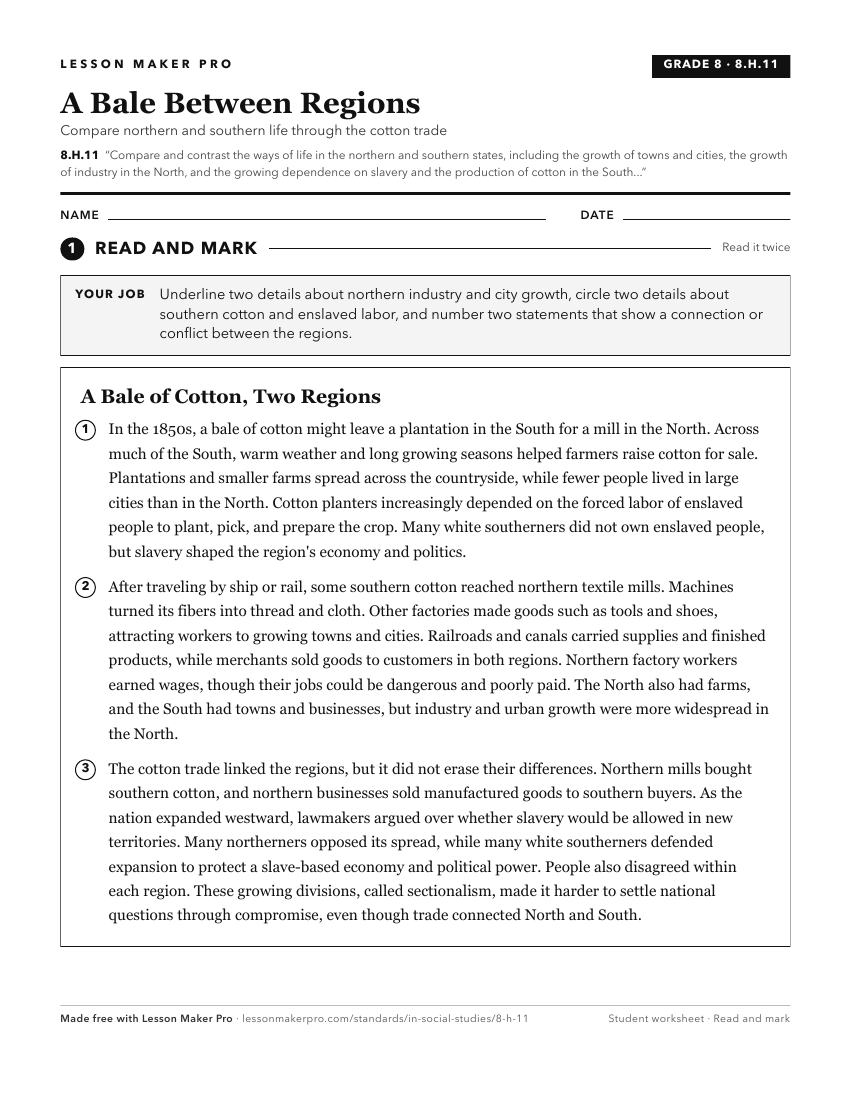
A ready-to-print activity worksheet aligned to 8.H.11, with an answer key for the teacher on its own page. No account needed.
PDF, US Letter, prints cleanly in black and white.
Download the worksheetKeep exploring
Related Standards
- 8.H.19
Give examples of how immigration affected American culture in the decades before and after the Civil War, including growth of industrial sites in the North; rel...
- 8.H.22
Analyze the causes and effects of events leading to the Civil War, and evaluate the impact issues such as states’ rights and slavery had in developing America’s...
- 7.H.6
Compare and contrast the institution of slavery in its various forms in Africa, Asia, and the Southwest Pacific, and analyze the impact slavery had on different...
- 5.G.5
Identify the major manufacturing and agricultural regions in colonial America, and summarize the ways that agriculture and manufacturing changed between 1600 an...
Turn this exact standard into a lesson
Grade, subject, topic, and the complete standard are prefilled. Create one free, no account needed.
Also for this standard:Make a WorksheetMake a QuizMake a Sub Lesson