Indiana Social Studies 3.E.4
The Standard
Define interdependence, and give examples of how people in the local community depend on each other for goods and services.
2026 Indiana Academic Standards: K-12 Social Studies
Teacher's field guide
What This Standard Means
What Students Need to Do
- Students explain how people in a community rely on one another. They identify goods people sell, services people do, and what each person gets from an exchange.
What Mastery Looks Like
- A student can explain why a baker needs a delivery driver and why the driver needs the bakery for work. They can name bread as a good and delivery as a service.
Common Misconceptions
- Some students think only the buyer benefits from an exchange. Others call a haircut a good because they pay for it, or assume a store makes everything it sells.
How to Assess It
- Exit ticket: A baker pays a local driver to deliver flour. Explain how each person depends on the other, and label the delivery as a good or service.
Lesson moves
Ways to Teach It
Give groups cards showing a neighborhood bakery, flour seller, and delivery driver; connect them with yarn and label what each provides.
Ask, 'What happens if the bakery's delivery driver misses work for a week?' Have partners name two people affected and explain why.
Play community match: pair barber, baker, and bus driver cards with haircut, bread, and ride cards; explain who relies on each good or service.
Show a photo of a nearby grocery store; have students name a good it sells and explain how the store and its delivery driver need each other.
Free download
Printable 3.E.4 Worksheet
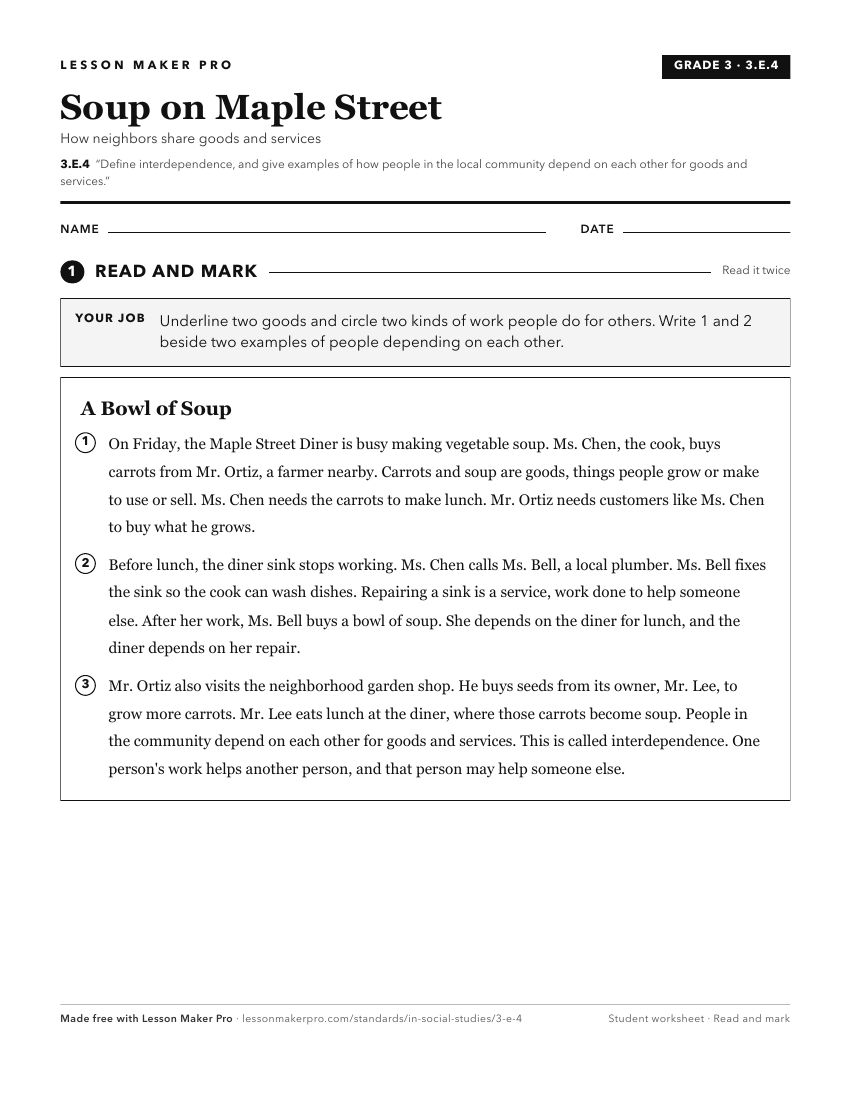
A ready-to-print activity worksheet aligned to 3.E.4, with an answer key for the teacher on its own page. No account needed.
PDF, US Letter, prints cleanly in black and white.
Download the worksheetKeep exploring
Related Standards
- 2.E.2
Research goods and services produced in the local community, and describe how people can be both producers and consumers.
- 3.E.2
Give examples of goods and services provided by local business and industry.
- 3.E.3
Give examples of trade in the local community, and explain how trade benefits both parties.
- 8.E.4
Explain and evaluate examples of domestic and international interdependence throughout United States history.
Turn this exact standard into a lesson
Grade, subject, topic, and the complete standard are prefilled. Create one free, no account needed.
Also for this standard:Make a WorksheetMake a QuizMake a Sub Lesson