Indiana Science HS-PSII-9.1
The Standard
Develop the relationship among frequency, wavelength, and energy for electromagnetic waves across the entire spectrum.
Indiana Academic Standards for Science (2023) · Particle and Wave Nature of Light
Teacher's field guide
What This Standard Means
What Students Need to Do
- Students connect wavelength, frequency, and photon energy across the electromagnetic spectrum. They use the speed of light in a vacuum to calculate frequency and photon energy from a given wavelength.
What Mastery Looks Like
- Given a wavelength, a student calculates frequency with c = fλ and photon energy with E = hf, using correct units. They can rank radio waves through gamma rays by wavelength, frequency, and photon energy.
Common Misconceptions
- Students may think longer waves have more energy because they take up more space. They may confuse brightness with the energy of one photon, or think radio waves travel slower than gamma rays in a vacuum.
How to Assess It
- Exit ticket: Compare 300 nm ultraviolet light and 600 nm visible light in a vacuum. Calculate each frequency, then use E = hf to identify which photon has more energy.
Lesson moves
Ways to Teach It
Give pairs seven cards with sample wavelengths from radio through gamma rays; have them sort by wavelength and draw frequency and photon-energy arrows.
Ask students to write why a 300 nm ultraviolet photon has more energy than a 600 nm visible-light photon.
Play a matching relay: teams pair wavelength cards with frequency cards, then check each match with c = fλ.
Compare a 2.4 GHz Wi-Fi router label with a printed 254 nm germicidal lamp spec sheet; calculate photon energies.
Free download
Printable HS-PSII-9.1 Worksheet
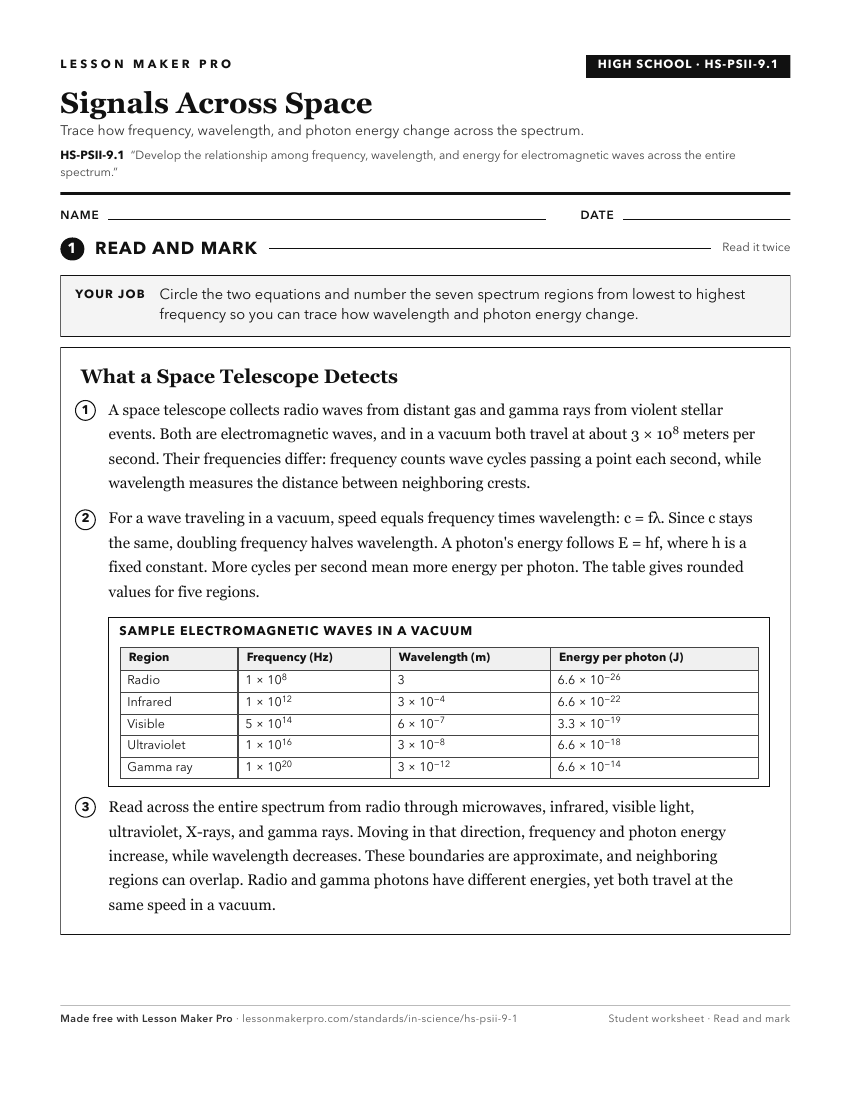
A ready-to-print activity worksheet aligned to HS-PSII-9.1, with an answer key for the teacher on its own page. No account needed.
PDF, US Letter, prints cleanly in black and white.
Download the worksheetKeep exploring
Related Standards
- HS-PSII-9.2
Explain how electromagnetic waves interact with matter both as particles (i.e., photons) and as waves and be able to apply the most appropriate model to any par...
- HS-PSII-9.3
Develop graphical and mathematical representations that describe the relationship between the frequency of a photon and the kinetic energy of an electron emitte...
- HS-ICP4-1
Use mathematical representations to support a claim regarding relationships among the frequency, wavelength, and speed of waves. [Clarification Statement: Examp...
Turn this exact standard into a lesson
Grade, subject, topic, and the complete standard are prefilled. Create one free, no account needed.
Also for this standard:Make a WorksheetMake a QuizMake a Sub Lesson