Indiana Science HS-ICP4-1
The Standard
Use mathematical representations to support a claim regarding relationships among the frequency, wavelength, and speed of waves. [Clarification Statement: Examples of data could include electromagnetic radiation traveling in a vacuum and glass, sound waves traveling through air and water, and seismic waves traveling through the Earth.]
Indiana Academic Standards for Science (2023) · Waves and their Applications in Technologies for Information Transfer
Teacher's field guide
What This Standard Means
What Students Need to Do
- Students use v = fλ to calculate wave speed, frequency, or wavelength from measurements. They use those calculations to support a claim about waves moving through different materials.
What Mastery Looks Like
- Given a speed of 24 m/s and a frequency of 8 Hz, a student finds a wavelength of 3 m and shows the calculation. They explain that doubling frequency in the same material halves wavelength, while entering a new material changes speed and wavelength, not frequency.
Common Misconceptions
- Students may think a higher frequency makes a wave travel faster through the same material. They may also think frequency changes when light enters glass, or that wavelength stays fixed when speed changes.
How to Assess It
- Exit ticket: A wave travels at 12 m/s with a frequency of 3 Hz. Find its wavelength, then show what happens to the wavelength if frequency doubles in the same material.
Lesson moves
Ways to Teach It
Stretch a slinky between tape marks, film steady waves, and measure crest spacing, shake rate, and crest travel time.
Ask, “Light slows in glass but keeps its frequency. What happens to its wavelength?” Have students justify their answer with v = fλ.
Hand partners cards showing two of three values, speed, frequency, and wavelength, and have them calculate the missing value and check units.
Give students 100 MHz FM and 2.4 GHz Wi-Fi frequencies; use 3 × 10⁸ m/s to compare their wavelengths in air.
Free download
Printable HS-ICP4-1 Worksheet
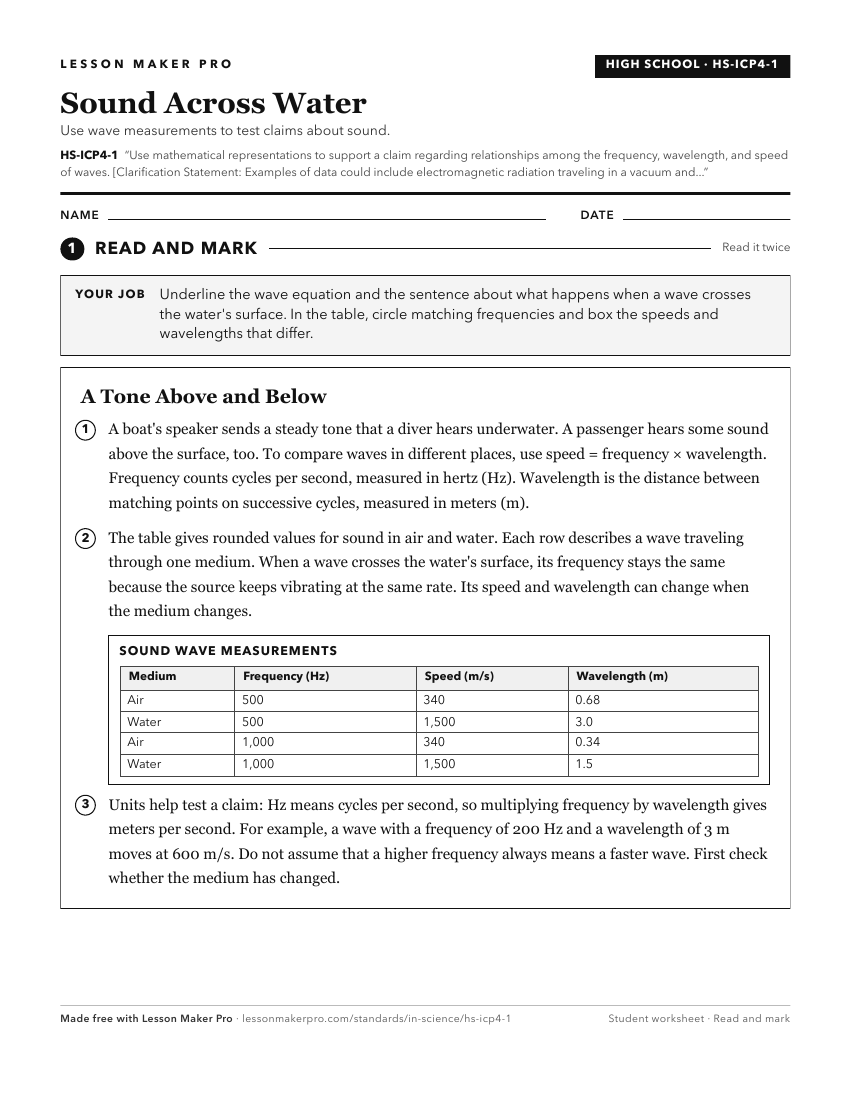
A ready-to-print activity worksheet aligned to HS-ICP4-1, with an answer key for the teacher on its own page. No account needed.
PDF, US Letter, prints cleanly in black and white.
Download the worksheetKeep exploring
Related Standards
Turn this exact standard into a lesson
Grade, subject, topic, and the complete standard are prefilled. Create one free, no account needed.
Also for this standard:Make a WorksheetMake a QuizMake a Sub Lesson