Indiana Science HS-PSII-5.5
The Standard
Explain and analyze simple arrangements of electrical components in series and parallel DC circuits in terms of current, resistance, voltage, and power. Use Ohm’s and Kirchhoff’s laws to analyze DC circuits.
Indiana Academic Standards for Science (2023) · Simple and Complex Circuits
Teacher's field guide
What This Standard Means
What Students Need to Do
- Students trace current through series and parallel paths. They use V = IR, current at junctions, and voltage around loops to find missing values. They calculate the power drawn by each component.
What Mastery Looks Like
- With a 12 V battery and two 6 Ω resistors, students find 1 A through both resistors in series and 2 A through each branch in parallel. They find 6 V across each series resistor and 12 V across each parallel resistor. They check that the parallel branch currents add to 4 A and calculate power for each resistor.
Common Misconceptions
- Some students think a resistor uses up current, so the next resistor in series gets less. Others add parallel resistances or assume branches with different resistances carry equal current. Students may also give each series resistor the full battery voltage.
How to Assess It
- Exit ticket: A 6 V battery connects to 3 Ω and 6 Ω resistors in parallel. Find the current in each branch, the total battery current, and the total power.
Lesson moves
Ways to Teach It
Wire two 3 V bulbs to a two-AA-cell holder in series, then parallel, and measure voltage across each bulb.
Ask partners to explain why a 3 Ω branch draws twice the current of a 6 Ω branch across the same battery.
Give pairs circuit cards with 6 V batteries and 2 Ω or 4 Ω resistors; have them match diagrams to branch currents.
Show a battery-powered lantern diagram with two 6 Ω bulbs in parallel; have students find battery current and total power.
Free download
Printable HS-PSII-5.5 Worksheet
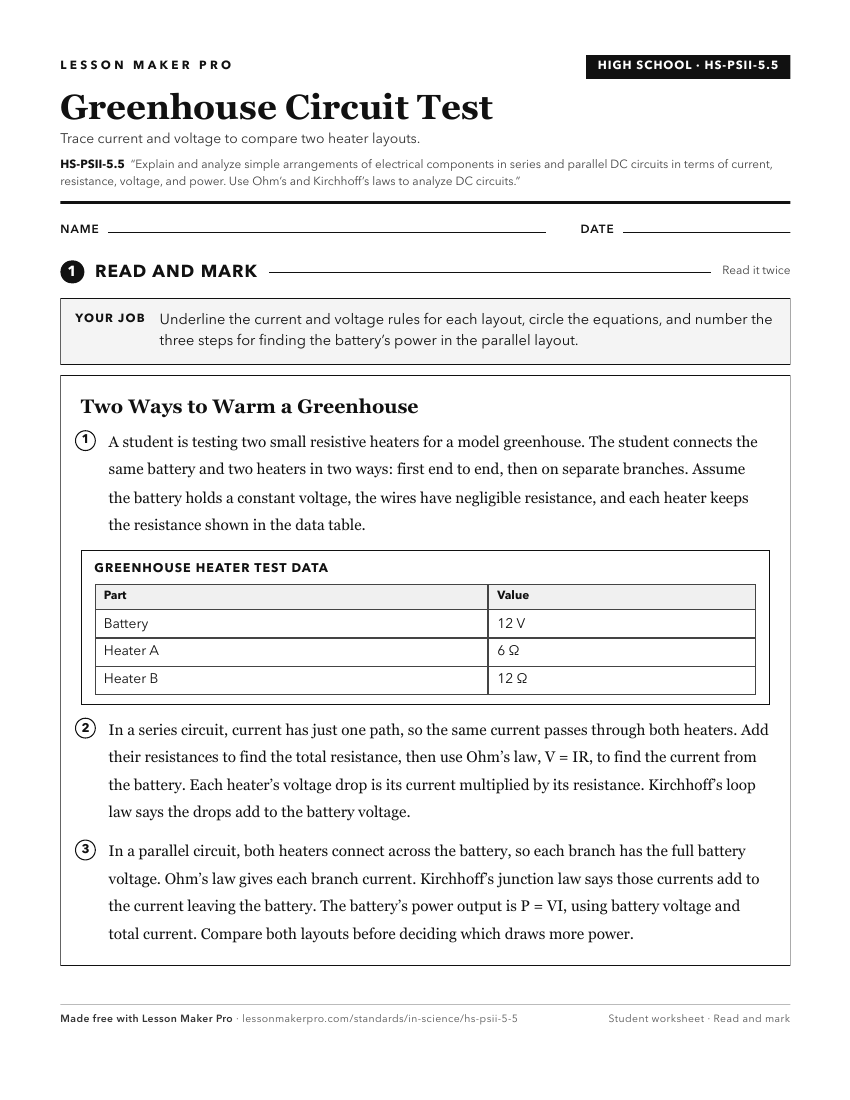
A ready-to-print activity worksheet aligned to HS-PSII-5.5, with an answer key for the teacher on its own page. No account needed.
PDF, US Letter, prints cleanly in black and white.
Download the worksheetKeep exploring
Related Standards
- HS-PSII-5.2
Develop graphical and mathematical representations that describe the relationship between the between the amount of current passing through an ohmic device and ...
- HS-ICP3-5
Gather data to build a model to describe and explain the flow of current through series and parallel electric circuits.
- HS-PSII-7.2
Develop graphical and mathematical representations that describe the relationship between the rate of change of magnetic flux and the amount of voltage induced ...
- HS-PSII-7.3
Apply Ohm's Law, Faraday's Law, and Lenz's Law to determine the amount and direction of current induced by a changing magnetic flux in a loop of wire or simple ...
Turn this exact standard into a lesson
Grade, subject, topic, and the complete standard are prefilled. Create one free, no account needed.
Also for this standard:Make a WorksheetMake a QuizMake a Sub Lesson