Indiana Science HS-PSII-3.5
The Standard
Describe how a change in the pressure of as static fluid in an enclosed container is transmitted equally in all directions (Pascal’s Principle) and apply Pascal’s Principle to determine the mechanical advantage of a hydraulic system.
Indiana Academic Standards for Science (2023) · Fluids
Teacher's field guide
What This Standard Means
What Students Need to Do
- Students explain how a push on fluid in a closed container changes pressure equally throughout the fluid. They use piston areas and input force to find output force and mechanical advantage.
What Mastery Looks Like
- A student can show that a 20 N push on a 2 cm² piston produces a 100 N push on a 10 cm² piston. They find a mechanical advantage of 5 and explain why the wider piston moves a shorter distance.
Common Misconceptions
- Students may think equal pressure means equal force, even when the piston areas differ. They may divide the smaller area by the larger area or assume the larger piston moves farther.
How to Assess It
- Exit ticket: A 15 N force presses a 3 cm² piston connected to a 12 cm² piston. Find the output force and mechanical advantage, then explain why the output force is larger.
Lesson moves
Ways to Teach It
Connect water-filled 5 mL and 20 mL syringes with tubing, press the small plunger, and mark how far each plunger moves.
Write two sentences explaining why equal pressure gives a larger lifting force at the wider piston.
Hand pairs cards with piston areas and input forces, then have them calculate output force and mechanical advantage before checking an answer key.
Give students a diagram of a hydraulic car lift and ask them to label each piston and predict which side carries the car.
Free download
Printable HS-PSII-3.5 Worksheet
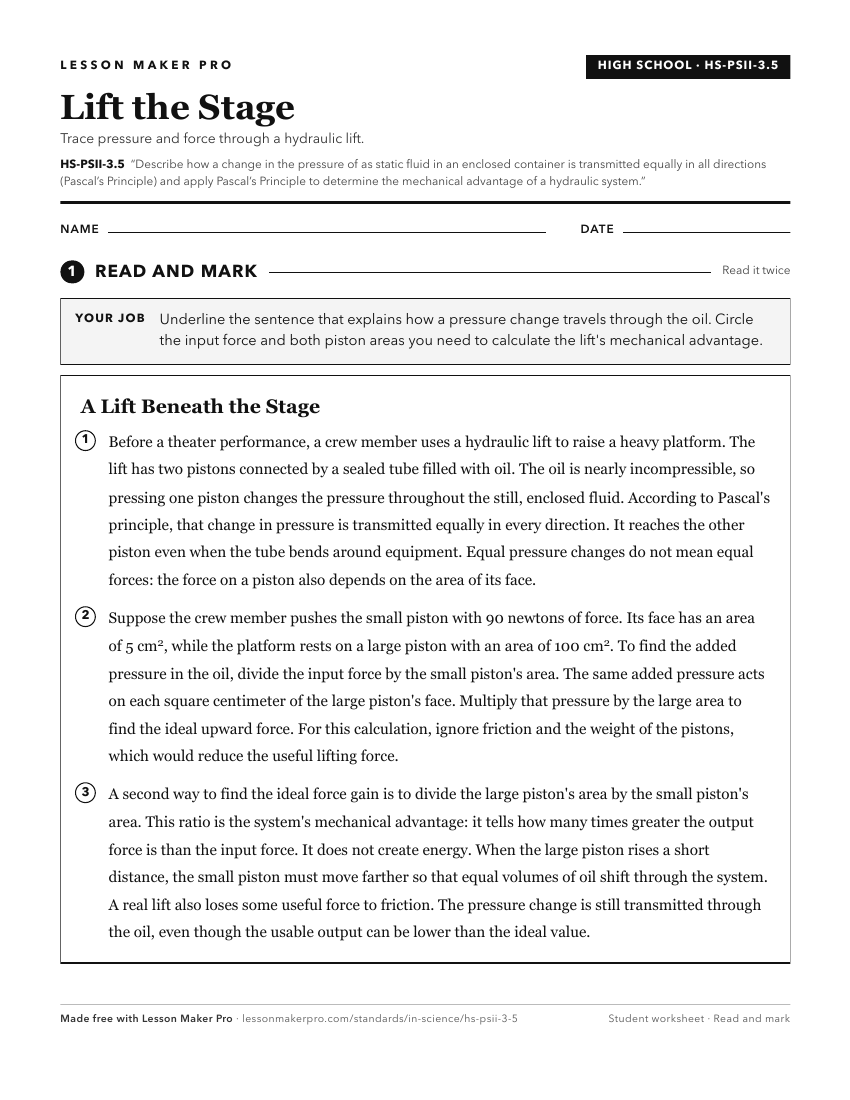
A ready-to-print activity worksheet aligned to HS-PSII-3.5, with an answer key for the teacher on its own page. No account needed.
PDF, US Letter, prints cleanly in black and white.
Download the worksheetKeep exploring
Related Standards
- HS-PSII-3.4
Develop and apply Bernoulli's principle and continuity equations to predict changes in the speed and pressure of a moving incompressible fluid.
- HS-PSII-3.1
For a static, incompressible fluid, develop and apply graphical and mathematical representations that describe the relationship between the density and the pres...
- HS-PSII-3.3
Develop and apply the principle of constant volume flow rate to determine the relationship between cross-sectional area of a pipe and the velocity of an incompr...
- HS-PSII-3.2
Qualitatively and quantitatively determine how the density of fluid or volume of fluid displaced is related to the force due to buoyancy acting on either a floa...
Turn this exact standard into a lesson
Grade, subject, topic, and the complete standard are prefilled. Create one free, no account needed.
Also for this standard:Make a WorksheetMake a QuizMake a Sub Lesson