Indiana Science HS-PSII-3.2
The Standard
Qualitatively and quantitatively determine how the density of fluid or volume of fluid displaced is related to the force due to buoyancy acting on either a floating or submerged object as described by Archimedes’ principle of buoyancy.
Indiana Academic Standards for Science (2023) · Fluids
Teacher's field guide
What This Standard Means
What Students Need to Do
- Students predict how buoyant force changes with fluid density and the amount of fluid displaced. They calculate that force for floating and fully submerged objects.
What Mastery Looks Like
- A student explains why the same floating object displaces less saltwater than freshwater but gets the same upward force in both. They calculate 20 N of buoyant force when an object displaces 0.002 m³ of water and g = 10 N/kg.
Common Misconceptions
- Students may use an object's full volume when it is only partly submerged. They may think saltwater pushes harder on the same floating object, rather than making it displace less fluid. Some assume pushing a fully submerged object deeper increases its buoyant force.
How to Assess It
- Exit ticket: A 20 N block floats in water. Find its buoyant force and displaced volume, then find its buoyant force when fully submerged (block volume 0.003 m³, water density 1,000 kg/m³, g = 10 N/kg).
Lesson moves
Ways to Teach It
Float a clay boat in an overflow cup, add coins, and weigh the collected water after each addition.
Ask: Why does a sealed bottle sit higher in saltwater than freshwater, yet have the same buoyant force while floating?
Match cards labeled 1,000 kg/m³, 0.002 m³, and 20 N; calculate with g = 10 N/kg before claiming a match.
Show a cargo ship load line photo; ask why the ship sits lower when loaded and why marks differ for freshwater and seawater.
Free download
Printable HS-PSII-3.2 Worksheet
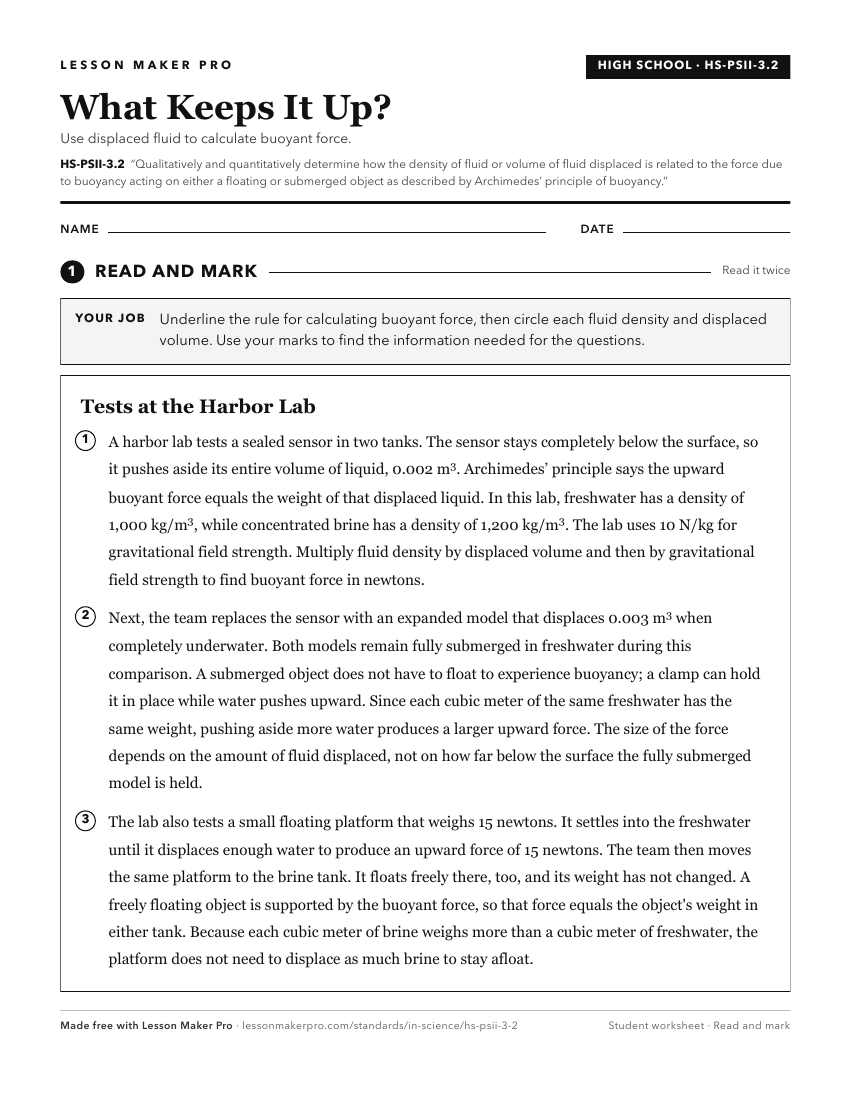
A ready-to-print activity worksheet aligned to HS-PSII-3.2, with an answer key for the teacher on its own page. No account needed.
PDF, US Letter, prints cleanly in black and white.
Download the worksheetKeep exploring
Related Standards
- HS-PSII-3.5
Describe how a change in the pressure of as static fluid in an enclosed container is transmitted equally in all directions (Pascal's Principle) and apply Pascal...
- HS-PSII-3.4
Develop and apply Bernoulli's principle and continuity equations to predict changes in the speed and pressure of a moving incompressible fluid.
- HS-PSII-3.1
For a static, incompressible fluid, develop and apply graphical and mathematical representations that describe the relationship between the density and the pres...
- HS-PSII-3.3
Develop and apply the principle of constant volume flow rate to determine the relationship between cross-sectional area of a pipe and the velocity of an incompr...
Turn this exact standard into a lesson
Grade, subject, topic, and the complete standard are prefilled. Create one free, no account needed.
Also for this standard:Make a WorksheetMake a QuizMake a Sub Lesson