Indiana Science HS-PSII-3.1
The Standard
For a static, incompressible fluid, develop and apply graphical and mathematical representations that describe the relationship between the density and the pressure exerted at various positions in the fluid, and apply those representations to qualitatively and quantitatively describe how changing the depth or density affects the pressure.
Indiana Academic Standards for Science (2023) · Fluids
Teacher's field guide
What This Standard Means
What Students Need to Do
- Students calculate pressure at different depths in a still fluid. They make graphs to show how pressure changes with depth and with fluid density.
What Mastery Looks Like
- Students draw straight-line graphs of gauge pressure against depth and against density, holding the other variable fixed. They use P = ρgh to calculate pressure and explain why denser fluids give higher readings at the same depth.
Common Misconceptions
- Students may think a wider container creates more pressure at the same depth. Some think pressure is greatest near the surface. Others treat zero gauge pressure at the surface as zero total pressure.
How to Assess It
- Exit ticket: Sketch gauge pressure versus depth for water with density 1,000 kg/m³, and calculate its pressure at 2 m using g = 10 m/s². What happens to that pressure if the density doubles?
Lesson moves
Ways to Teach It
Lower a pressure probe into a bucket of water at 5 cm intervals, record readings, and graph pressure against depth.
Two tanks have the same water depth but different widths. Which has more pressure at the bottom? Draw and explain.
Give pairs cards showing depths, fluid densities, and pressure graphs; have them match each graph to a calculation using P = ρgh.
Show a photo of a dam; ask students to mark where water pressure is greatest and explain why the wall is thickest there.
Free download
Printable HS-PSII-3.1 Worksheet
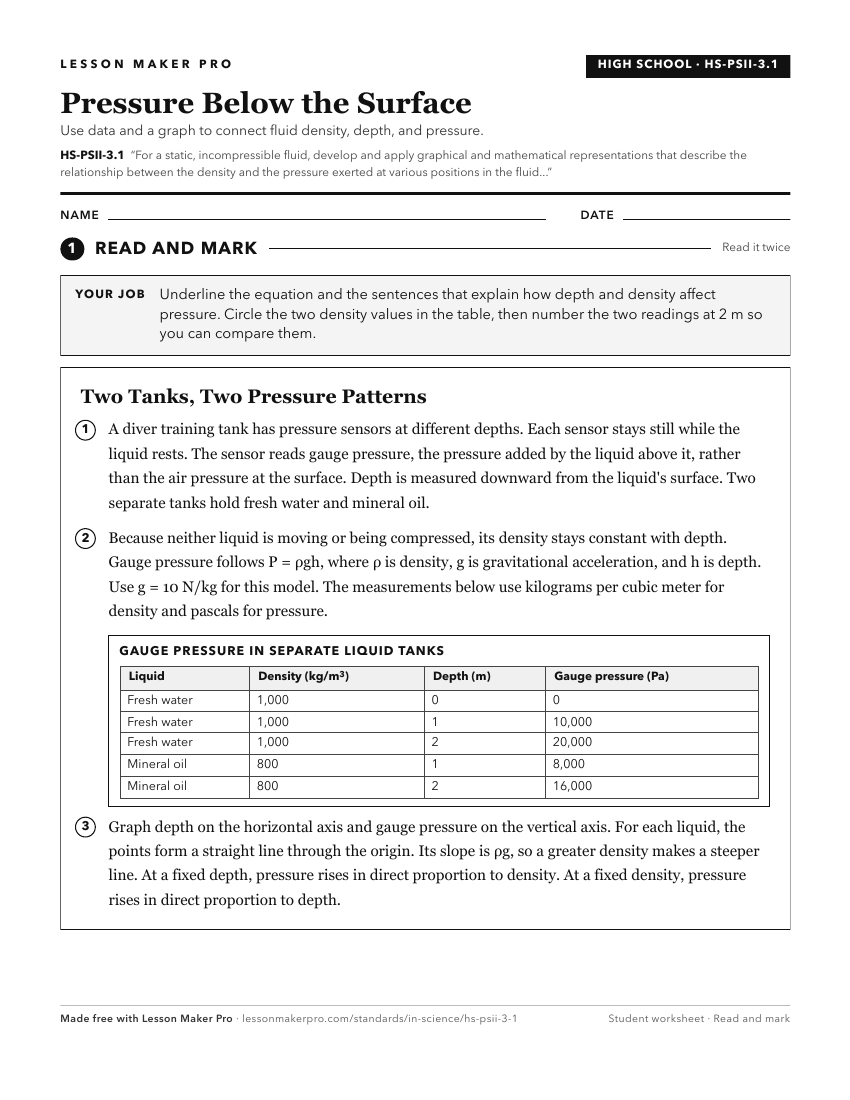
A ready-to-print activity worksheet aligned to HS-PSII-3.1, with an answer key for the teacher on its own page. No account needed.
PDF, US Letter, prints cleanly in black and white.
Download the worksheetKeep exploring
Related Standards
- HS-PSII-2.4
Develop graphical and mathematical representations that describe the relationship among the volume, temperature, and number of molecules of an ideal gas in a cl...
- HS-PSII-3.4
Develop and apply Bernoulli's principle and continuity equations to predict changes in the speed and pressure of a moving incompressible fluid.
- HS-PSII-3.3
Develop and apply the principle of constant volume flow rate to determine the relationship between cross-sectional area of a pipe and the velocity of an incompr...
- HS-PSII-3.2
Qualitatively and quantitatively determine how the density of fluid or volume of fluid displaced is related to the force due to buoyancy acting on either a floa...
Turn this exact standard into a lesson
Grade, subject, topic, and the complete standard are prefilled. Create one free, no account needed.
Also for this standard:Make a WorksheetMake a QuizMake a Sub Lesson