Indiana Science HS-AP9-3
The Standard
Differentiate between innate and acquired immunity.
Indiana Academic Standards for Science (2023) · Transport, the Lymphatic System and Immune Mechanisms
Teacher's field guide
What This Standard Means
What Students Need to Do
- Students identify defenses that respond quickly to many threats, such as mucus and inflammation. They distinguish these from defenses that target a specific germ and develop after infection or vaccination.
What Mastery Looks Like
- Students can identify inflammation after a scraped knee as an innate response and memory cells after a flu shot as an acquired defense. They can explain why the body responds faster when it meets the same virus again.
Common Misconceptions
- Some students think acquired immunity comes only from vaccines, not past infections. Others label inflammation as acquired because it appears after an injury. They may think antibodies recognize every new germ right away.
How to Assess It
- Exit ticket: Mucus traps a flu virus on first contact. Months after a flu shot, memory cells recognize that virus. Label each defense innate or acquired, and circle the one that has memory.
Lesson moves
Ways to Teach It
Give pairs cards labeled skin, inflammation, phagocytes, antibodies, and memory cells; have them sort the cards into innate and acquired defenses.
Ask, 'Why might a second encounter with the same virus cause fewer symptoms?' Require a two-sentence answer using memory cells.
Read examples such as 'mucus traps a germ' and 'antibodies recognize measles'; have teams hold up innate or acquired cards.
Show a flu shot reminder and a photo of a scraped knee; ask which defense responds immediately and which remembers a virus.
Free download
Printable HS-AP9-3 Worksheet
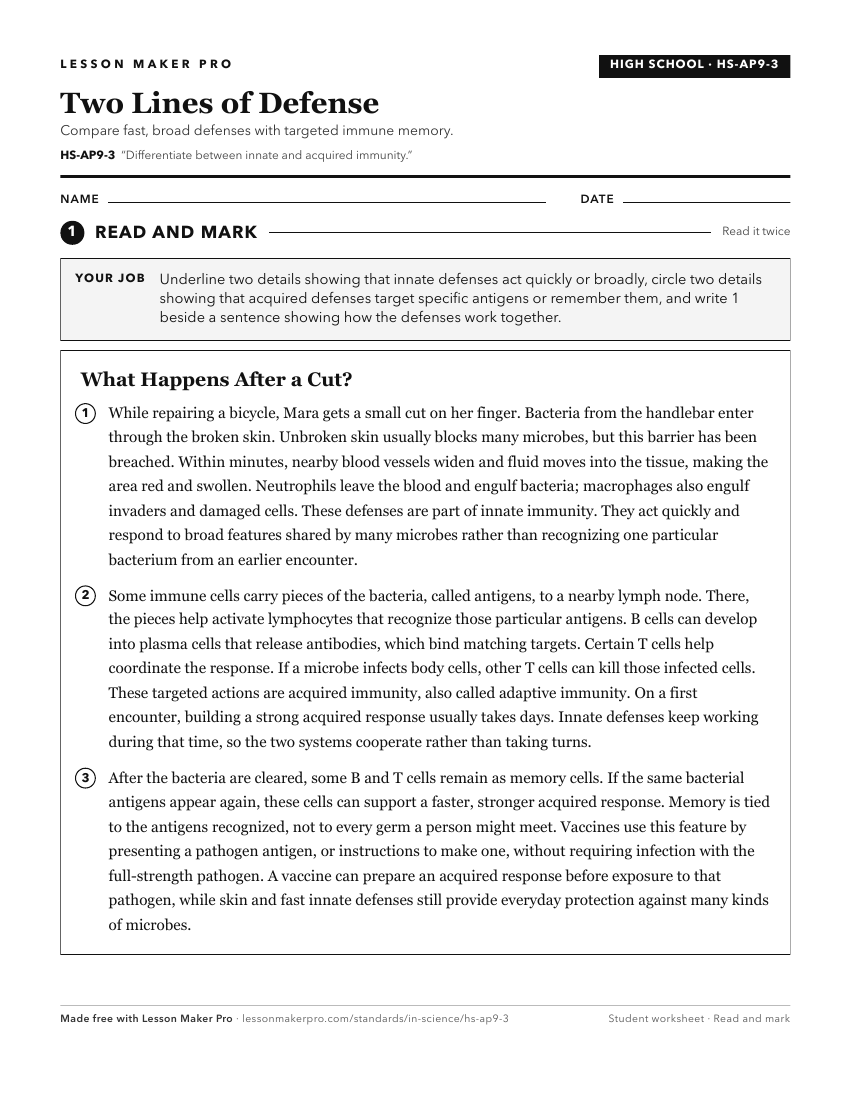
A ready-to-print activity worksheet aligned to HS-AP9-3, with an answer key for the teacher on its own page. No account needed.
PDF, US Letter, prints cleanly in black and white.
Download the worksheetKeep exploring
Related Standards
- HS-AP10-4
Differentiate between metabolic and respiratory acidosis and alkalosis.
- HS-AP7-2
Assess the structural and functional differences between an endocrine gland and an exocrine gland.
- HS-AP5-3
Compare and contrast the actions, origins, and pathways of nerve fibers in the parasympathetic and sympathetic divisions of the autonomic nervous system.
- HS-AP9-4
Construct an explanation for defense against foreign pathogens using cellular and non-cellular components of the immune response.
Turn this exact standard into a lesson
Grade, subject, topic, and the complete standard are prefilled. Create one free, no account needed.
Also for this standard:Make a WorksheetMake a QuizMake a Sub Lesson